modelPVSystem
Information
Overview
Model that determines the DC performance of a PV array.
Concept
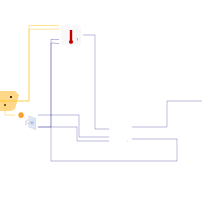
Model consists of a model determining the IV Characteristic, a model to calculate the cell temperature and a model to calculate the irradiance and absorption ratio for the PV module.
1. IV Characteristic:
Model for determining the I-V characteristics of a PV array based on Batzelis et al., De Soto et al. and Boyd.
2. Cell Temperature calculation:
Two cell temperature models are implemented and should be chosen depending on the module's topology:
CellTemperatureOpenRack:
Module is installed on open rack based on Duffie et al.. Here, the resulting cell temperature is usually lower compared to the cell temperature model CellTemperatureMountingCloseToGround resulting in higher efficiencies.
CellTemperatureMountingCloseToGround:
Module is installed close to ground (e.g. on roof) based on King et al.
CellTemperatureMountingContactToGround:
Module is installed in contact to ground (e.g. integrated in roof) based on King et al.
If line losses are not known, the model CellTemperatureMountingCloseToGround can be used for a more conservative estimation of PV DC power output. This is due to the fact that line losses are not included in the calculation process.
Known limitations
- Model does not include line losses and decreasing panel efficiency due to shading! This leads to the fact that model usually overestimates real DC power.
- Some parameter combinations result in high peaks for variables such as V_mp, I_mp and T_c. The output power is therefore limited to the reasonable values 0 and P_mp0*1.05, with 5 % being a common tolerance for power at MPP.
References
A Method for the analytical extraction of the Single-Diode PV model parameters. by Batzelis, Efstratios I. ; Papathanassiou, Stavros A.
Improvement and validation of a model for photovoltaic array performance. by De Soto, W. ; Klein, S. A. ; Beckman, W. A.
Performance Data from the NIST Photovoltaic Arrays and Weather Station. by Boyd, M.
SANDIA REPORT SAND 2004-3535 Unlimited Release Printed December 2004 Photovoltaic Array Performance Model. (2005). by King, D. L. et al.
Solar engineering of thermal processes. by Duffie, John A. ; Beckman, W. A.
Parameters
| Type | Name | Default | Description |
|---|---|---|---|
| AixLib.DataBase.SolarElectric.PVBaseDataDefinition | data | ||
| Real | n_mod | Number of connected PV modules | |
| Mounting | |||
| Modelica.Units.SI.Angle | til | Surface's tilt angle (0:flat) | |
| Modelica.Units.SI.Angle | azi | Surface's azimut angle (0:South) | |
| Location | |||
| Modelica.Units.SI.Angle | lat | Location's Latitude | |
| Modelica.Units.SI.Angle | lon | Location's Longitude | |
| Real | alt | Site altitude in Meters, default= 1 | |
| Modelica.Units.SI.Time | timZon | Time zone. Should be equal with timZon in ReaderTMY3, if PVSystem and ReaderTMY3 are used together. | |
| Real | groRef | 0.2 | Ground reflectance (default=0.2) Urban environment: 0.14 - 0.22 Grass: 0.15 - 0.25 Fresh grass: 0.26 Fresh snow: 0.82 Wet snow: 0.55-0.75 Dry asphalt: 0.09-0.15 Wet Asphalt: 0.18 Concrete: 0.25-0.35 Red tiles: 0.33 Aluminum: 0.85 Copper: 0.74 New galvanized steel: 0.35 Very dirty galvanized steel: 0.08 |
| Glazing | |||
| Boolean | use_ParametersGlaz | false | = false if standard values for glazing can be used |
| Real | glaExtCoe | 4 | Glazing extinction coefficient (for glass = 4) |
| Real | glaThi | 0.002 | Glazing thickness (for most cells = 0.002 m) |
| Real | refInd | 1.526 | Effective index of refraction of the cell cover (glass = 1.526) |
Connectors
| Type | Name | Default | Description |
|---|---|---|---|
| Modelica.Blocks.Interfaces.RealOutput | DCOutputPower | DC output power of the PV array | |
| BoundaryConditions.WeatherData.Bus | weaBus |
Components
| Type | Name | Default | Description |
|---|---|---|---|
| IVCharacteristics | iVCharacteristics | Model for determining the I-V characteristics of a PV array | |
| CellTemperature | cellTemperature | Model for determining the cell temperature of a PV array | |
| BaseClasses.PVRadiationHorizontal | pVRadiationHorizontalTRY | Radiation and absorptance model for PV simulations |
Contents
| Name | Description |
|---|---|
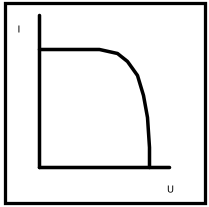 IVCharacteristics IVCharacteristics | Model for determining the I-V characteristics of a PV array |
 CellTemperature CellTemperature | Model for determining the cell temperature of a PV array |