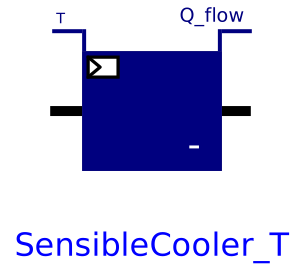
modelSensibleCooler_T
Extends from AixLib.Fluid.HeatExchangers.BaseClasses.PartialPrescribedOutlet (Ideal heater, cooler, humidifier or dehumidifier with prescribed outlet conditions).
Information
Model for an ideal sensible-only cooler that controls its outlet temperature to a prescribed outlet temperature.
This model forces the outlet temperature at port_b to be
no higher than the temperature of the input signal
TSet, subject to optional limits on the
capacity.
By default, the model has unlimited cooling capacity.
The output signal Q_flow ≤ 0 is the heat added
to the medium if the mass flow rate is from port_a to port_b.
If the flow is reversed, then Q_flow=0.
The outlet conditions at port_a are not affected by this model,
other than for a possible pressure difference due to flow friction.
If the parameter energyDynamics is different from
Modelica.Fluid.Types.Dynamics.SteadyState,
the component models the dynamic response using a first order differential equation.
The time constant of the component is equal to the parameter tau.
This time constant is adjusted based on the mass flow rate using
τeff = τ |ṁ| ⁄ ṁnom
where τeff is the effective time constant for the given mass flow rate ṁ and τ is the time constant at the nominal mass flow rate ṁnom. This type of dynamics is equal to the dynamics that a completely mixed control volume would have.
Optionally, this model can have a flow resistance.
Set dp_nominal = 0 to disable the flow friction calculation.
For a similar model that is a heater, use AixLib.Fluid.HeatExchangers.Heater_T. For a model that uses a control signal u ∈ [0, 1] and multiplies this with the nominal heating or cooling power, use AixLib.Fluid.HeatExchangers.HeaterCooler_u.
Limitations
If the flow is from port_b to port_a,
then the enthalpy of the medium is not affected by this model.
This model does not affect the humidity of the air. Therefore, if used to cool air below the dew point temperature, the water mass fraction will not change.
Validation
The model has been validated against the analytical solution in the examples AixLib.Fluid.HeatExchangers.Validation.PrescribedOutlet and AixLib.Fluid.HeatExchangers.Validation.PrescribedOutlet_dynamic.
Parameters
| Type | Name | Default | Description |
|---|---|---|---|
| Boolean | homotopyInitialization (from PartialPrescribedOutlet) | true | = true, use homotopy method |
| Modelica.Units.SI.HeatFlowRate | QMin_flow | -Modelica.Constants.inf | Maximum heat flow rate for cooling (negative) |
| Assumptions | |||
| Boolean | allowFlowReversal (from PartialTwoPort) | true | = false to simplify equations, assuming, but not enforcing, no flow reversal |
| Nominal condition | |||
| Modelica.Units.SI.MassFlowRate | m_flow_nominal (from PartialTwoPortInterface) | Nominal mass flow rate | |
| Modelica.Units.SI.PressureDifference | dp_nominal (from TwoPortFlowResistanceParameters) | Pressure difference | |
| Advanced | |||
| Modelica.Units.SI.MassFlowRate | m_flow_small (from PartialTwoPortInterface) | 1E-4*abs(m_flow_nominal) | Small mass flow rate for regularization of zero flow |
| Advanced › Diagnostics | |||
| Boolean | show_T (from PartialTwoPortInterface) | false | = true, if actual temperature at port is computed |
| Flow resistance | |||
| Boolean | computeFlowResistance (from TwoPortFlowResistanceParameters) | true | =true, compute flow resistance. Set to false to assume no friction |
| Boolean | from_dp (from TwoPortFlowResistanceParameters) | false | = true, use m_flow = f(dp) else dp = f(m_flow) |
| Boolean | linearizeFlowResistance (from TwoPortFlowResistanceParameters) | false | = true, use linear relation between m_flow and dp for any flow rate |
| Real | deltaM (from TwoPortFlowResistanceParameters) | 0.1 | Fraction of nominal flow rate where flow transitions to laminar |
| Dynamics › Conservation equations | |||
| Modelica.Fluid.Types.Dynamics | energyDynamics (from PartialPrescribedOutlet) | Modelica.Fluid.Types.Dynamics.SteadyState | Type of energy balance: dynamic (3 initialization options) or steady state |
| Dynamics | |||
| Modelica.Units.SI.Time | tau (from PartialPrescribedOutlet) | 10 | Time constant at nominal flow rate (used if energyDynamics not equal Modelica.Fluid.Types.Dynamics.SteadyState) |
| Initialization | |||
| Modelica.Units.SI.Temperature | T_start | Medium.T_default | Start value of temperature |
Connectors
| Type | Name | Default | Description |
|---|---|---|---|
| Modelica.Fluid.Interfaces.FluidPort_a | port_a (from PartialTwoPort) | Fluid connector a (positive design flow direction is from port_a to port_b) | |
| Modelica.Fluid.Interfaces.FluidPort_b | port_b (from PartialTwoPort) | Fluid connector b (positive design flow direction is from port_a to port_b) | |
| Modelica.Blocks.Interfaces.RealInput | TSet | Set point temperature of the fluid that leaves port_b | |
| Modelica.Blocks.Interfaces.RealOutput | Q_flow | Heat flow rate added to the fluid (if flow is from port_a to port_b) |
Components
| Type | Name | Default | Description |
|---|---|---|---|
| Modelica.Units.SI.MassFlowRate | m_flow (from PartialTwoPortInterface) | port_a.m_flow | Mass flow rate from port_a to port_b (m_flow > 0 is design flow direction) |
| Modelica.Units.SI.PressureDifference | dp (from PartialTwoPortInterface) | port_a.p - port_b.p | Pressure difference between port_a and port_b |
| Medium.ThermodynamicState | sta_a (from PartialTwoPortInterface) | if allowFlowReversal then Medium.setState_phX(port_a.p, noEvent(actualStream(port_a.h_outflow)), noEvent(actualStream(port_a.Xi_outflow))) else Medium.setState_phX(port_a.p, noEvent(inStream(port_a.h_outflow)), noEvent(inStream(port_a.Xi_outflow))) | Medium properties in port_a |
| Medium.ThermodynamicState | sta_b (from PartialTwoPortInterface) | if allowFlowReversal then Medium.setState_phX(port_b.p, noEvent(actualStream(port_b.h_outflow)), noEvent(actualStream(port_b.Xi_outflow))) else Medium.setState_phX(port_b.p, noEvent(port_b.h_outflow), noEvent(port_b.Xi_outflow)) | Medium properties in port_b |
Revisions
-
September 10, 2018, by Michael Wetter:
Corrected missing propagation of initial conditions.
This is for AixLib, #1016. -
May 3, 2017, by Michael Wetter:
First implementation.
This is for AixLib, #763.