modelTableData4DDeltaT
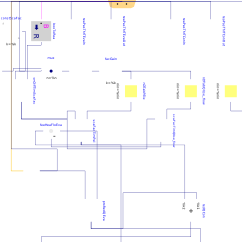
Extends from AixLib.Fluid.HeatPumps.ModularReversible.RefrigerantCycle.BaseClasses.PartialTableData3D (Partial model with components for TableData3D approach for heat pumps and chillers), AixLib.Fluid.HeatPumps.ModularReversible.RefrigerantCycle.BaseClasses.PartialHeatPumpTableDataND (Partial model with components for TableDataND approach for heat pumps).
Information
This model uses four-dimensional table data estimated using tools, such as VCLibPy, to calculate
QCon_flow and PEle.
In addition to AixLib.Fluid.HeatPumps.ModularReversible.RefrigerantCycle.TableData3D, this model uses the secondary sides temperature spread at the condenser
to estimate efficiency and power. Thus, simulation studies with influence of consnder mass flow control
are possible. Developed for the publication Römer et al., where you can also see the validation and impact on heat pump system design.
Note that losses are often not implicitly included in generated data. Thus, frosting modules should be used.
Scaling factor
For the scaling factor, the table data for condenser heat flow rate (QConTabDat_flow)
is evaluated at nominal conditions. Hence, the scaling factor is
scaFac = QCon_flow_nominal/QConTabDat_flow(TCon_nominal, TEva_nominal, y_nominal, dTCon_nominal).
Using scaFac, the table data is scaled linearly.
This implies a constant COP over different design sizes:
QCon_flow = scaFac * tabQCon_flow.y
PEle = scaFac * tabPel.y
References
Römer, Fabian and Fuchs, Nico and Fuchs, Nico and Müller, Dirk, Practical, Near-Optimal Design Rule Extraction for Heat Pumps in Single-Family Buildings (September 03, 2025). Available at SSRN: https://ssrn.com/abstract=5633891
Parameters
| Type | Name | Default | Description |
|---|---|---|---|
| String | devIde (from PartialRefrigerantCycle) | "" | Indicates the data source, used to warn users about different vapor compression devices in reversible models |
| Boolean | useInHeaPum (from PartialHeatPumpCycle) | =false to indicate that this model is used in a chiller | |
| Integer | nDim (from PartialTableDataSDF) | Number of input dimensions | |
| Real | scaFac (from PartialTableDataSDF) | Scaling factor | |
| AixLib.Fluid.HeatPumps.ModularReversible.Data.TableDataSDF.GenericHeatPump | datTab (from PartialHeatPumpTableDataND) | ||
| Modelica.Units.SI.TemperatureDifference | dTCon_nominal | 10 | Nominal condenser temperature difference to calculate scaling factor |
| Nominal condition | |||
| Real | y_nominal (from PartialTableData3D) | 1 | Nominal compressor speed |
| Modelica.Units.SI.Power | PEle_nominal (from PartialRefrigerantCycle) | Nominal electrical power consumption | |
| Modelica.Units.SI.Temperature | TCon_nominal (from PartialRefrigerantCycle) | Nominal temperature at secondary condenser side | |
| Modelica.Units.SI.Temperature | TEva_nominal (from PartialRefrigerantCycle) | Nominal temperature at secondary evaporator side | |
| Modelica.Units.SI.HeatFlowRate | QHea_flow_nominal (from PartialHeatPumpCycle) | Nominal heating capacity | |
| Modelica.Units.SI.HeatFlowRate | QHeaNoSca_flow_nominal (from PartialHeatPumpTableDataND) | evaluate(extTabQUse_flow, uOrdSca_nominal, interpMethod, extrapMethod) | Unscaled nominal heating capacity |
| Advanced › Medium properties | |||
| Modelica.Units.SI.SpecificHeatCapacity | cpCon (from PartialRefrigerantCycle) | Evaporator medium specific heat capacity | |
| Modelica.Units.SI.SpecificHeatCapacity | cpEva (from PartialRefrigerantCycle) | Evaporator medium specific heat capacity | |
| Data handling | |||
| SDF.Types.InterpolationMethod | interpMethod (from PartialTableDataSDF) | SDF.Types.InterpolationMethod.Linear | Interpolation method |
| SDF.Types.ExtrapolationMethod | extrapMethod (from PartialTableDataSDF) | SDF.Types.ExtrapolationMethod.Hold | Extrapolation method |
| Extra states | |||
| Boolean | useExtSta (from PartialTableDataSDF) | false | =true to output extra states stored in sdf file |
| Integer | nExtSta (from PartialTableDataSDF) | 1 | |
| String[nExtSta] | datasetExt (from PartialTableDataSDF) | {"p_1"} | Dataset names for extra states |
| String[nExtSta] | dataUnitExt (from PartialTableDataSDF) | {"Pa"} | Data unit for extra states |
Connectors
| Type | Name | Default | Description |
|---|---|---|---|
| Modelica.Blocks.Interfaces.RealOutput | PEle (from PartialRefrigerantCycle) | Electrical Power consumed by the device | |
| Modelica.Blocks.Interfaces.RealOutput | QCon_flow (from PartialRefrigerantCycle) | Heat flow rate through condenser | |
| AixLib.Fluid.HeatPumps.ModularReversible.BaseClasses.RefrigerantMachineControlBus | sigBus (from PartialRefrigerantCycle) | Bus-connector | |
| Modelica.Blocks.Interfaces.RealOutput | QEva_flow (from PartialRefrigerantCycle) | Heat flow rate through evaporator |
Components
| Type | Name | Default | Description |
|---|---|---|---|
| AixLib.Fluid.HeatPumps.ModularReversible.RefrigerantCycle.Frosting.NoFrosting | iceFacCal (from PartialRefrigerantCycle) | ||
| Modelica.Blocks.Math.Add | redQCon (from PartialRefrigerantCycle) | Reduce heat flow to the condenser based on the reduction to the evaporator | |
| Modelica.Blocks.Math.Product | proRedQEva (from PartialRefrigerantCycle) | Reduce heat flow to the evaporator based on the icing factor | |
| Modelica.Blocks.Math.Feedback | feeHeaFloEva (from PartialHeatPumpCycle) | Calculates evaporator heat flow with total energy balance | |
| Modelica.Blocks.Math.Product | scaFacTimPel (from PartialTableDataSDF) | Scale electrical power consumption | |
| Modelica.Blocks.Math.Product | scaFacTimQUse_flow (from PartialTableDataSDF) | Scale useful heat flow rate | |
| Modelica.Blocks.Sources.Constant | constScaFac (from PartialTableDataSDF) | Calculates correction of table output based on scaling factor | |
| Modelica.Blocks.Routing.RealPassThrough | reaPasThrTEvaIn (from PartialTableDataSDF) | Used to enable conditional bus connection | |
| Modelica.Blocks.Routing.RealPassThrough | reaPasThrTConIn (from PartialTableDataSDF) | Used to enable conditional bus connection | |
| Modelica.Blocks.Routing.RealPassThrough | reaPasThrTEvaOut (from PartialTableDataSDF) | Used to enable conditional bus connection | |
| Modelica.Blocks.Routing.RealPassThrough | reaPasThrTConOut (from PartialTableDataSDF) | Used to enable conditional bus connection | |
| Modelica.Blocks.Math.Gain[nDim] | facGain (from PartialTableDataSDF) | Convert relative speed n to an absolute value for interpolation in sdf tables | |
| SDF.NDTable | nDTabQUse_flow (from PartialTableDataSDF) | SDF-Table data for condenser heat flow | |
| SDF.NDTable | nDTabPEle (from PartialTableDataSDF) | SDF table data for electrical power | |
| Modelica.Blocks.Routing.Multiplex | mux (from PartialTableDataSDF) | Concat all inputs into an array | |
| RearrangeInputs | ordInp (from PartialTableDataSDF) | Possibly change Input order | |
| Modelica.Blocks.Math.Product | onOffTimScaFac (from PartialTableDataSDF) | Create the product of the scaling factor and whether the device is even on | |
| Modelica.Blocks.Math.BooleanToReal | booToRea (from PartialTableDataSDF) | Convert on/off signal to real | |
| SDF.NDTable[nExtSta] | nDTabSta (from PartialTableDataSDF) | SDF-Table data for extra states | |
| Modelica.Blocks.Math.Add | dTConMea | Condenser delta T |
Revisions
-
August 27, 2024 by Fabian Wuellhorst:
First implementation (see issue AixLib #1520)