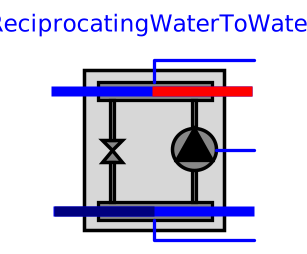
modelReciprocatingWaterToWater
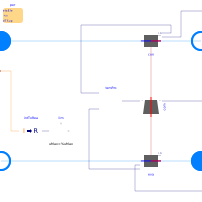
Extends from AixLib.Fluid.HeatPumps.BaseClasses.PartialWaterToWater (Partial model for water to water heat pumps and chillers).
Information
Model for a water to water heat pump with a reciprocating compressor, as described in Jin (2002). The thermodynamic heat pump cycle is represented below.
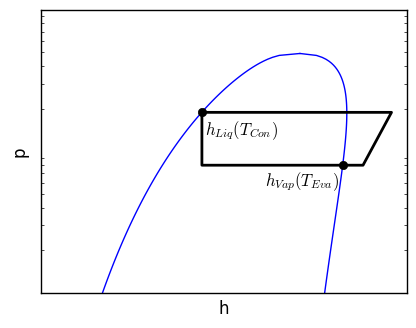
The rate of heat transferred to the evaporator is given by:
Q̇Eva = ṁref ( hVap(TEva) - hLiq(TCon) ).
The power consumed by the compressor is given by a linear efficiency relation:
P = PTheoretical / η + PLoss,constant.
Heat transfer in the evaporator and condenser is calculated using an ε-NTU method, assuming constant refrigerant temperature and constant heat transfer coefficient between fluid and refrigerant.
Variable speed is acheived by multiplying the full load piston displacement by the normalized compressor speed. The power and heat transfer rates are forced to zero if the resulting heat pump state has higher evaporating pressure than condensing pressure.
Options
Parameters TConMax and TEvaMin
may be used to set an upper or lower bound for the
condenser and evaporator.
The compressor is disabled when these conditions
are not satisfied, or when the
evaporator temperature is larger
than the condenser temperature.
This mimics the temperature protection
of heat pumps and moreover it avoids
non-converging algebraic loops of equations,
or freezing of evaporator medium.
This option can be disabled by setting
enable_temperature_protection = false.
Assumptions and limitations
The compression process is assumed isentropic. The thermal energy of superheating is ignored in the evaluation of the heat transferred to the refrigerant in the evaporator. There is no supercooling.
References
H. Jin. Parameter estimation based models of water source heat pumps. PhD Thesis. Oklahoma State University. Stillwater, Oklahoma, USA. 2002.
Parameters
| Type | Name | Default | Description |
|---|---|---|---|
| Boolean | homotopyInitialization (from PartialWaterToWater) | true | = true, use homotopy method |
| Boolean | enable_variable_speed (from PartialWaterToWater) | true | Set to true to allow modulating of compressor speed |
| Real | scaling_factor (from PartialWaterToWater) | 1.0 | Scaling factor for heat pump capacity |
| Modelica.Units.SI.ThermalConductance | UACon (from PartialWaterToWater) | Thermal conductance of condenser | |
| Modelica.Units.SI.ThermalConductance | UAEva (from PartialWaterToWater) | Thermal conductance of evaporator | |
| Data.ReciprocatingWaterToWater.Generic | per | Heat pump performance data | |
| Assumptions | |||
| Boolean | allowFlowReversal1 (from PartialFourPort) | true | = false to simplify equations, assuming, but not enforcing, no flow reversal for medium 1 |
| Boolean | allowFlowReversal2 (from PartialFourPort) | true | = false to simplify equations, assuming, but not enforcing, no flow reversal for medium 2 |
| Nominal condition | |||
| Modelica.Units.SI.MassFlowRate | m1_flow_nominal (from PartialFourPortInterface) | Nominal mass flow rate | |
| Modelica.Units.SI.MassFlowRate | m2_flow_nominal (from PartialFourPortInterface) | Nominal mass flow rate | |
| Modelica.Units.SI.PressureDifference | dp1_nominal (from FourPortFlowResistanceParameters) | Pressure difference | |
| Modelica.Units.SI.PressureDifference | dp2_nominal (from FourPortFlowResistanceParameters) | Pressure difference | |
| Advanced | |||
| Medium1.MassFlowRate | m1_flow_small (from PartialFourPortInterface) | 1E-4*abs(m1_flow_nominal) | Small mass flow rate for regularization of zero flow |
| Medium2.MassFlowRate | m2_flow_small (from PartialFourPortInterface) | 1E-4*abs(m2_flow_nominal) | Small mass flow rate for regularization of zero flow |
| Advanced › Diagnostics | |||
| Boolean | show_T (from PartialFourPortInterface) | false | = true, if actual temperature at port is computed |
| Flow resistance › Medium 1 | |||
| Boolean | computeFlowResistance1 (from FourPortFlowResistanceParameters) | true | =true, compute flow resistance. Set to false to assume no friction |
| Boolean | from_dp1 (from FourPortFlowResistanceParameters) | false | = true, use m_flow = f(dp) else dp = f(m_flow) |
| Boolean | linearizeFlowResistance1 (from FourPortFlowResistanceParameters) | false | = true, use linear relation between m_flow and dp for any flow rate |
| Real | deltaM1 (from FourPortFlowResistanceParameters) | 0.1 | Fraction of nominal flow rate where flow transitions to laminar |
| Flow resistance › Medium 2 | |||
| Boolean | computeFlowResistance2 (from FourPortFlowResistanceParameters) | true | =true, compute flow resistance. Set to false to assume no friction |
| Boolean | from_dp2 (from FourPortFlowResistanceParameters) | false | = true, use m_flow = f(dp) else dp = f(m_flow) |
| Boolean | linearizeFlowResistance2 (from FourPortFlowResistanceParameters) | false | = true, use linear relation between m_flow and dp for any flow rate |
| Real | deltaM2 (from FourPortFlowResistanceParameters) | 0.1 | Fraction of nominal flow rate where flow transitions to laminar |
| Dynamics › Condenser | |||
| Modelica.Units.SI.Time | tau1 (from PartialWaterToWater) | 60 | Time constant at nominal flow rate (used if energyDynamics1 <> Modelica.Fluid.Types.Dynamics.SteadyState) |
| Modelica.Units.SI.Temperature | T1_start (from PartialWaterToWater) | Medium1.T_default | Initial or guess value of set point |
| Dynamics › Evaporator | |||
| Modelica.Units.SI.Time | tau2 (from PartialWaterToWater) | 60 | Time constant at nominal flow rate (used if energyDynamics2 <> Modelica.Fluid.Types.Dynamics.SteadyState) |
| Modelica.Units.SI.Temperature | T2_start (from PartialWaterToWater) | Medium2.T_default | Initial or guess value of set point |
| Dynamics › Evaporator and condenser | |||
| Modelica.Fluid.Types.Dynamics | energyDynamics (from PartialWaterToWater) | Modelica.Fluid.Types.Dynamics.DynamicFreeInitial | Type of energy balance: dynamic (3 initialization options) or steady state |
| Temperature protection | |||
| Boolean | enable_temperature_protection (from PartialWaterToWater) | true | Enable temperature protection |
| Modelica.Units.SI.Temperature | TConMax (from PartialWaterToWater) | ref.TCri - 5 | Upper bound for condenser temperature |
| Modelica.Units.SI.Temperature | TEvaMin (from PartialWaterToWater) | 275.15 | Lower bound for evaporator temperature |
| Real | dTHys (from PartialWaterToWater) | 5 | Hysteresis interval width |
Connectors
| Type | Name | Default | Description |
|---|---|---|---|
| Modelica.Fluid.Interfaces.FluidPort_a | port_a1 (from PartialFourPort) | Fluid connector a1 (positive design flow direction is from port_a1 to port_b1) | |
| Modelica.Fluid.Interfaces.FluidPort_b | port_b1 (from PartialFourPort) | Fluid connector b1 (positive design flow direction is from port_a1 to port_b1) | |
| Modelica.Fluid.Interfaces.FluidPort_a | port_a2 (from PartialFourPort) | Fluid connector a2 (positive design flow direction is from port_a2 to port_b2) | |
| Modelica.Fluid.Interfaces.FluidPort_b | port_b2 (from PartialFourPort) | Fluid connector b2 (positive design flow direction is from port_a2 to port_b2) | |
| Modelica.Blocks.Interfaces.BooleanOutput | errLowPre (from PartialWaterToWater) | if true, compressor disabled since evaporator temperature is above upper bound | |
| Modelica.Blocks.Interfaces.BooleanOutput | errHigPre (from PartialWaterToWater) | if true, compressor disabled since condenser temperature is below lower bound | |
| Modelica.Blocks.Interfaces.BooleanOutput | errNegTemDif (from PartialWaterToWater) | if true, compressor disabled since condenser temperature is below evaporator temperature | |
| Modelica.Blocks.Interfaces.RealInput | y (from PartialWaterToWater) | Modulating signal for compressor frequency, equal to 1 at full load condition | |
| Modelica.Blocks.Interfaces.IntegerInput | stage (from PartialWaterToWater) | Current stage of the heat pump, equal to 1 at full load condition | |
| Modelica.Blocks.Interfaces.RealOutput | QCon_flow (from PartialWaterToWater) | Actual heating heat flow rate added to fluid 1 | |
| Modelica.Blocks.Interfaces.RealOutput | P (from PartialWaterToWater) | Electric power consumed by compressor | |
| Modelica.Blocks.Interfaces.RealOutput | QEva_flow (from PartialWaterToWater) | Actual cooling heat flow rate removed from fluid 2 |
Components
| Type | Name | Default | Description |
|---|---|---|---|
| Medium1.MassFlowRate | m1_flow (from PartialFourPortInterface) | port_a1.m_flow | Mass flow rate from port_a1 to port_b1 (m1_flow > 0 is design flow direction) |
| Modelica.Units.SI.PressureDifference | dp1 (from PartialFourPortInterface) | port_a1.p - port_b1.p | Pressure difference between port_a1 and port_b1 |
| Medium2.MassFlowRate | m2_flow (from PartialFourPortInterface) | port_a2.m_flow | Mass flow rate from port_a2 to port_b2 (m2_flow > 0 is design flow direction) |
| Modelica.Units.SI.PressureDifference | dp2 (from PartialFourPortInterface) | port_a2.p - port_b2.p | Pressure difference between port_a2 and port_b2 |
| Medium1.ThermodynamicState | sta_a1 (from PartialFourPortInterface) | if allowFlowReversal1 then Medium1.setState_phX(port_a1.p, noEvent(actualStream(port_a1.h_outflow)), noEvent(actualStream(port_a1.Xi_outflow))) else Medium1.setState_phX(port_a1.p, inStream(port_a1.h_outflow), inStream(port_a1.Xi_outflow)) | Medium properties in port_a1 |
| Medium1.ThermodynamicState | sta_b1 (from PartialFourPortInterface) | if allowFlowReversal1 then Medium1.setState_phX(port_b1.p, noEvent(actualStream(port_b1.h_outflow)), noEvent(actualStream(port_b1.Xi_outflow))) else Medium1.setState_phX(port_b1.p, port_b1.h_outflow, port_b1.Xi_outflow) | Medium properties in port_b1 |
| Medium2.ThermodynamicState | sta_a2 (from PartialFourPortInterface) | if allowFlowReversal2 then Medium2.setState_phX(port_a2.p, noEvent(actualStream(port_a2.h_outflow)), noEvent(actualStream(port_a2.Xi_outflow))) else Medium2.setState_phX(port_a2.p, inStream(port_a2.h_outflow), inStream(port_a2.Xi_outflow)) | Medium properties in port_a2 |
| Medium2.ThermodynamicState | sta_b2 (from PartialFourPortInterface) | if allowFlowReversal2 then Medium2.setState_phX(port_b2.p, noEvent(actualStream(port_b2.h_outflow)), noEvent(actualStream(port_b2.Xi_outflow))) else Medium2.setState_phX(port_b2.p, port_b2.h_outflow, port_b2.Xi_outflow) | Medium properties in port_b2 |
| AixLib.Fluid.HeatExchangers.EvaporatorCondenser | con (from PartialWaterToWater) | Condenser | |
| AixLib.Fluid.HeatExchangers.EvaporatorCondenser | eva (from PartialWaterToWater) | Evaporator | |
| AixLib.Fluid.HeatPumps.Compressors.BaseClasses.PartialCompressor | com (from PartialWaterToWater) | Compressor |
Revisions
-
May 30, 2017, by Filip Jorissen:
Revised documentation for temperature protection. See #769. -
November 14, 2016, by Massimo Cimmino:
First implementation.