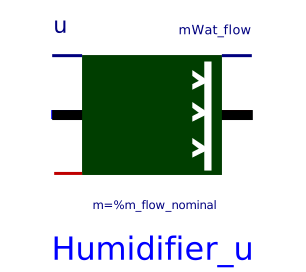
modelHumidifier_u
Extends from AixLib.Fluid.Interfaces.TwoPortHeatMassExchanger (Partial model transporting one fluid stream with storing mass or energy).
Information
Model for an air humidifier or dehumidifier.
This model adds (or removes) moisture from the air stream. The amount of exchanged moisture is equal to
ṁwat = u ṁwat,nom,
where u is the control input signal and
ṁwat,nom is equal to the parameter mWat_flow_nominal.
The parameter mWat_flow_nominal can be positive or negative.
If ṁwat is positive, then moisture is added
to the air stream, otherwise it is removed.
If the heat port heatPort is unconnected, then the enthalpy of the
air that flows through the device remains unchanged, e.g., the humidification
is adiabatic. To change the enthalpy of the air, add heat flow to the connector
heatPort.
Parameters
| Type | Name | Default | Description |
|---|---|---|---|
| Boolean | homotopyInitialization (from TwoPortHeatMassExchanger) | true | = true, use homotopy method |
| Modelica.Units.SI.MassFlowRate | mWat_flow_nominal | Water mass flow rate at u=1, positive for humidification | |
| Assumptions | |||
| Boolean | allowFlowReversal (from PartialTwoPort) | true | = false to simplify equations, assuming, but not enforcing, no flow reversal |
| Nominal condition | |||
| Modelica.Units.SI.MassFlowRate | m_flow_nominal (from PartialTwoPortInterface) | Nominal mass flow rate | |
| Modelica.Units.SI.PressureDifference | dp_nominal (from TwoPortFlowResistanceParameters) | Pressure difference | |
| Advanced | |||
| Modelica.Units.SI.MassFlowRate | m_flow_small (from PartialTwoPortInterface) | 1E-4*abs(m_flow_nominal) | Small mass flow rate for regularization of zero flow |
| Advanced › Diagnostics | |||
| Boolean | show_T (from PartialTwoPortInterface) | false | = true, if actual temperature at port is computed |
| Flow resistance | |||
| Boolean | computeFlowResistance (from TwoPortFlowResistanceParameters) | true | =true, compute flow resistance. Set to false to assume no friction |
| Boolean | from_dp (from TwoPortFlowResistanceParameters) | false | = true, use m_flow = f(dp) else dp = f(m_flow) |
| Boolean | linearizeFlowResistance (from TwoPortFlowResistanceParameters) | false | = true, use linear relation between m_flow and dp for any flow rate |
| Real | deltaM (from TwoPortFlowResistanceParameters) | 0.1 | Fraction of nominal flow rate where flow transitions to laminar |
| Dynamics › Nominal condition | |||
| Modelica.Units.SI.Time | tau (from TwoPortHeatMassExchanger) | 30 | Time constant at nominal flow (if energyDynamics <> SteadyState) |
| Dynamics › Conservation equations | |||
| Modelica.Fluid.Types.Dynamics | energyDynamics (from TwoPortHeatMassExchanger) | Modelica.Fluid.Types.Dynamics.DynamicFreeInitial | Type of energy balance: dynamic (3 initialization options) or steady state |
| Initialization | |||
| Medium.AbsolutePressure | p_start (from TwoPortHeatMassExchanger) | Medium.p_default | Start value of pressure |
| Medium.Temperature | T_start (from TwoPortHeatMassExchanger) | Medium.T_default | Start value of temperature |
| Medium.MassFraction[Medium.nX] | X_start (from TwoPortHeatMassExchanger) | Medium.X_default | Start value of mass fractions m_i/m |
| Medium.ExtraProperty[Medium.nC] | C_start (from TwoPortHeatMassExchanger) | fill(0, Medium.nC) | Start value of trace substances |
Connectors
| Type | Name | Default | Description |
|---|---|---|---|
| Modelica.Fluid.Interfaces.FluidPort_a | port_a (from PartialTwoPort) | Fluid connector a (positive design flow direction is from port_a to port_b) | |
| Modelica.Fluid.Interfaces.FluidPort_b | port_b (from PartialTwoPort) | Fluid connector b (positive design flow direction is from port_a to port_b) | |
| Modelica.Blocks.Interfaces.RealInput | u | Control input | |
| Modelica.Blocks.Interfaces.RealOutput | mWat_flow | Water added to the fluid | |
| Modelica.Thermal.HeatTransfer.Interfaces.HeatPort_a | heatPort | Heat port for total heat exchange with the control volume |
Components
| Type | Name | Default | Description |
|---|---|---|---|
| Modelica.Units.SI.MassFlowRate | m_flow (from PartialTwoPortInterface) | port_a.m_flow | Mass flow rate from port_a to port_b (m_flow > 0 is design flow direction) |
| Modelica.Units.SI.PressureDifference | dp (from PartialTwoPortInterface) | port_a.p - port_b.p | Pressure difference between port_a and port_b |
| Medium.ThermodynamicState | sta_a (from PartialTwoPortInterface) | if allowFlowReversal then Medium.setState_phX(port_a.p, noEvent(actualStream(port_a.h_outflow)), noEvent(actualStream(port_a.Xi_outflow))) else Medium.setState_phX(port_a.p, noEvent(inStream(port_a.h_outflow)), noEvent(inStream(port_a.Xi_outflow))) | Medium properties in port_a |
| Medium.ThermodynamicState | sta_b (from PartialTwoPortInterface) | if allowFlowReversal then Medium.setState_phX(port_b.p, noEvent(actualStream(port_b.h_outflow)), noEvent(actualStream(port_b.Xi_outflow))) else Medium.setState_phX(port_b.p, noEvent(port_b.h_outflow), noEvent(port_b.Xi_outflow)) | Medium properties in port_b |
| AixLib.Fluid.MixingVolumes.MixingVolume | vol (from TwoPortHeatMassExchanger) | ||
| AixLib.Fluid.FixedResistances.PressureDrop | preDro (from TwoPortHeatMassExchanger) | Flow resistance |
Revisions
-
February 9, 2023, by Michael Wetter:
Removed access to parameteruse_T_inwhich does not exist in this model.
This is for #1697. -
March 7, 2022, by Michael Wetter:
RemovedmassDynamics.
This is for #1542. -
April 12, 2017, by Michael Wetter:
Removed parametersuse_T_inandT. This removes the optional specification of temperature through the parameterTor the input connectorT_in. Exposed the heat port of the control volume to allow adding heat, for example, to use the model as a steam humidifier.
This is for issue Buildings #704. -
May 6, 2015, by Michael Wetter:
SetprescribedHeatFlowRate=true. This is for issue #412. -
May 29, 2014, by Michael Wetter:
Removed undesirable annotationEvaluate=true. -
February 11, 2014 by Michael Wetter:
Corrected issue #197 which led to twice the amount of latent heat being added to the fluid stream. -
October 14, 2013 by Michael Wetter:
Constrained medium to be a subclass ofModelica.Media.Interfaces.PartialCondensingGases, as this base class declares the functionenthalpyOfCondensingGas. -
July 30, 2013 by Michael Wetter:
Updated model to use new variablemWat_flowin the base class. -
May 24, 2011, by Michael Wetter:
Changed base class to allow using the model as a dynamic or a steady-state model. -
April 14, 2010, by Michael Wetter:
Converted temperature input to a conditional connector. -
April 17, 2008, by Michael Wetter:
First implementation.