
modelTwoPhaseSeparator
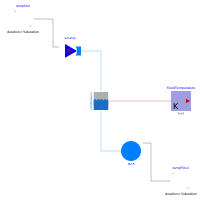
Test model to show the functionality of the two-phase seperator
Extends from Modelica.Icons.Example (Icon for runnable examples).
Information
This is a simple example model to test the two-phase separator model. Therefore, the tank's temperature at inlet is a function of time as well as the tank's pressure at outlet. The time dependencies of temperature and pressure leads to changes of steam quality at inlet and outlet conditions as well as the tank's mean steam quality.
Suggestions
Although the two-phase separator works for water introduced as two-phase medium (e.g. WaterIF97_phy), it is recommended to use refrigerants as working fluids.Parameters
| Type | Name | Default | Description |
|---|---|---|---|
| Modelica.Units.SI.AbsolutePressure | pInl | Medium.pressure(Medium.setBubbleState(Medium.setSat_T(TInl + 5))) | Actual pressure at inlet conditions |
| Modelica.Units.SI.Temperature | TInl | 323.15 | Actual temperature at inlet conditions |
| Modelica.Units.SI.AbsolutePressure | pOut | Medium.pressure(Medium.setDewState(Medium.setSat_T(TOut))) | Actual set point of the compressor's outlet pressure |
| Modelica.Units.SI.Temperature | TOut | 333.15 | Actual temperature at outlet conditions |
Components
| Type | Name | Default | Description |
|---|---|---|---|
| Modelica.Blocks.Sources.Ramp | ramphInl | Ramp to provide temperature at tank's inlet | |
| Sources.MassFlowSource_h | source | Source of constant mass flow and variable enthalpy | |
| AixLib.Fluid.Storage.TwoPhaseSeparator | twoPhaseSeperator | Model of a two-phase tank loacted after condenser | |
| Sources.Boundary_ph | sink | Sink of constant enthalpy and variable pressure | |
| Modelica.Blocks.Sources.Ramp | rampPOut | Ramp to provide pressure at tank's outlet | |
| Modelica.Thermal.HeatTransfer.Sources.FixedTemperature | fixedTemperature | Fixed ambient temperature to simulate heat losses to ambient |
Contents
| Name | Description |
|---|---|
 Medium Medium | Actual medium of the compressor |
Revisions
- October 18, 2017, by Mirko Engelpracht, Christian Vering:
First implementation (see issue 457).