modelFiveElements
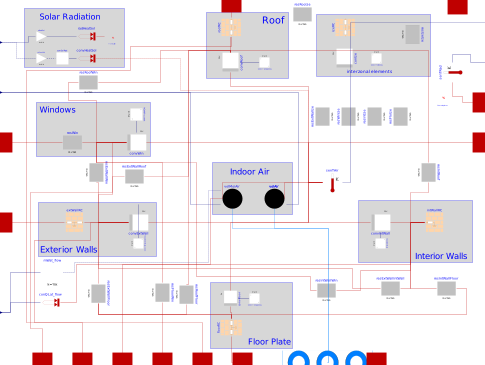
Extends from FourElements (Thermal Zone with four elements for exterior walls, interior walls, floor plate and roof).
Information
This model adds another element for interzonal elements modelling heat
transfer to adjacent zones. These
elements are not represented in the reduced-order models with less components.
For each interzonal element, one extra element is produced, which makes
this model, in fact, be able to have a much higher number of elements (4 for
the other elements plus the number of zone borders nIze), but the
elements bordering zones with a lower index in
othZoneInd[nIze] than this zone's index zoneInd
are ignored here and calculated in the other zone's ROM.
Ths implementation increases calculation times and calculation complexity -
also because the interzonal elements are directly connected via heat flow
ports to ensure no energy is produced out of or lost to nowhere.
The interzonal elements are parameterized via the length of the RC-chain
nIzeRC,
the vector of capacities CIze[nIze, nIzeRC], the vector of resistances
RIze[nIze, nIzeRC] and the remaining resistances RIzeRem[nIze].
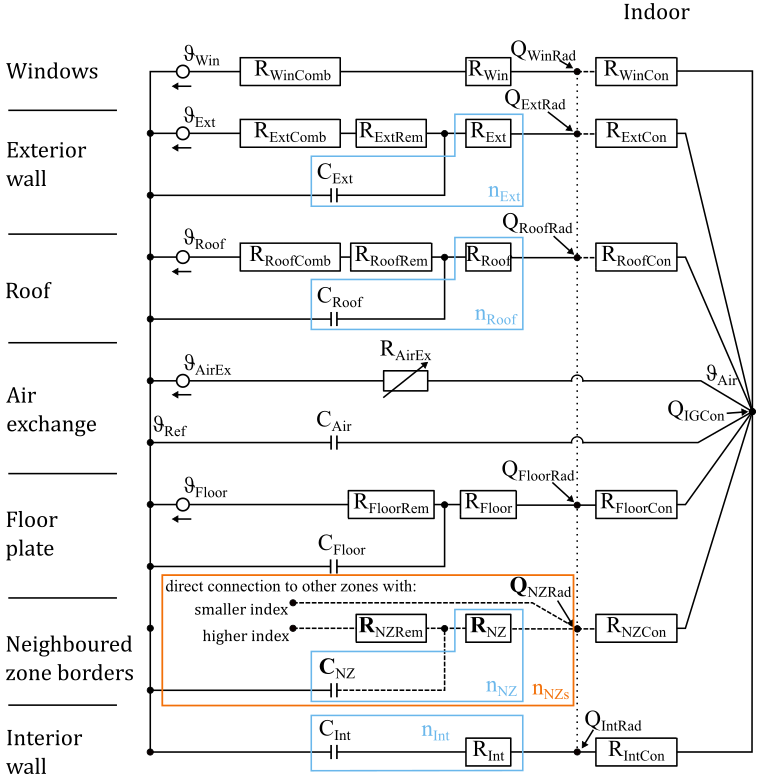
The image below shows the RC-network of this model. In the image, dashed
lines represent the possibly multiple interzonal elements (= array
of borders). Dotted lines represent the radiation resistances between each
pair of surfaces facing the indoor, which are not explicitly shown here due
to the high amount of resistances. See the documentation of
FourElement for a better visualisation.
Parameters
| Type | Name | Default | Description |
|---|---|---|---|
| Boolean | use_moisture_balance (from OneElement) | false | If true, input connector QLat_flow is enabled and room air computes moisture balance |
| Dynamics › Conservation equations | |||
| Modelica.Fluid.Types.Dynamics | energyDynamics (from LumpedVolumeDeclarations) | Modelica.Fluid.Types.Dynamics.DynamicFreeInitial | Type of energy balance: dynamic (3 initialization options) or steady state |
| Modelica.Fluid.Types.Dynamics | substanceDynamics (from LumpedVolumeDeclarations) | energyDynamics | Type of independent mass fraction balance: dynamic (3 initialization options) or steady state |
| Modelica.Fluid.Types.Dynamics | traceDynamics (from LumpedVolumeDeclarations) | energyDynamics | Type of trace substance balance: dynamic (3 initialization options) or steady state |
| Advanced › Dynamics | |||
| Modelica.Fluid.Types.Dynamics | massDynamics (from LumpedVolumeDeclarations) | energyDynamics | Type of mass balance: dynamic (3 initialization options) or steady state, must be steady state if energyDynamics is steady state |
| Initialization | |||
| Medium.AbsolutePressure | p_start (from LumpedVolumeDeclarations) | Medium.p_default | Start value of pressure |
| Medium.Temperature | T_start (from LumpedVolumeDeclarations) | Medium.T_default | Start value of temperature |
| Medium.MassFraction[Medium.nX] | X_start (from LumpedVolumeDeclarations) | Medium.X_default | Start value of mass fractions m_i/m |
| Medium.ExtraProperty[Medium.nC] | C_start (from LumpedVolumeDeclarations) | fill(0, Medium.nC) | Start value of trace substances |
| Medium.ExtraProperty[Medium.nC] | C_nominal (from LumpedVolumeDeclarations) | fill(1E-2, Medium.nC) | Nominal value of trace substances. (Set to typical order of magnitude.) |
| Dynamics | |||
| Real | mSenFac (from LumpedVolumeDeclarations) | 1 | Factor for scaling the sensible thermal mass of the volume |
| Thermal zone | |||
| Modelica.Units.SI.Volume | VAir (from OneElement) | Air volume of the zone | |
| Modelica.Units.SI.CoefficientOfHeatTransfer | hRad (from OneElement) | Coefficient of heat transfer for linearized radiation exchange between walls | |
| Integer | nOrientations (from OneElement) | Number of orientations | |
| General › Ports | |||
| Integer | nPorts (from OneElement) | 0 | Number of fluid ports |
| Windows | |||
| Modelica.Units.SI.Area[nOrientations] | AWin (from OneElement) | Vector of areas of windows by orientations | |
| Modelica.Units.SI.Area[nOrientations] | ATransparent (from OneElement) | Vector of areas of transparent (solar radiation transmittend) elements by orientations | |
| Modelica.Units.SI.CoefficientOfHeatTransfer | hConWin (from OneElement) | Convective coefficient of heat transfer of windows (indoor) | |
| Modelica.Units.SI.ThermalResistance | RWin (from OneElement) | Resistor for windows | |
| Modelica.Units.SI.TransmissionCoefficient | gWin (from OneElement) | Total energy transmittance of windows | |
| Real | ratioWinConRad (from OneElement) | Ratio for windows between indoor convective and radiative heat emission | |
| Boolean | indoorPortWin (from OneElement) | false | Additional heat port at indoor surface of windows |
| Exterior walls | |||
| Modelica.Units.SI.Area[nOrientations] | AExt (from OneElement) | Vector of areas of exterior walls by orientations | |
| Modelica.Units.SI.CoefficientOfHeatTransfer | hConExt (from OneElement) | Convective coefficient of heat transfer of exterior walls (indoor) | |
| Integer | nExt (from OneElement) | Number of RC-elements of exterior walls | |
| Modelica.Units.SI.ThermalResistance[nExt] | RExt (from OneElement) | Vector of resistances of exterior walls, from inside to outside | |
| Modelica.Units.SI.ThermalResistance | RExtRem (from OneElement) | Resistance of remaining resistor RExtRem between capacity n and outside | |
| Modelica.Units.SI.HeatCapacity[nExt] | CExt (from OneElement) | Vector of heat capacities of exterior walls, from inside to outside | |
| Boolean | indoorPortExtWalls (from OneElement) | false | Additional heat port at indoor surface of exterior walls |
| Advanced | |||
| Boolean | use_C_flow (from OneElement) | false | Set to true to enable input connector for trace substance |
| Interior walls | |||
| Modelica.Units.SI.Area | AInt (from TwoElements) | Area of interior walls | |
| Modelica.Units.SI.CoefficientOfHeatTransfer | hConInt (from TwoElements) | Convective coefficient of heat transfer of interior walls (indoor) | |
| Integer | nInt (from TwoElements) | Number of RC-elements of interior walls | |
| Modelica.Units.SI.ThermalResistance[nInt] | RInt (from TwoElements) | Vector of resistances of interior walls, from port to center | |
| Modelica.Units.SI.HeatCapacity[nInt] | CInt (from TwoElements) | Vector of heat capacities of interior walls, from port to center | |
| Boolean | indoorPortIntWalls (from TwoElements) | false | Additional heat port at indoor surface of interior walls |
| Floor plate | |||
| Modelica.Units.SI.Area | AFloor (from ThreeElements) | Area of floor plate | |
| Modelica.Units.SI.CoefficientOfHeatTransfer | hConFloor (from ThreeElements) | Convective coefficient of heat transfer of floor plate (indoor) | |
| Integer | nFloor (from ThreeElements) | Number of RC-elements of floor plate | |
| Modelica.Units.SI.ThermalResistance[nFloor] | RFloor (from ThreeElements) | Vector of resistances of floor plate, from inside to outside | |
| Modelica.Units.SI.ThermalResistance | RFloorRem (from ThreeElements) | Resistance of remaining resistor RFloorRem between capacity n and outside | |
| Modelica.Units.SI.HeatCapacity[nFloor] | CFloor (from ThreeElements) | Vector of heat capacities of floor plate, from inside to outside | |
| Boolean | indoorPortFloor (from ThreeElements) | false | Additional heat port at indoor surface of floor plate |
| Roof | |||
| Modelica.Units.SI.Area | ARoof (from FourElements) | Area of roof | |
| Modelica.Units.SI.CoefficientOfHeatTransfer | hConRoof (from FourElements) | Convective coefficient of heat transfer of roof (indoor) | |
| Integer | nRoof (from FourElements) | Number of RC-elements of roof | |
| Modelica.Units.SI.ThermalResistance[nRoof] | RRoof (from FourElements) | Vector of resistances of roof, from inside to outside | |
| Modelica.Units.SI.ThermalResistance | RRoofRem (from FourElements) | Resistance of remaining resistor RRoofRem between capacity n and outside | |
| Modelica.Units.SI.HeatCapacity[nRoof] | CRoof (from FourElements) | Vector of heat capacities of roof, from inside to outside | |
| Boolean | indoorPortRoof (from FourElements) | false | Additional heat port at indoor surface of roof |
| Zone borders | |||
| Integer | nIze | Number of interzonal elements to consider | |
| Modelica.Units.SI.Area[nIze] | AIze | Area of interzonal elements | |
| Modelica.Units.SI.CoefficientOfHeatTransfer[nIze] | hConIze | Convective coefficient of heat transfer of interzonal elements (indoor) | |
| Integer | nIzeRC | Number of RC-elements of interzonal elements | |
| Modelica.Units.SI.ThermalResistance[nIze,nIzeRC] | RIze | Vector of resistances of interzonal elements, from inside to outside | |
| Modelica.Units.SI.ThermalResistance[nIze] | RIzeRem | Vector of resistances of remaining resistor RIzeRem between capacity n and outside | |
| Modelica.Units.SI.HeatCapacity[nIze,nIzeRC] | CIze | Vector of heat capacities of interzonal elements, from inside to outside | |
| Boolean | indPorIze | false | Additional heat port at indoor surface of interzonal elements |
| Integer[nIze] | othZoneInd | index of the zone each interzonal element is adjacent to | |
| Integer | zoneInd | index of this zone | |
Connectors
Components
Revisions
-
April 20, 2023, by Philip Groesdonk:
First Implementation. This is for AixLib issue #1080.