 .Bodylight.Chemical.Components.GasSolubility .Bodylight.Chemical.Components.GasSolubility
ConcentrationLiquid = kH · ConcentrationGas
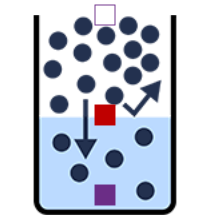
Henry's law: The concentration of the gas in the liquid is proportional to the partial pressure of the gas during equilibrium.
|
kd·A·cgas |
dissolution rate |
|
kv·A·cliquid |
volatility rate |
|
kH = kd/kv = cliquid/cgas |
equilibrium |
|
van't Hoff's equation |
|
|
ΔrG0= ΔH - T·ΔS = -R·T·log(KH) |
Gibb's energy |
|
entropy |
|
cgas |
gaseous molar concentration of the substance |
|
cliquid |
liquid molar concentration of the substance |
|
KH |
Henry's coeficient at current temperature T |
|
kd |
dissolution rate coefficient in liquid at current temperature T |
|
kv |
volatility rate coefficient at current temperature T |
|
A |
surface area between gas and liquid |
|
ΔH |
enthalpy of dissolution |
|
TheatPort |
current temperature T |
|
KH0 |
tabulated Henry's constant at base temperature TK |
|
TK |
base temperature of tabulated coefficients |
|
Ω |
change of number of ways of arranging molecules |
|
ΔS |
entropy of the dissolution |
|
ΔsG0 |
Gibb's energy of the dissolution |
Henry's coefficient kH depends on temperature and on the identities of all substances present in solution.
Water fraction (W_solution, plasma 0.94, RBC 0.65 => blood 0.81 ml/ml) in solution can change the solubility of gases in water [1] as c_pure=c_solution/W_solution.
[1] Dash RK, Bassingthwaighte JB. Erratum to: Blood HbO2 and HbCO2 dissociation curves at varied O2, CO2, pH, 2, 3-DPG and temperature levels. Ann Biomed Eng 2010;38:1683-701.
2009-2015 by Marek Matejak, Charles University, Prague, Czech Republic