modelMembrane
Extends from Icons.Membrane, Interfaces.ConditionalHeatPort (Partial model to include a conditional HeatPort in order to describe the power loss via a thermal network).
Information
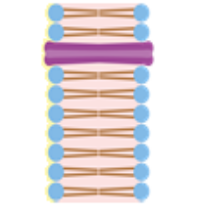
Filtration throught semipermeable membrane.
The penetrating particles are driven by electric and chemical gradient to reach Donnan's equilibrium. The permeabilities of particles are used only in dynamic simulation with non-zero fluxes. If zero-flow Donnan's equilibrium is reached, it is independent on the permeabilities.
This class can be used for glomerular membrane, open(leak) channels (pores) of cellular (or any lipid bilayer) membrane, chloride schift, ...
The membrane permeabilities depends on (D/membrameThicknes)*membraneArea, where D is Fick's diffusion coefficient.
................................
Filtration example of tree particles
ALP .. small penetrating anion
P .. nonpenetrating protein with negative charge
C .. small penetrating cation
In outer side of membrane are not protein P (it leaves inside).
In equilibrium 4 concentration are unknown:
ALP_in, ALP_out, C_in, C_out.
Closed system equilibrium equations:
tALP = ALP_in + ALP_out ... total amount of ALP
tC = C_in + C_out ... total amount of C
P + ALP_in = C_in ... electroneutrality inside
ALP_out = C_out ... electroneutrality outside
----------------------------------------------------
It is possible to write these equations also in form of KAdjustment, which connect also more than tree type of particles with Donnan's equilibrium equations:
ALP_in/ALP_out = (1-KAdjustment)
C_in/C_out = (1+KAdjustment)
where KAdjustment = P/(2*C_in-P) and C_out=ALP_out=(2*C_in-P)/2, because ALP_in/ALP_out = (C_in - P)/C_out = (2C_in-2P)/(2C_in-P) = 1 - P/(2C_in-P) = 1-KAdjustment and C_in/C_out = (2C_in)/(2C_in-P) = 1 + P/(2C_in-P) = 1+KAdjustment .
Problem with different solubilities/Henry constants/ (kH1, kH2)
Equilibrated is chemical potential, not concentrations (c1,c2)!
Equality of chemical potential is approximated by equality of partial pressure (p1,p2):
p1=kH1*c1
p2=kH2*c2
c2 = (kH1/kH2) * c1
Henry constant between both side can be defined as kH_T0 = kH1/kH2 at temperature T0, where kH1 is Henry constant in first side of membrane and kH2 is Henry constant in second side of membrane.
Temperature dependence of Henry constants by Van't Hoff
kH1 = kH1_T0 * Modelica.Math.exp(C1* (1/T - 1/T0))
kH2 = kH2_T0 * Modelica.Math.exp(C2* (1/T - 1/T0))
kH1/kH2 = kH_T0 * Modelica.Math.exp(C * (1/T - 1/T0))
Specific constant for Van't Hoff's change of kH_T0 can be defined as C = C1-C2, where C1 is specific constant in first side of membrane and C2 is specific constant in second side of membrane.
Parameters
| Type | Name | Default | Description |
|---|---|---|---|
| Integer | NumberOfParticles | 1 | Number of penetrating particle types |
| Integer[NumberOfParticles] | Charges | zeros(NumberOfParticles) | Elementary charges of particles |
| Types.DiffusionPermeability[NumberOfParticles] | Permeabilities | zeros(NumberOfParticles) | Permeabilities of particles through membrane chanel |
| Types.Fraction | solventFractionInside | 1 | Free solvent fraction inside (i.e. 'mol/mol' ratio between current solution and pure solvent in one liter; e.g. in plasma=0.96, in RBC=0.717) |
| Types.Fraction | solventFractionOutside | 1 | Free solvent fraction outside (i.e. 'mol/mol' ratio between current solution and pure solvent in one liter; e.g. in plasma=0.96, in RBC=0.717) |
| External inputs/outputs | |||
| Boolean | useHeatPort (from ConditionalHeatPort) | false | =true, if HeatPort is enabled |
| Boolean | usePermeabilityInput | false | =true, if external permeability value is used |
| Temperature dependence | |||
| Types.Temperature | T (from ConditionalHeatPort) | 310.15 | Fixed device temperature if useHeatPort = false |
| Types.Temperature | T0 | 298.15 | Base temperature for kH_T0 |
| Types.Temperature[NumberOfParticles] | C | zeros(NumberOfParticles) | Specific constant difference (C1-C2) for Van't Hoff's change of kH |
| Different solubilities | |||
| Types.GasSolubility[NumberOfParticles] | kH_T0 | ones(NumberOfParticles) | Equilibrated concentration ratio at temperature T0 - can be estimated by Henry's law coefficient ratios (kH1/kH2) |
Connectors
| Type | Name | Default | Description |
|---|---|---|---|
| Thermal.Interfaces.HeatPort_a | heatPort (from ConditionalHeatPort) | ||
| Interfaces.ChemicalPort_a[NumberOfParticles] | particlesInside | inner side of membrane, solution | |
| Interfaces.ChemicalPort_b[NumberOfParticles] | particlesOutside | outer side of membrane, solution | |
| Types.RealIO.DiffusionPermeabilityInput[NumberOfParticles] | permeability | p |
Components
| Type | Name | Default | Description |
|---|---|---|---|
| Types.Temperature | T_heatPort (from ConditionalHeatPort) | Temperature of HeatPort | |
| Types.HeatFlowRate | lossHeat (from ConditionalHeatPort) | Loss heat leaving component via HeatPort | |
| Types.GasSolubility[NumberOfParticles] | kH | Concentration ratio at equilibrium |