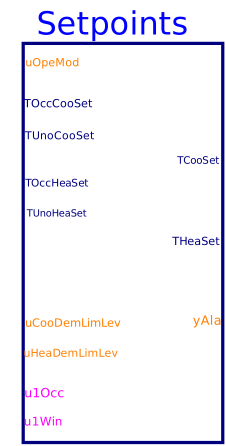
blockSetpoints
Block outputs thermal zone cooling and heating active setpoint
Information
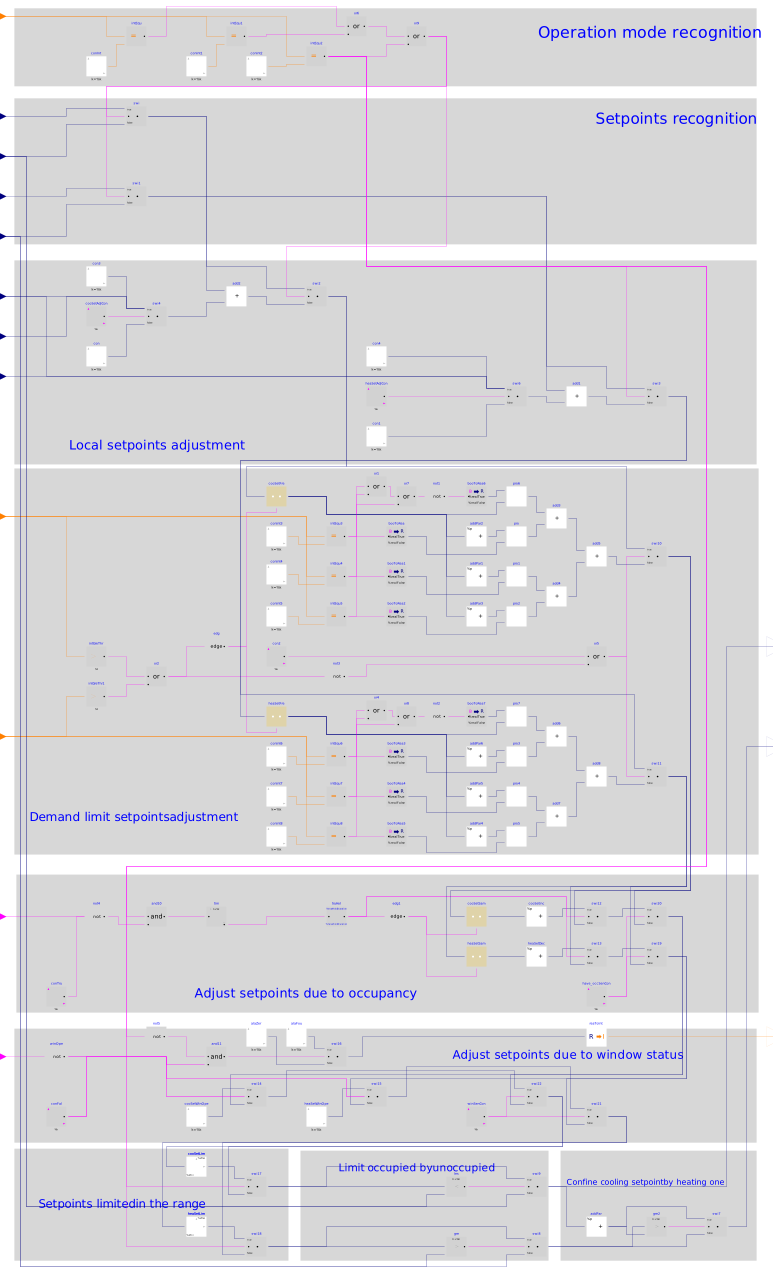
This sequence sets the thermal zone cooling and heating active setpoints. The implementation is according to the ASHRAE Guideline 36, Section 5.3.2. The calculation is done following the steps below.
-
According to Guideline 36, Section 3.1.1.1, zone setpoints shall be based on zone
type.
Zone Type Occupied Unoccupied Heating Cooling Heating Cooling VAV 21 °C (70 °F) 24 °C (75 °F) 16 °C (60 °F) 32 °C (90 °F) Mechanical/electrical rooms 18 °C (65 °F) 29 °C (85 °F) 18 °C (65 °F) 29 °C (85 °F) Networking/computer 18 °C (65 °F) 24 °C (75 °F) 18 °C (65 °F) 24 °C (75 °F)
- Each zone shall have separate occupied and unoccupied heating and cooling setpoints.
- The active setpoints shall be determined by the operating mode of the zone
group.
- The setpoints shall be the occupied setpoints during occupied, warm-up, and cooldown modes.
- The setpoints shall be the unoccupied setpoints during unoccupied, setback, and setup modes.
-
The software shall prevent,
- The heating setpoint from exceeding the cooling setpoint minus 0.5 °C (1 °F), i.e. the minimum difference between heating and cooling setpoint shall be 0.5 °C (1 °F).
- The unoccupied heating setpoint from exceeding the occupied heating setpoint.
- The unoccupied cooling setpoint from being less than occupied cooling setpoint.
-
Where the zone has a local setpoint adjustment knob/button,
- The setpoint adjustment offsets established by the occupant shall be software points that are persistent (e.g. not reset daily), but the actual offset used in control logic shall be adjusted based on limits and modes as described below.
- The adjustment shall be capable of being limited in software.
- As a default, the active occupied cooling setpoint shall be limited between 22 °C (72 °F) and 27 °C (80 °F);
- As a default, the active occupied heating setpoint shall be limited between 18 °C (65 °F) and 22 °C (72 °F);
- The active heating and cooling setpoint shall be independently adjustable, respecting the limits and anti-overlap logic described above. If zone thermostat provides only a single setpoint adjustment, then the adjustment shall move both the same amount, within the limits described above.
- The adjustment shall only affect occupied setpoints in occupied mode, warm-up mode and cool-down mode and shall have no impact on setpoints in all other modes.
- At the onset of demand limiting, the local setpoint adjustment value shall be frozen. Further adjustment of the setpoint by local controls shall be suspended for the duration of the demand limit event.
- Cooling demand limit setpoint adjustment.
The active cooling setpoints for all zones shall be increased when a demand limit
is imposed on the associated zone group. The operator shall have the ability
to exempt individual zones from this adjustment through the normal
Building Automation System (BAS) user interface. Changes due to demand limits
are not cumulative.
- At Demand Limit Level 1, increase setpoint by 0.5 °C (1 °F).
- At Demand Limit Level 2, increase setpoint by 1 °C (2 °F).
- At Demand Limit Level 3, increase setpoint by 2 °C (4 °F).
- Heating demand limit setpoint adjustment.
The active heating setpoints for all zones shall be decreased when a demand limit
is imposed on the associated zone group. The operator shall have the ability
to exempt individual zones from this adjustment through the normal BAS user
interface. Changes due to demand limits are not cumulative.
- At Demand Limit Level 1, decrease setpoint by 0.5 °C (1 °F).
- At Demand Limit Level 2, decrease setpoint by 1 °C (2 °F).
- At Demand Limit Level 3, decrease setpoint by 2 °C (4 °F).
- Window switches. For zones that have operable windows with indicator switches, when the window switch indicates the window is open, the heating setpoint shall be temporarily set to 4 °C (40 °F) and the cooling setpoint shall be temporarily set to 49 °C (120 °F). When the window switch indicates the window is open during other than Occupied Mode, a Level 4 alarm shall be generated.
- Occupancy sensor
- When the switch indicates the space has been unpopulated for 5 minutes continuously during the Occupied Mode, the active heating setpoint shall be decreased by 0.5 °C (1 °F) and the cooling setpoint shall be increased by 0.5 °C (1 °F).
- When the switch indicated that the space has been populated for 1 minute continuously, the active heating and cooling setpoints shall be restored to their previously values.
- Hierarchy of setpoint adjustments: the following adjustment restrictions
shall prevail in order from highest to lowest priority.
- Setpoint overlap restriction
- Absolute limits on local setpoint adjustment
- Window swtiches
- Demand limit (a. Occupancy sensors; b. Local setpoint adjustment)
- Scheduled setpoints based on zone group mode
Parameters
| Type | Name | Default | Description |
|---|---|---|---|
| Sensors | |||
| Boolean | have_occSen | Check if the zone has occupancy sensor | |
| Boolean | have_winSen | Check if the zone has window status sensor | |
| Setpoint adjustable setting | |||
| Boolean | have_locAdj | true | True: the zone has local setpoint adjustment knob |
| Boolean | sepAdj | true | True: cooling and heating setpoint can be adjusted separately |
| Boolean | ignDemLim | true | True: exempt the individual zone from demand limit setpoint adjustment |
| Setpoints limits setting | |||
| Real | TActCoo_max | 300.15 | Maximum active cooling setpoint |
| Real | TActCoo_min | 295.15 | Minimum active cooling setpoint |
| Real | TActHea_max | 295.15 | Maximum active heating setpoint |
| Real | TActHea_min | 291.15 | Minimum active heating setpoint |
| Real | TWinOpeCooSet | 322.15 | Cooling setpoint when window is open |
| Real | TWinOpeHeaSet | 277.15 | Heating setpoint when window is open |
| Demand control › Setpoint adjustment | |||
| Real | incTSetDem_1 | 0.5 | Cooling setpoint increase value (degC) when cooling demand limit level 1 is imposed |
| Real | incTSetDem_2 | 1 | Cooling setpoint increase value (degC) when cooling demand limit level 2 is imposed |
| Real | incTSetDem_3 | 2 | Cooling setpoint increase value (degC) when cooling demand limit level 3 is imposed |
| Real | decTSetDem_1 | 0.5 | Heating setpoint decrease value (degC) when heating demand limit level 1 is imposed |
| Real | decTSetDem_2 | 1 | Heating setpoint decrease value (degC) when heating demand limit level 2 is imposed |
| Real | decTSetDem_3 | 2 | Heating setpoint decrease value (degC) when heating demand limit level 3 is imposed |
Connectors
| Type | Name | Default | Description |
|---|---|---|---|
| Buildings.Controls.OBC.CDL.Interfaces.IntegerInput | uOpeMod | AHU operation mode status signal | |
| Buildings.Controls.OBC.CDL.Interfaces.RealInput | TOccCooSet | Occupied zone cooling setpoint | |
| Buildings.Controls.OBC.CDL.Interfaces.RealInput | TUnoCooSet | Unoccupied zone cooling setpoint | |
| Buildings.Controls.OBC.CDL.Interfaces.RealInput | TOccHeaSet | Occupied zone heating setpoint | |
| Buildings.Controls.OBC.CDL.Interfaces.RealInput | TUnoHeaSet | Unoccupied zone heating setpoint | |
| Buildings.Controls.OBC.CDL.Interfaces.RealInput | setAdj | The adjustment value for both heating and cooling setpoints if it allows only single setpoint adjustment | |
| Buildings.Controls.OBC.CDL.Interfaces.RealInput | cooSetAdj | Cooling setpoint adjustment value | |
| Buildings.Controls.OBC.CDL.Interfaces.RealInput | heaSetAdj | Heating setpoint adjustment value | |
| Buildings.Controls.OBC.CDL.Interfaces.IntegerInput | uCooDemLimLev | Cooling demand limit level | |
| Buildings.Controls.OBC.CDL.Interfaces.IntegerInput | uHeaDemLimLev | Heating demand limit level | |
| Buildings.Controls.OBC.CDL.Interfaces.BooleanInput | u1Occ | Occupancy sensor (occupied=true, unoccupied=false) | |
| Buildings.Controls.OBC.CDL.Interfaces.BooleanInput | u1Win | Window status, normally closed (true), when windows open, it becomes false | |
| Buildings.Controls.OBC.CDL.Interfaces.RealOutput | TCooSet | Cooling setpoint temperature | |
| Buildings.Controls.OBC.CDL.Interfaces.RealOutput | THeaSet | Heating setpoint temperature | |
| Buildings.Controls.OBC.CDL.Interfaces.IntegerOutput | yAla | Alarm level |
Revisions
-
June 3, 2020, by Jianjun Hu:
Upgraded according to G36 official release. -
October 11, 2017, by Michael Wetter:
Removed wrong conditional onyAla. -
August 17, 2017, by Jianjun Hu:
First implementation.