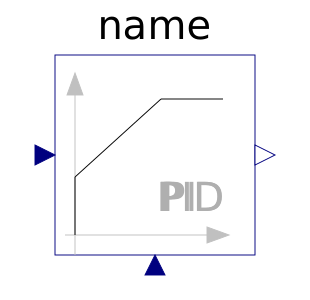
 .Buildings.Controls.OBC.CDL.Reals.PID .Buildings.Controls.OBC.CDL.Reals.PID
PID controller in the standard form
yu = k/r (e(t) + 1 ⁄ Ti ∫ e(τ) dτ + Td d⁄dt e(t)),
where yu is the control signal before output limitation, e(t) = us(t) - um(t) is the control error, with us being the set point and um being the measured quantity, k is the gain, Ti is the time constant of the integral term, Td is the time constant of the derivative term, and r is a scaling factor, with default r=1. The scaling factor should be set to the typical order of magnitude of the range of the error e. For example, you may set r=100 to r=1000 if the control input is a pressure of a heating water circulation pump in units of Pascal, or leave r=1 if the control input is a room temperature.
Note that the units of k are the inverse of the units of the control error, while the units of Ti and Td are seconds.
The actual control output is
y = min( ymax, max( ymin, y)),
where ymin and ymax are limits for the control signal.
Through the parameter controllerType, the
controller can be configured as P, PI, PD or PID controller. The
default configuration is PI.
Through the parameter reverseActing, the controller
can be configured to be reverse or direct acting. The above
standard form is reverse acting, which is the default
configuration. For a reverse acting controller, for a constant set
point, an increase in measurement signal u_m decreases
the control output signal y (Montgomery and McDowall,
2008). Thus,
reverseActing = true, butreverseActing = false.If reverseAction=false, then the error e
above is multiplied by -1.
The controller anti-windup compensation is as follows: Instead of the above basic control law, the implementation is
yu = k (e(t) ⁄ r + 1 ⁄ Ti ∫ (-Δy + e(τ) ⁄ r) dτ + Td ⁄ r d⁄dt e(t)),
where the anti-windup compensation Δy is
Δy = (yu - y) ⁄ (k Ni),
where Ni > 0 is the time constant for the anti-windup compensation. To accelerate the anti-windup, decrease Ni.
Note that the anti-windup term (-Δy + e(τ) ⁄ r) shows that the range of the typical control error r should be set to a reasonable value so that
e(τ) ⁄ r = (us(τ) - um(τ)) ⁄ r
has order of magnitude one, and hence the anti-windup compensation should work well.
Note that this controller implements an integrator anti-windup. Therefore, for most applications, the controller output does not need to be reset. However, if the controller is used in conjuction with equipment that is being switched on, better control performance may be achieved by resetting the controller output when the equipment is switched on. This is in particular the case in situations where the equipment control input should continuously increase as the equipment is switched on, such as a light dimmer that may slowly increase the luminance, or a variable speed drive of a motor that should continuously increase the speed. In this case, the controller Buildings.Controls.OBC.CDL.Reals.PIDWithReset that can reset the output should be used.
The derivative of the control error d ⁄ dt e(t) is approximated using
d⁄dt x(t) = (e(t)-x(t)) Nd ⁄ Td,
and
d⁄dt e(t) ≈ Nd (e(t)-x(t)),
where x(t) is an internal state.
The parameters of the controller can be manually adjusted by performing closed loop tests (= controller + plant connected together) and using the following strategy:
k (the total gain of the controller) until
the closed-loop response cannot be improved any more.k and Ti (the time constant of
the integrator). The first value of Ti can be selected
such that it is in the order of the time constant of the
oscillations occurring with the P-controller. If, e.g.,
oscillations in the order of 100 seconds occur in the
previous step, start with Ti=1/100 seconds.k, Ti, Td (time
constant of derivative block).yMax and yMin
according to your specification.Ni (Ni
Ti is the time constant of the anti-windup
compensation) such that the input to the limiter block (=
lim.u) goes quickly enough back to its limits. If
Ni is decreased, this happens faster. If
Ni is very large, the anti-windup compensation is not
effective and the controller works bad.R. Montgomery and R. McDowall (2008). "Fundamentals of HVAC Control Systems." American Society of Heating Refrigerating and Air-Conditioning Engineers Inc. Atlanta, GA.
y to icon.Modelica.Units.SI.r, removed set point weights
wp and wd. Revised documentation.trigger and
y_rest_in. Refactored to internally implement the
derivative block.yMax from
unspecified to 1 and yMin from
-yMax to 0.xd_start that was
used to initialize the state of the derivative term. This state is
now initialized based on the requested initial output
yd_start which is a new parameter with a default of
0. Also, removed the parameters y_start
and initType because the initial output of the
controller can be set by using xi_start and
yd_start. This is a non-backward compatible change,
made to simplify the controller through the removal of options that
can be realized differently and are hardly ever used. This
refactoring also removes the parameter strict that was
used in the output limiter. The new implementation enforces a
strict check by default.k.homotopyType=NoHomotopy.limitsAtInit because it was only
propagated to the instance limiter, but this block no
longer makes use of this parameter. This is a non-backward
compatible change.strict=true in order to
avoid events when the controller saturates. This is for Buildings,
issue 433.