blockOutsideAirFlow
Information
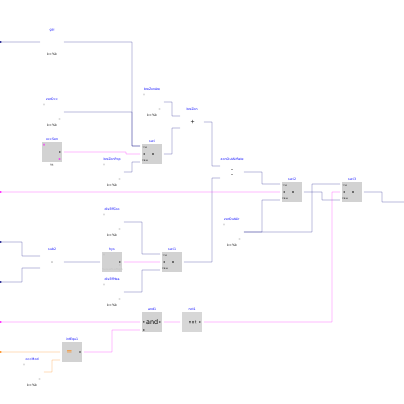
This atomic sequence sets the minimum outdoor airflow setpoint for compliance with the ventilation rate procedure of ASHRAE 62.1-2013. The implementation is according to ASHRAE Guidline 36 (G36), PART 5.P.4.b, PART 5.B.2.b, PART3.1-D.2.a.
Step 1: Minimum breathing zone outdoor airflow required breZon
- The area component of the breathing zone outdoor airflow:
breZonAre = AFlo*VOutPerAre_flow. - The population component of the breathing zone outdoor airflow:
breZonPop = occCou*VOutPerPer_flow.
The number of occupant occCou could be retrieved
directly from occupancy sensor nOcc if the sensor exists
(have_occSen=true), or using the default occupant density
occDen to find it AFlo*occDen. The occupant
density can be found from Table 6.2.2.1 in ASHRAE Standard 62.1-2013.
Step 2: Zone air-distribution effectiveness zonDisEff
Table 6.2.2.2 in ASHRAE 62.1-2013 lists some typical values for setting the
effectiveness. Depending on difference between zone space temperature
TZon and supply air temperature TDis, Warm-air
effectiveness zonDisEffHea or Cool-air effectiveness
zonDisEffCoo should be applied.
Step 3: Minimum required zone outdoor airflow zonOutAirRate
For each zone in any mode other than occupied mode and for zones that have
window switches and the window is open, zonOutAirRate shall be
zero.
Otherwise, the required zone outdoor airflow zonOutAirRate
shall be calculated as follows:
- If discharge air temperature at the terminal unit is less than or equal to
zone space temperature:
zonOutAirRate = (breZonAre+breZonPop)/disEffCoo. -
If discharge air temperature at the terminal unit is greater than zone space
temperature:
zonOutAirRate = (breZonAre+breZonPop)/disEffHea
- If discharge air temperature at the terminal unit is less than or equal to
zone space temperature:
zonOutAirRate = breZonAre/disEffCoo - If discharge air temperature at the terminal unit is greater than zone
space temperature:
zonOutAirRate = breZonAre/disEffHea
For the single zone system, the required minimum outdoor airflow setpoint
VOutMinSet_flow equals to the zonOutAirRate.
Parameters
| Type | Name | Default | Description |
|---|---|---|---|
| Boolean | have_occSen | Set to true if zones have occupancy sensor | |
| Real | occDen | 0.05 | Default number of person in unit area |
| Real | zonDisEffHea | 0.8 | Zone air distribution effectiveness during heating |
| Real | zonDisEffCoo | 1.0 | Zone air distribution effectiveness during cooling |
| Nominal condition | |||
| Real | VOutPerAre_flow | 3e-4 | Outdoor air rate per unit area |
| Real | VOutPerPer_flow | 2.5e-3 | Outdoor air rate per person |
| Real | AFlo | Floor area | |
| Advanced | |||
| Real | uLow | -0.5 | If zone space temperature minus supply air temperature is less than uLow, then it should use heating supply air distribution effectiveness |
| Real | uHigh | 0.5 | If zone space temperature minus supply air temperature is more than uHig, then it should use cooling supply air distribution effectiveness |
Connectors
| Type | Name | Default | Description |
|---|---|---|---|
| Buildings.Controls.OBC.CDL.Interfaces.RealInput | nOcc | Number of occupants | |
| Buildings.Controls.OBC.CDL.Interfaces.RealInput | TZon | Measured zone air temperature | |
| Buildings.Controls.OBC.CDL.Interfaces.RealInput | TDis | Measured discharge air temperature | |
| Buildings.Controls.OBC.CDL.Interfaces.IntegerInput | uOpeMod | AHU operation mode status signal | |
| Buildings.Controls.OBC.CDL.Interfaces.BooleanInput | uSupFan | Supply fan status, true if on, false if off | |
| Buildings.Controls.OBC.CDL.Interfaces.BooleanInput | uWin | Window status, true if open, false if closed | |
| Buildings.Controls.OBC.CDL.Interfaces.RealOutput | VOutMinSet_flow | Effective minimum outdoor airflow setpoint |
Revisions
-
November 2, 2018, by Michael Wetter:
Made the input connectornOccconditionally removable, as it is for the multizone implementation. This is for issue 1270. -
July 6, 2017, by Jianjun Hu:
ReplacedcooCtrlSiginput withTZonandTDisinputs to check if cool or warm air distribution effectiveness should be applied. Applied hysteresis to avoid rapid change. -
May 12, 2017, by Jianjun Hu:
First implementation.