modelOpaqueConstruction

Extends from Buildings.ThermalZones.EnergyPlus_24_2_0.BaseClasses.PartialEnergyPlusObject (Partial definitions of an EnergyPlus object), Buildings.ThermalZones.EnergyPlus_24_2_0.BaseClasses.Synchronize.ObjectSynchronizer (Block that synchronizes an object).
Information
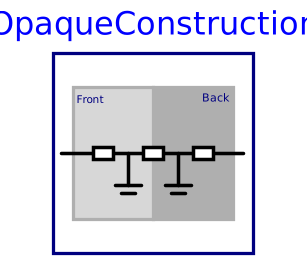
Model that interfaces with the EnergyPlus object BuildingSurface:Detailed.
It sets in EnergyPlus the temperature of the front and back surface
to the values obtained from Modelica through the heat ports
of this model,
and imposes the heat flow rate obtained from EnergyPlus at the heat ports
of this model.
For the front surface, this heat flow rate consists of
- convective heat flow rate,
- absorbed solar radiation, and
- absorbed infrared radiation minus emitted infrared radiation.
For the back-side surface, the above quantities, but now for the back-side of the construction, are also returned if the back-side faces another thermal zone or the outside. If the back-side surface is above ground, then the heat flow rate from the ground is returned.
Usage
This model allows for example coupling of a radiant slab that is modeled in Modelica to the EnergyPlus thermal zone model. Examples of such radiant systems include a floor slab with embedded pipes and a radiant cooling panel that is suspended from a ceiling. The model Buildings.ThermalZones.EnergyPlus_24_2_0.Examples.SingleFamilyHouse.RadiantHeatingCooling_TRoom illustrates the use of this model for a floor and ceiling slab.
Note that if the ground heat transfer of the floor slab is modeled in Modelica, then the model Buildings.ThermalZones.EnergyPlus_24_2_0.ZoneSurface can be used, as shown for the floor slab in Buildings.ThermalZones.EnergyPlus_24_2_0.Examples.SingleFamilyHouse.HeatPumpRadiantHeatingGroundHeatTransfer.
By convention, if a surface cools the thermal zone,
then heaPorFro.Q_flow < 0 for a front surface and heaPorBac.Q_flow < 0 for a back surface.
The variable qFro_flow is equal to qFro_flow = heaPorFro.Q_flow/A, where
A is the area of the heat transfer surface as obtained from EnergyPlus.
Similarly, use qBac_flow to check the back side heat flux.
Configuration for EnergyPlus
Consider an EnergyPlus input data file that has the following entry for the surface of an attic above a living room:
  BuildingSurface:Detailed,
    Attic:LivingFloor,       !- Name
    FLOOR,                   !- Surface Type
    reverseCEILING:LIVING,   !- Construction Name
    ATTIC ZONE,              !- Zone Name
    Surface,                 !- Outside Boundary Condition
    Living:Ceiling,          !- Outside Boundary Condition Object
    NoSun,                   !- Sun Exposure
    NoWind,                  !- Wind Exposure
    0.5000000,               !- View Factor to Ground
    4,                       !- Number of Vertices
    0,0,2.4384,  !- X,Y,Z ==> Vertex 1 {m}
    0,10.778,2.4384,  !- X,Y,Z ==> Vertex 2 {m}
    17.242,10.778,2.4384,  !- X,Y,Z ==> Vertex 3 {m}
    17.242,0,2.4384;  !- X,Y,Z ==> Vertex 4 {m}
If this construction is modeled with a radiant slab, that may have pipes embedded near the ceiling to cool the living room, then this model can be used as
Buildings.ThermalZones.EnergyPlus_24_2_0.OpaqueConstruction attFlo(surfaceName="Attic:LivingFloor")
    "Floor of the attic above the living room";
The heat port attFlo.heaPorFro can then be connected to the heat port of the upward facing
surface of a radiant slab, and the
heat port attFlo.heaPorBac can be connected to the downward facing surface of the radiant slab
that cool the living room via the surface Living:Ceiling.
This configuration is illustrated in the example
Buildings.ThermalZones.EnergyPlus_24_2_0.Examples.SingleFamilyHouse.RadiantHeatingCooling_TRoom.
Parameters
| Type | Name | Default | Description |
|---|---|---|---|
| String | surfaceName | Surface unique name in the EnergyPlus idf file | |
| Modelica.Units.SI.Area | A | Surface area |
Connectors
| Type | Name | Default | Description |
|---|---|---|---|
| Modelica.Thermal.HeatTransfer.Interfaces.HeatPort_a | heaPorFro | Heat port for front surface | |
| Modelica.Thermal.HeatTransfer.Interfaces.HeatPort_b | heaPorBac | Heat port for back surface |
Components
| Type | Name | Default | Description |
|---|---|---|---|
| Buildings.ThermalZones.EnergyPlus_24_2_0.Building | building (from PartialEnergyPlusObject) | Building-level declarations | |
| SynchronizeBuilding | synBui (from ObjectSynchronizer) | Model that synchronize the Spawn objects | |
| Modelica.Units.SI.HeatFlux | qFro_flow | Heat flow rate at front surface per unit area | |
| Modelica.Units.SI.HeatFlux | qBac_flow | Heat flow rate at back surface per unit area |
Revisions
-
March 24, 2021, by Michael Wetter:
First implementation.
This is for issue 2358.