modelThermalZone
Extends from Buildings.ThermalZones.EnergyPlus_24_2_0.BaseClasses.PartialEnergyPlusObject (Partial definitions of an EnergyPlus object).
Information
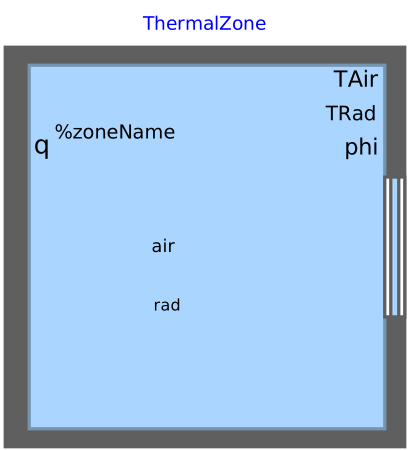
Model for a thermal zone that is implemented in EnergyPlus.
This model instantiates the FMU with the name idfName and
connects to the thermal zone with name zoneName.
The idfName needs to be specified in an instance of
Buildings.ThermalZones.EnergyPlus_24_2_0.Building
that is named building, and that is placed at this
or at a higher hierarchy-level of the model.
If the FMU is already instantiated by another instance of this model,
it will use the already instantiated FMU. Hence, for each thermal zone
in an EnergyPlus FMU, one instance of this model needs to be used.
See
Buildings.ThermalZones.EnergyPlus_24_2_0.UsersGuide
for how zones are simulated that are declared in the EnergyPlus input data file
but not in Modelica.
If there are two instances that declare the same zoneName
and have in the model hierarchy the same instance of
Buildings.ThermalZones.EnergyPlus_24_2_0.Building,
then the simulation will stop with an error.
Main Equations
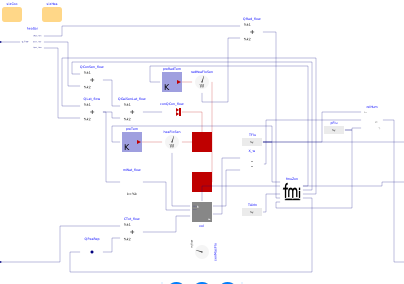
This model computes in Modelica the air energy, mass and species balance. Outside air infiltration needs to be modeled in Modelica, because any infiltration that the EnergyPlus model may specify is ignored. The convective heat transfer with the building fabric, the long-wave and the short-wave radiation are computed by EnergyPlus.
Heat and mass balance
The zone uses a volume of air that is fully mixed. The size of this volume,
and its floor area, which is used to scale the heat gains q_flow,
are obtained from the EnergyPlus model.
The zone has a fluid port fluPor that can be used to connect one or several
HVAC inlets, flow paths for air infiltration and exfiltration,
or for interzonal air exchange, using for example models from
Buildings.Airflow.Multizone.
The model also has a heat port heaPorAir that connects to the sensible heat balance of the room air,
and a heat port heaPorRad that connects to the radiative heat balance of the room inside surfaces.
If heat is added to heaPorRad.Q_flow, then this heat is sent to EnergyPlus as if it were
a radiant heat gain of the zone.
The heat port temperature heaPorRad.T is the radiant temperature
of the room. Hence, these two ports heaPorAir and heaPorRad could
be used to connect a radiator. Note, however, that such a coupling is an approximation
as the surface temperature of the radiator will not be reflected in the radiative temperature
of the room.
Also, read the section Notes about modeling components that are connected to the radiative heat port below.
Contaminant balance
The model has a parameter use_C_flow. If set to true,
then an input connector C_flow is enabled, which allows adding trace substances
to the room air. Note that this requires a medium model that has trace substances enabled.
Heat gains and CO2 added by people
If the EnergyPlus model computes internal heat gains
such as from people or equipment, then their sensible convective
and latent heat gains are automatically added to this room model,
and the radiant fraction is added to the EnergyPlus envelope and thus
treated correctly.
In addition, if desired, radiant, convective and latent heat gains
in units of W/m2
can be added using the input connector qGai_flow.
Similarly, if people are modeled in EnergyPlus (using the
EnergyPlus People object), and if the
Modelica Medium contains CO2 (e.g., if
Medium.nC > 0 and
there is a Medium.substanceName = "CO2"),
then the CO2 emitted by the people is automatically added to this volume.
However, the "Generic Contaminant" modeled in EnergyPlus is not
added to the air volume. (Because EnergyPlus does not declare the
name of the species or its molar mass and hence it cannot be matched
to species in Modelica or converted to emitted mass flow rate.)
Also, note that while CO2 emitted from people simulated in EnergyPlus is added automatically to
the air balance of this model,
there is no CO2 added automatically for the heat gain specified through the input connector
qGai_flow. Hence, if qGai_flow accounts for people and CO2 should be modelled,
then the CO2 emitted by the people specified in qGai_flow
needs to be added manually to the input connector C_flow.
(This manual addition is needed because qGai_flow can also contain heat gains not caused
by people.)
Notes about modeling components that are connected to the radiative heat port
Models in which a component is connected to the radiative heat port heaPorRad may cause
convergence problems during the initialization of the simulation
if that component computes the radiative heat exchange heaPorRad.Q_flow
based on the temperature heaPorRad.T, and if the parameter
building.setInitialRadiativeHeatGainToZero is changed from its default value
true.
It is therefore recommended to leave the parameter setInitialRadiativeHeatGainToZero
at its default value true.
This sets the radiative heat flow rate sent from Modelica to EnergyPlus
to zero during the initialization of the model, thereby avoiding a potential nonlinear system
of equations that may give convergence problems. This only affects the initialization of the model
but not the time integration, hence the error should be small for typical models.
If you decide to set setInitialRadiativeHeatGainToZero = false, you need to be aware of the following:
If setInitialRadiativeHeatGainToZero = false,
then the radiative heat gain from the model input is being used.
If this radiative heat gain depends on the radiative temperature that is an output of the EnergyPlus model,
a nonlinear equation is formed.
Because in EnergyPlus, computing the radiative temperature involves an iterative solution,
this can cause convergence problems due to having two nested solvers,
the outer being the Modelica solver that solves for the radiative heat flow rate QGaiRad_flow,
and the innner being the EnergyPlus solver that solves for the radiative temperature TRad.
Hence, we recommend to leave building.setInitialRadiativeHeatGainToZero = true.
If you decide to set building.setInitialRadiativeHeatGainToZero = false, you may need to also
tighten the tolerance of the EnergyPlus solver by tightening building.relativeSurfaceTolerance,
but one cannot assure that the nested nonlinear equations converge.
Because a Modelica model does not have knowledge of the solver tolerance, automatically tightening
building.relativeSurfaceTolerance as a function of the Modelica solver tolerance
is not possible.
Parameters
| Type | Name | Default | Description |
|---|---|---|---|
| String | zoneName | Name of the thermal zone as specified in the EnergyPlus input | |
| Modelica.Units.SI.Volume | V | fmuZon.V | Zone volume |
| Modelica.Units.SI.Area | AFlo | fmuZon.AFlo | Floor area |
| Autosizing | |||
| String | hvacSystemName | "none" | Name of the HVAC system that this zone belongs for auto-sizing |
| Real | airChaRatInf | 0.0 | Infiltration air change rate for auto-sizing |
| General › Ports | |||
| Integer | nPorts | 0 | Number of fluid ports (equals to 2 for one inlet and one outlet) |
| Ports | |||
| Boolean | use_C_flow | false | Set to true to enable input connector for trace substance that is connected to room air |
| Initialization | |||
| Medium.AbsolutePressure | p_start | Medium.p_default | Start value of zone air pressure |
| Medium.Temperature | T_start | Medium.T_default | Start value of zone air temperature |
| Medium.MassFraction[Medium.nX] | X_start | Medium.X_default | Start value of zone air mass fractions m_i/m |
| Medium.ExtraProperty[Medium.nC] | C_start | fill(0, Medium.nC) | Start value of zone air trace substances |
| Medium.ExtraProperty[Medium.nC] | C_nominal | fill(1E-2, Medium.nC) | Nominal value of zone air trace substances. (Set to typical order of magnitude.) |
| Dynamics › Zone air | |||
| Real | mSenFac | fmuZon.mSenFac | Factor for scaling the sensible thermal mass of the zone air volume |
Connectors
| Type | Name | Default | Description |
|---|---|---|---|
| Modelica.Blocks.Interfaces.RealInput[3] | qGai_flow | Radiant, convective sensible and latent heat input into room (positive if heat gain) | |
| Modelica.Blocks.Interfaces.RealInput | C_flow | Trace substance mass flow rate added to the medium | |
| Modelica.Thermal.HeatTransfer.Interfaces.HeatPort_a | heaPorAir | Heat port to air volume | |
| Modelica.Thermal.HeatTransfer.Interfaces.HeatPort_a | heaPorRad | Heat port to radiative temperature and radiative energy balance | |
| Modelica.Fluid.Vessels.BaseClasses.VesselFluidPorts_b[nPorts] | ports | Fluid inlets and outlets | |
| Modelica.Blocks.Interfaces.RealOutput | TAir | Air temperature of the zone | |
| Modelica.Blocks.Interfaces.RealOutput | TRad | Radiative temperature of the zone | |
| Modelica.Blocks.Interfaces.RealOutput | phi | Relative humidity |
Components
| Type | Name | Default | Description |
|---|---|---|---|
| Buildings.ThermalZones.EnergyPlus_24_2_0.Building | building (from PartialEnergyPlusObject) | Building-level declarations | |
| Buildings.ThermalZones.EnergyPlus_24_2_0.BaseClasses.Sizing | sizCoo | Sizing parameters for zone cooling load | |
| Buildings.ThermalZones.EnergyPlus_24_2_0.BaseClasses.Sizing | sizHea | Sizing parameters for zone heating load |
Contents
| Name | Description |
|---|---|
 Medium Medium | Medium in the component |
Revisions
-
March 30, 2026, by Michael Wetter:
Added check for air pressure to be within reasonable limits.
This is for #3319. -
September 17, 2025, by Michael Wetter:
Corrected graphical annotation forText. -
March 22, 2024, by Michael Wetter:
Changed radiative heat flow rate sent to EnergyPlus to be the average over the last synchronization time step rather than the instantaneous value, and set the initial value by default to zero. Introduced parametersetInitialRadiativeHeatGainToZero. This avoids a nonlinear system of equation during the time integration for models in which the radiative heat gain is a function of the room radiative temperature, such as when a radiator is connected to the room model.
This is for Buildings, #3707. -
February 14, 2024, by Michael Wetter:
Added heat port to radiative balanceheaPorRad.
This is for Buildings, #3659. -
November 22, 2019, by Michael Wetter:
Replaced volume with dynamic balance.
This is for issue 1657. -
April 04, 2018, by Thierry S. Nouidui:
Added additional parameters for parametrizing the EnergyPlus model. -
March 21, 2018, by Thierry S. Nouidui:
Revised implementation for efficiency. -
February 14, 2018, by Michael Wetter:
First implementation for issue 1129.