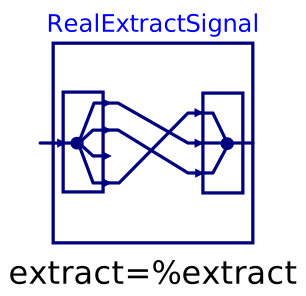
blockRealExtractSignal
Extract signals from a real input signal vector

Information
Extract signals from the vector-valued real input signal and transfer them to the vector-valued real output signal.
The extraction scheme is specified by the integer vector extract.
This vector specifies which input signals are taken and in which
order they are transferred to the output vector. Note that the
dimension of extract has to match the number of outputs and the elements
of extract has to be in the range of [1, nin].
Additionally, the dimensions of the input connector signals and
the output connector signals have to be explicitly defined via the
parameters nin and nout.
Example
The specification
     nin = 7 "Number of inputs";
     nout = 4 "Number of outputs";
     extract[nout] = {6,3,3,2} "Extracting vector";
extracts four output signals (nout=4)
from the seven elements of the
input vector (nin=7):
y[1, 2, 3, 4] = u[6, 3, 3, 2];
Parameters
| Type | Name | Default | Description |
|---|---|---|---|
| Integer | nin | 1 | Number of inputs |
| Integer | nout | 1 | Number of outputs |
| Integer[nout] | extract | 1:nout | Extracting vector |
Connectors
| Type | Name | Default | Description |
|---|---|---|---|
| Buildings.Controls.OBC.CDL.Interfaces.RealInput[nin] | u | Real input signals | |
| Buildings.Controls.OBC.CDL.Interfaces.RealOutput[nout] | y | Real signals extracted from the input vector with the extraction scheme specified by the integer vector |
Revisions
-
October 14, 2022, by Jianjun Hu:
Added assertion to check if there is any element in extracting vector is out of range. -
July 19, 2018, by Jianjun Hu:
Changed block name. -
July 24, 2017, by Jianjun Hu:
First implementation, based on the implementation of the Modelica Standard Library.