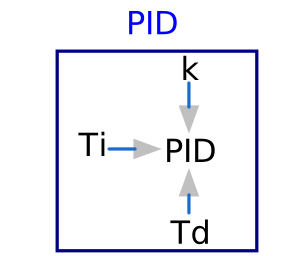
blockPID
Identify control gain, integral time, and derivative time of the PID model
Information
This block calculates the control gain, the integral time, and the derivative time of a PID model.
Refer to the following blocks for detailed information:
- Buildings.Controls.OBC.Utilities.PIDWithAutotuning.SystemIdentification.AutoTuner.AMIGO.BaseClasses.PIDGain
- Buildings.Controls.OBC.Utilities.PIDWithAutotuning.SystemIdentification.AutoTuner.AMIGO.BaseClasses.PIDIntegralTime
- Buildings.Controls.OBC.Utilities.PIDWithAutotuning.SystemIdentification.AutoTuner.AMIGO.BaseClasses.PIDDerivativeTime
Connectors
| Type | Name | Default | Description |
|---|---|---|---|
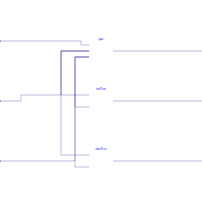
| Buildings.Controls.OBC.CDL.Interfaces.RealInput | kp | Gain of a first-order plus time-delay (FOPTD) model | |
| Buildings.Controls.OBC.CDL.Interfaces.RealInput | T | Time constant of the FOPTD model | |
| Buildings.Controls.OBC.CDL.Interfaces.RealInput | L | Time delay of the FOPTD model | |
| Buildings.Controls.OBC.CDL.Interfaces.RealOutput | k | Control gain signal | |
| Buildings.Controls.OBC.CDL.Interfaces.RealOutput | Ti | Time constant signal for the integral term | |
| Buildings.Controls.OBC.CDL.Interfaces.RealOutput | Td | Time constant signal for the derivative term |
Revisions
-
June 1, 2022, by Sen Huang:
First implementation.