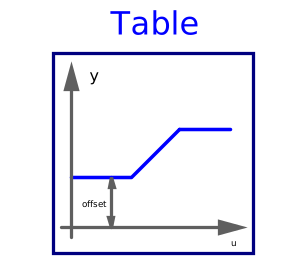
modelTable
Model for a set point that is interpolated based on a user-specified table
Extends from Modelica.Blocks.Interfaces.SISO (Single Input Single Output continuous control block).
Information
This block can be used to schedule a set-point by using piecewise linear functions. For example, the instances
Buildings.Controls.SetPoints.Table tabLinExt(constantExtrapolation=false,
                                             table=[20, 0.0;
                                                    22, 0.5;
                                                    25, 0.5;
                                                    26, 1.0]);
Buildings.Controls.SetPoints.Table tabConExt(constantExtrapolation=true,
                                             table=[20, 0.0;
                                                    22, 0.5;
                                                    25, 0.5;
                                                    26, 1.0]);
will cause the following output:
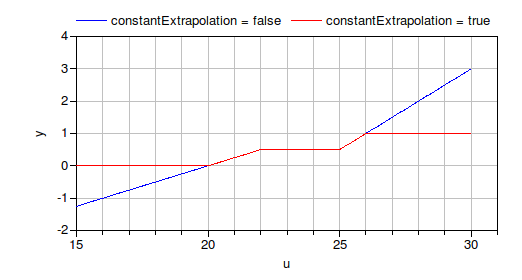
For the default setting constantExtrapolation=true, the
block outputs
y=y1+offset for u ≤ u1, and
y=yMax+offset for u ≥ uMax.
Otherwise, the table is linearly extrapolated with a constant derivative.
Note that the first column must be strictly increasing.
Parameters
| Type | Name | Default | Description |
|---|---|---|---|
| Real[:,2] | table | fill(0.0, 1, 2) | Table matrix ( e.g., table=[u1, y1; u2, y2; u3, y3]) |
| Real | offset | 0 | Offset of output signal |
| Boolean | constantExtrapolation | true | If true, then y=y1 for u<u1, and y=yMax for u>uMax |
Connectors
| Type | Name | Default | Description |
|---|---|---|---|
| RealInput | u (from SISO) | Connector of Real input signal | |
| RealOutput | y (from SISO) | Connector of Real output signal |
Revisions
-
April 29, 2026, by Michael Wetter:
Changed configuration of table to cause the parameters to be evaluated, as this leads to more efficient code.
This is for IBPSA, #2111. -
August 30, 2016, by Michael Wetter:
Changed protected final parameternColtonRow.
This is for issue 555. -
April 5, 2011, by Michael Wetter:
Fixed wrong table declaration. -
July 13, 2010, by Michael Wetter:
First implementation.