
modelLinearizedLoad
Extends from Modelica.Icons.Example (Icon for runnable examples).
Information
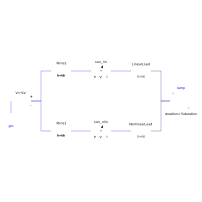
This example demonstrates the use of a linealized load model Buildings.Electrical.DC.Loads.Conductor.
Both loads are connected to the same DC voltage source through a resistive element that represents a line. The loads consume the same amount of power that is specified by the input ramp signal.
The nonlinear conductor model NonlinearLoad consumes exactly the amount of power specified by the input NonlinearLoad.Pow.
The linearized conductor model LinearizedLoad does not consumes the amount of power specified by the input LinearizedLoad.Pow. The voltage at the load deviates from the nominal value when the power consumption increases. Since the model is approximated in a neighbor of the nominal voltage, moving from that point introduces approximation errors. The plot below shows the error introduced with such an approximation.
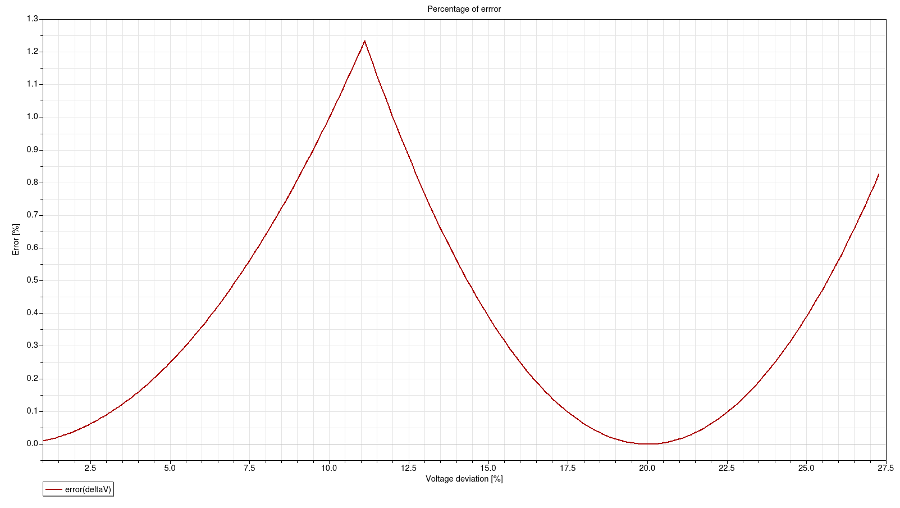
The linearized load is tested over a voltage variation of about 30 % of the nominal voltage and within this range the maximum error is 1.23457 % that occurs when the voltage deviation is 11.11 %.
Components
| Type | Name | Default | Description |
|---|---|---|---|
| Real | error | (sen_nlin.P - sen_lin.P)*100/sen_nlin.P | Percentage of error between the linearized and actual power consumption |
| Real | deltaV | LinearLoad.V_nominal - sen_lin.V | Voltage distance between nominal condition and actual voltage |
| Buildings.Electrical.DC.Loads.Conductor | NonlinearLoad | Nonlinear load model | |
| Sources.ConstantVoltage | sou | Voltage source | |
| Modelica.Electrical.Analog.Basic.Ground | gro | Ground | |
| Lines.TwoPortResistance | Rline1 | Line resistance | |
| Sensors.GeneralizedSensor | sen_nlin | Sensor | |
| Buildings.Electrical.DC.Loads.Conductor | LinearLoad | Linearized load model | |
| Sensors.GeneralizedSensor | sen_lin | Sensor | |
| Lines.TwoPortResistance | Rline2 | Line resistance | |
| Modelica.Blocks.Sources.Ramp | ramp | Power consumption |
Revisions
-
June 2, 2014, by Marco Bonvini:
Revised documentation. -
August 16, 2013, by Michael Wetter:
First implementation.