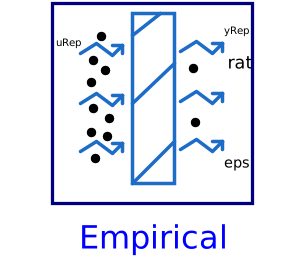
modelEmpirical
Extends from Buildings.Fluid.Interfaces.PartialTwoPort (Partial component with two ports).
Information
Component that empirically models the performance of air filters, focusing on key factors such as contamination and pressure drop, without requiring geometric data.
The model uses as parameters performance characteristics
that describe how the filter works under various conditions.
The performance of the air filter is characterized by a performance dataset per
(see
Buildings.Fluid.AirFilters.Data.Generic), which contains key parameters that
define the filter:
-
Contaminant Names: The array
per.namCondefines the type of contaminants that can be captured by the filter. -
Nominal Conditions: They include the nominal pressure drop
dp_nominaland the nominal mass flow ratem_flow_nominalof the clean filter. They also include the maximum total mass of contaminantsmCon_maxthat the filter can hold. -
Resistance Coefficient: The parameter
per.bdescribes how the pressure drop of the filter increases as the contaminants accumulate over time. See Buildings.Fluid.AirFilters.BaseClasses.FlowCoefficientCorrection for more information. -
Filtration Efficiency Curves: The array
per.filEffParcontains the filtration efficiency curves. Each curve defines the efficiencies for capturing each contaminant that is defined inper.namCon. See Buildings.Fluid.AirFilters.BaseClasses.FiltrationEfficiency for more information.
The input boolean flag, uRep, indicates that the filter has been replaced
and thus reset the mass accumulation to the initial status, i.e.,
when uRep changes from false to true, the
mass of the captured contaminants is reset to per.mCon_start.
Warnings will be written when,
-
the captured contaminant mass exceeds the
mCon_max, or -
the
extraPropertiesNamesin the medium model does not contain all the contaminants specified in theper.namCon.
References
Parameters
| Type | Name | Default | Description |
|---|---|---|---|
| Buildings.Fluid.AirFilters.Data.Generic | per | Performance dataset | |
| Assumptions | |||
| Boolean | allowFlowReversal (from PartialTwoPort) | true | = false to simplify equations, assuming, but not enforcing, no flow reversal |
Connectors
| Type | Name | Default | Description |
|---|---|---|---|
| Modelica.Fluid.Interfaces.FluidPort_a | port_a (from PartialTwoPort) | Fluid connector a (positive design flow direction is from port_a to port_b) | |
| Modelica.Fluid.Interfaces.FluidPort_b | port_b (from PartialTwoPort) | Fluid connector b (positive design flow direction is from port_a to port_b) | |
| Buildings.Controls.OBC.CDL.Interfaces.BooleanInput | uRep | True: replace the filter and reset the accumulation | |
| Buildings.Controls.OBC.CDL.Interfaces.BooleanOutput | yRep | True if the filter is full and should be replaced | |
| Buildings.Controls.OBC.CDL.Interfaces.RealOutput | rat | Relative mass of the contaminant captured by the filter, which is the total captured contaminant mass divided by the filter's maximum contaminant capacity | |
| Buildings.Controls.OBC.CDL.Interfaces.RealOutput[nConSub] | eps | Filtration efficiency |
Components
| Type | Name | Default | Description |
|---|---|---|---|
| Buildings.Fluid.AirFilters.BaseClasses.MassAccumulation | masAcc | Contaminant accumulation |
Revisions
-
December 22, 2023, by Sen Huang:
First implementation.