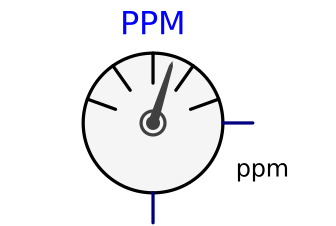
modelPPM

Extends from Buildings.Fluid.Sensors.BaseClasses.PartialAbsoluteSensor (Partial component to model a sensor that measures a potential variable), Modelica.Icons.RoundSensor (Icon representing a round measurement device).
Information
This model outputs the trace substance concentration in ppm contained in the fluid connected to its port. The sensor is ideal, i.e., it does not influence the fluid.
The parameter MM is the molar mass of the trace substance.
For a list of molar masses, see
Modelica.Media.IdealGases.Common.SingleGasesData
and
Modelica.Media.IdealGases.Common.FluidData.
To measure PPM in a duct or pipe, use Buildings.Fluid.Sensors.PPMTwoPort rather than this sensor. Read the Buildings.Fluid.Sensors.UsersGuide prior to using this model to see about potential numerical problems if this sensor is used incorrectly in a system model.
Assumptions
This sensor assumes that the concentration C of the medium is in mass fraction. Otherwise, the conversion to ppm will be wrong.
Parameters
| Type | Name | Default | Description |
|---|---|---|---|
| Boolean | warnAboutOnePortConnection (from PartialAbsoluteSensor) | true | Set to false to suppress warning about potential numerical issues, see Buildings.Fluid.Sensors.UsersGuide for more information |
| String | substanceName | "CO2" | Name of trace substance |
| Modelica.Units.SI.MolarMass | MM | Modelica.Media.IdealGases.Common.SingleGasesData.CO2.MM | Molar mass of the trace substance |
Connectors
| Type | Name | Default | Description |
|---|---|---|---|
| Modelica.Fluid.Interfaces.FluidPort_a | port (from PartialAbsoluteSensor) | ||
| Modelica.Blocks.Interfaces.RealOutput | ppm | Trace substance in port medium in ppm |
Revisions
-
September 21, 2020, by Michael Wetter:
Introduced parameterwarnAboutOnePortConnectionand updated documentation.
This is for #1399. -
February 25, 2020, by Michael Wetter:
Changed icon to display its operating state.
This is for #1294. -
December 16, 2015, by Michael Wetter:
Revised implementation, corrected error in the molar fraction which used the inverse ratio. -
December 2, 2015, by Filip Jorissen:
First implementation.