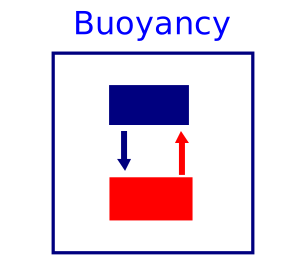
modelBuoyancy
Model to add buoyancy if there is a temperature inversion in the tank
Extends from Modelica.Blocks.Icons.Block (Basic graphical layout of input/output block).
Information
This model outputs a heat flow rate that can be added to fluid volumes
in order to emulate buoyancy during a temperature inversion.
For simplicity, this model does not compute a buoyancy induced mass flow rate,
but rather a heat flow that has the same magnitude as the enthalpy flow
associated with the buoyancy induced mass flow rate.
Contents
| Name | Description |
|---|
 Medium Medium | Medium model |
Revisions
-
June 7, 2018 by Filip Jorissen:
Copied model from Buildings and update the model accordingly.
This is for
#314.
-
December 14, 2012 by Michael Wetter:
Renamed protected parameters for consistency with naming convention.
-
October 8, 2011 by Michael Wetter:
Added noEvent(...) to
Q_flow[i] = k*smooth(1, if dT[i]>0 then dT[i]^2 else 0);
since the equation returns the same value to the left and right of
dT[i]>0.
-
September 16, 2011 by Michael Wetter:
Changed the implementation from Q_flow[i] = k*max(heatPort[i+1].T-heatPort[i].T, 0); to
Q_flow[i] = k*smooth(1, if dT[i]>0 then dT[i]^2 else 0);.
The previous implementation was not differentiable. In modeling a solar system, this
change reduced the computing time by a factor of 20 during the time when the pumps
were almost switched off and colder temperature was fed from the collector to the tank.
-
October 28, 2008 by Michael Wetter:
First implementation.