modelExterior

Extends from Buildings.HeatTransfer.Convection.BaseClasses.PartialConvection (Partial model for heat convection).
Information
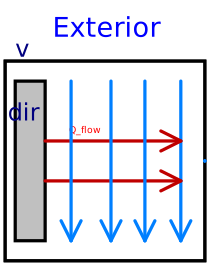
This is a model for a convective heat transfer for exterior, outside-facing surfaces.
The parameter conMod determines the model that is used to compute
the heat transfer coefficient:
If
conMod=

Buildings.HeatTransfer.Types.ExteriorConvection.Fixed
, then the convective heat transfer coefficient is set to the value specified by the parameterhFixed.-
If
conMod=

Buildings.HeatTransfer.Types.ExteriorConvection.TemperatureWind
, then the convective heat transfer coefficient is computed based on wind speed, wind direction and temperature difference.The total convection coefficient ht is the sum of the temperature-driven free convection coefficient hn and the wind-driven forced convection coefficient hf,
ht = hn + hf
The free convection coefficient hn is computed in the same way as in Buildings.HeatTransfer.Convection.Interior. The forced convection coefficient hf is computed based on a correlation by Sparrow, Ramsey, and Mass (1979), which ishf = 2.537 W R √( P v ⁄ A )
where W=1 for windward surfaces and W=0.5 for leeward surfaces, with leeward defined as greater than 100 degrees from normal incidence, R is a surface roughness multiplier, P is the perimeter of the surface and A is the area of the surface. This is the same equation as implemented in EnergyPlus 6.0.
We make the simplified assumption that the surface is square, and hence we set
hf = 2.537 W R √( 4 v ⁄ √(A) )
The surface roughness is specified by the parameter
surfaceRoughnesswhich has to be set to a type of Buildings.HeatTransfer.Types.SurfaceRoughness.The coefficients for the surface roughness areRoughness index R Example material VeryRough 2.17 Stucco Rough 1.67 Brick MediumRough 1.52 Concrete MediumSmooth 1.13 Clear pine Smooth 1.11 Smooth plaster VerySmooth 1.00 Glass
References
Sparrow, E. M., J. W. Ramsey, and E. A. Mass. 1979. Effect of Finite Width on Heat Transfer and Fluid Flow about an Inclined Rectangular Plate. Journal of Heat Transfer, Vol. 101, p. 204.
Walton, G. N. 1981. Passive Solar Extension of the Building Loads Analysis and System Thermodynamics (BLAST) Program, Technical Report, United States Army Construction Engineering Research Laboratory, Champaign, IL.
Parameters
| Type | Name | Default | Description |
|---|---|---|---|
| Modelica.Units.SI.Area | A (from PartialConvection) | Heat transfer area | |
| Buildings.HeatTransfer.Types.ExteriorConvection | conMod | Buildings.HeatTransfer.Types.ExteriorConvection.TemperatureWind | Convective heat transfer model |
| Modelica.Units.SI.CoefficientOfHeatTransfer | hFixed | 3 | Constant convection coefficient |
| Buildings.HeatTransfer.Types.SurfaceRoughness | roughness | Buildings.HeatTransfer.Types.SurfaceRoughness.Medium | Surface roughness |
| Modelica.Units.SI.Angle | azi | Surface azimuth | |
| Modelica.Units.SI.Angle | til | Surface tilt |
Connectors
| Type | Name | Default | Description |
|---|---|---|---|
| Modelica.Thermal.HeatTransfer.Interfaces.HeatPort_a | solid (from PartialConvection) | ||
| Modelica.Thermal.HeatTransfer.Interfaces.HeatPort_b | fluid (from PartialConvection) | ||
| Modelica.Blocks.Interfaces.RealInput | v | Wind speed | |
| Modelica.Blocks.Interfaces.RealInput | dir | Wind direction (0=wind from North) |
Components
| Type | Name | Default | Description |
|---|---|---|---|
| Modelica.Units.SI.HeatFlowRate | Q_flow (from PartialConvection) | Heat flow rate from solid -> fluid | |
| Modelica.Units.SI.HeatFlux | q_flow (from PartialConvection) | Convective heat flux from solid -> fluid | |
| Modelica.Units.SI.TemperatureDifference | dT (from PartialConvection) | = solid.T - fluid.T | |
| Modelica.Units.SI.CoefficientOfHeatTransfer | hF | Convective heat transfer coefficient due to forced convection | |
| Modelica.Units.SI.HeatFlux | qN_flow | Convective heat flux from solid -> fluid due to natural convection | |
| Modelica.Units.SI.HeatFlux | qF_flow | Convective heat flux from solid -> fluid due to forced convection |
Revisions
-
February 11, 2022, by Michael Wetter:
Change parameterisFloortois_floor, andisCeilingtois_ceiling, for consistency with naming convention. -
May 7, 2020, by Michael Wetter:
Set wind direction modifier to a constant as wind velocity approaches zero.
This is for #1923. -
September 17, 2016, by Michael Wetter:
Refactored model as part of enabling the pedantic model check in Dymola 2017 FD01 beta 2.
This is for issue 557. -
November 29, 2011, by Michael Wetter:
Fixed error in assignment of wind-based convection coefficient. The old implementation did not take into account the surface roughness. Bug fix is due to feedback from Tobias Klingbeil (Fraunhofer ISE). -
March 10 2010, by Michael Wetter:
First implementation.