blockLoadAverage
Compute the rolling average of the load on a system
Information
This block computes the load on a system based on the return temperature, active supply temperature setpoint and measured flow through the associated circuit flow meter, using the following equation.
- For cooling applications:
Q_flow = V_flow * rho_default * cp_default * (TSupSet - TRet) - For cooling applications:
Q_flow = V_flow * rho_default * cp_default * (TRet - TSupSet) -
For all applications:
Q_flowless than or equal to zero means that there is no actual load on the system.
The output load QReq_flow is the rolling average of Q_flow
over a period of dtMea.
Parameters
| Type | Name | Default | Description |
|---|---|---|---|
| Buildings.Templates.Plants.Controls.Types.Application | typ | Type of application | |
| Real | cp_default | Default specific heat capacity used to compute required capacity | |
| Real | rho_default | Default fluid density used to compute required capacity | |
| Real | dtMea | 300 | Duration used to compute the moving average of required capacity |
Connectors
| Type | Name | Default | Description |
|---|---|---|---|
| Buildings.Controls.OBC.CDL.Interfaces.RealInput | TRet | Return temperature | |
| Buildings.Controls.OBC.CDL.Interfaces.RealInput | TSupSet | Active supply temperature setpoint | |
| Buildings.Controls.OBC.CDL.Interfaces.RealInput | V_flow | Volume flow rate | |
| Buildings.Controls.OBC.CDL.Interfaces.RealOutput | QReq_flow | Load |
Components
| Type | Name | Default | Description |
|---|---|---|---|
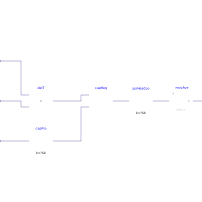
| Buildings.Controls.OBC.CDL.Reals.Subtract | delT | Compute ∆T | |
| Buildings.Controls.OBC.CDL.Reals.MultiplyByParameter | capFlo | Compute capacity flow rate | |
| Buildings.Controls.OBC.CDL.Reals.Multiply | capReq | Compute required capacity | |
| Buildings.Controls.OBC.CDL.Reals.MovingAverage | movAve | Compute moving average | |
| Buildings.Controls.OBC.CDL.Reals.MultiplyByParameter | polHeaCoo | Polarity depending on heating or cooling application |
Revisions
-
May 31, 2024, by Antoine Gautier:
First implementation.