
modelSoftMin
Gradual approach of a ceiling that cannot be exceeded
Extends from Interfaces.PartialConverters.SISO (Converter with single input and single output).
Information
The output y is obtained by applying a factor in the interval [0,1] to the maximum output u_max (the ceiling). It effectively calculates a smooth minimum with regard to the inputs u and u_max:

The following graph shows the results for u_max = 1.0 and k ∈ {10,5,3,2}:
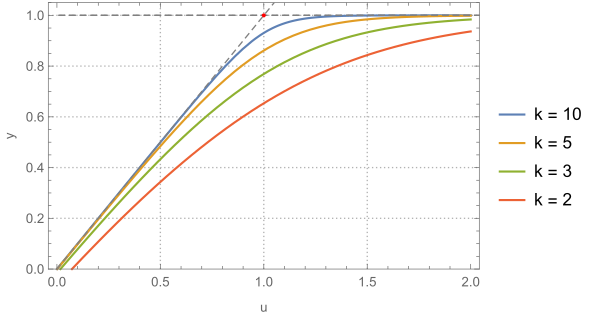 |
When the intended output u is a small fraction of the maximum output u_max (ceiling) the actual output y will be equal to the intended output. As u approaches the ceiling the limitations will have a gradual effect so that less than the intended output is returned. Eventually the output will be identical to the maximum value.
Notes
- The basic structure matches the one given by Jim Hines [6, pp. 95-97] in that the ratio
u : u_maxis used as input to the smooth minimum; John Sterman [3, pp. 711-713] uses the ratiou_max : uinstead. - The typical use case for this component is the determination of a production start rate given capacity restrictions. Since production will most often be treated as an aggregate process for many different variants of a basic product, the capacity restriction will likely be felt before the aggregate capacity limit is reached.
- The soft minimum is a special case of the generalized f-mean.
See also
Parameters
| Type | Name | Default | Description |
|---|---|---|---|
| Real | k | 4.7 | Parameter to control the closeness to a hard minimum |
| Structural Parameters | |||
| Boolean | useMinOperator | false | = true, if a regular 'hard' minimum is to be used |
| Boolean | clipNegativeOutput | true | = true, if output can never be less than zero |
| Advanced | |||
| Boolean | strict | true | = true, if strict limits with noEvent(..) (clippedOutput.strict) |
Connectors
| Type | Name | Default | Description |
|---|---|---|---|
| Connectors.RealInput | u (from SISO) | Input | |
| Interfaces.Connectors.RealInput | u_max | The ceiling |
Components
| Type | Name | Default | Description |
|---|---|---|---|
| RealOutput | y (from SO) |
Revisions
- Introduced in v2.0.0.