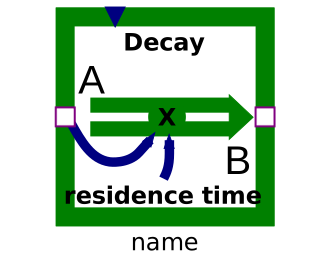
 .BusinessSimulation.Flows.Unidirectional.Decay .BusinessSimulation.Flows.Unidirectional.Decay
This information is part of the Business Simulation Library (BSL). Please support this work and ► donate.
The stock connected to port A (stockA) will be gradually drained
at a rate determined by the average time of residence
(residenceTime) in the stock. The rate which
drains the stock (draining) is given by:
draining = stockA.y / residenceTime
The residence time is clipped to never be smaller than the
global parameter dt.
The process of decay is essentially exponential decline, since the outflow is a fraction of the stock. The rate of decay thus also exponentially declines towards zero if there is no inflow to the stock, that is connected to port A.
If there is no inflow to the stock the level of the stock will be less than α x InitialLevel (0 < α <1) after a time span of - ln(α) × residenceTime.
So we can note the following multiples for the
residenceTime to calculate the time it takes to drain
the stock A to α [%] of its initial level:
| α [%] | Time to drain as multiple
of the residenceTime |
| 50 |
0.69 ⋅ |
| 1/e ≈ 37 |
1.0 ⋅ |
| 10 |
2.3 ⋅ |
| 5 |
3.0 ⋅ |
| 1 |
4.6 ⋅ |
| 0.1 = 1 ‰ |
6.9 ⋅ |
The time span it takes to drain the stock by half is called its
half life. As can be seen from the equation and table
above it is about ln(2)
⋅ residenceTime ≈ 69% of the (average)
residence time.
ProportionalTransition, ExponentialDecay
unspecified in
v2.1.0.