blockEffectOfFatigue
Extends from Icons.SubsystemBlock (Icon for subsystems with flow ports).
Information
This information is part of the Business Simulation Library (BSL). Please support this work and ► donate.
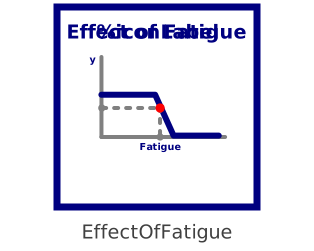
Fatigue is modeled as a smooth of the normalized input u which is indicating the current workload with regard to capital equipment or workers. The current workload will be normalized by dividing the input u by a constant or a variable reference workload (referenceWorkload or u_ref, respectively). The timeToGetFatigued describes the time constant for the smooth and indicates the lag between beginning to work at an excessive level and the onset of the full effect on productivity (or quality).
Janoscheks growth curve is used to model the nonlinear effect of a prolonged work intensity. It describes a negatively sloping s-shaped curve that will pass through the reference point (1,1). The upper bound of the effect (effectMax) must be given slightly above 1.0 as the curve will collapse in all other cases. If the effect is to be clipped at 1.0 then the parameter clipEffect should be set to true.
Notes
- The workload (and its reference value) will typically be some rate (e.g.,
hours worked per month,output per houretc.). - Jim Hines [6, p. 82] uses overtime as the main driver of fatigue. See also on his Molecules of Structure website (→Effect of Fatigue).
- The parameter
initin the Advanced tab allows to select →InitializationOptions:
- FixedValue (default) will use the parameter
initialFatigueto determine the initial output of the smoothed, normalized workload. - SteadyState will set the initialFatigue to the normalized workload at the start of the simulation.
- Free there will be no initial equation and thus the solver is free to find an initial value for
fatigueusinginitialFatigueas an initial guess.
- FixedValue (default) will use the parameter
See also
Parameters
| Type | Name | Default | Description |
|---|---|---|---|
| String | iconLabel (from SubsystemBlock) | "" | |
| Time | timeToGetFatigued | Time constant for the exponential smooth of overtime in periods | |
| Rate | referenceWorkload | 1 | Constant reference workload (optinal) |
| Real | effectMax | 1.1 | The upper bound for the effect of less work than normal on PDY (MAX >= 1) |
| Real | effectMin | 0 | The lower bound for the effect of fatigue on PDY (MIN >= 0) |
| Real | steepness | 10 | High values indicate a steep gradient for the lookup curve (JanoschoekNegative.growthRate) |
| Real | initialFatigue | 1 | Initial Output (fatigue.initialValue) |
| Structural Parameters | |||
| Integer | delayOrder | 1 | Delay order of the smooth for workload |
| Boolean | hasConstantReference | true | = true, if the reference workload is given by a constant parameter |
| Boolean | clipEffect | false | = true, if the maximum effect is to be 1.0 |
| Advanced | |||
| InitializationOptions | init | modelSettings.init | Provide InitializationOptions (Free, FixedValue, SteadyState) |
| Boolean | strict | true | = true, if strict limits with noEvent(..) (clippedEffect.strict) |
Connectors
| Type | Name | Default | Description |
|---|---|---|---|
| Interfaces.Connectors.RealInput | u | Input of workload | |
| Interfaces.Connectors.RealInput | u_ref | Input for the reference workload (optional) | |
| Interfaces.Connectors.RealOutput | y | Effect on Productivity given as a multiplier |
Components
| Type | Name | Default | Description |
|---|---|---|---|
| ModelSettings | modelSettings |