blockTrend
Extends from Interfaces.PartialConverters.InformationProcessing_SO (Information Processing Block).
Information
This information is part of the Business Simulation Library (BSL). Please support this work and ► donate.
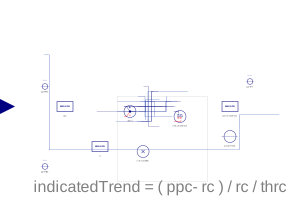
The Trend component represents forecasting in behavioral models and has been proposed by Sterman [3, pp. 634 - 638]. The basic idea is rather intuitive: Forecasters perceive a present condition of some input as a smoothed input (ppc), while they also perceive the historic or reference condition (rc) as a smooth of their current perception.
Dividing the diffence between the current condition and the reference condition by the reference condition will determine the fractional increase. A further division by the time horizon for the reference condition will then turn this into a fractional rate. The thus calculated rate of change (i.e., the indicated trend) may then again be smoothed, if smoothTrend = true.
See also
Parameters
| Type | Name | Default | Description |
|---|---|---|---|
| Rate | initialTrend | 0 | Initial trend |
| Time | tppc | 1 | Averaging time for perception of current quantity (i.e., the present condition) |
| Time | thrc | 1 | Time horizon for reference condition |
| Time | tpt | 1 | Time to perceive the trend (i.e., there is gradual adaptation to a new trend) |
| Structural Parameters | |||
| Boolean | smoothTrend | false | = true, if the calculated trend is to be smoothed |
| Boolean | reportPPC | false | = true, if the perceived present conditon is to be reported |
| Advanced | |||
| InitializationOptions | init | modelSettings.init | Provide InitializationOptions (Free, FixedValue, SteadyState) |
Connectors
| Type | Name | Default | Description |
|---|---|---|---|
| Interfaces.Connectors.RealInput | u | Current value as basis for trend formulation | |
| Interfaces.Connectors.RealOutput | y_ppc | Report the perceived present condition (optional) |
Components
| Type | Name | Default | Description |
|---|---|---|---|
| RealOutput | y (from InformationProcessing_SO) | Information output signal | |
| ModelSettings | modelSettings |