modelSteamGenerator_L1
A steam generation and reaheater model using characteristic lines and transfer functions
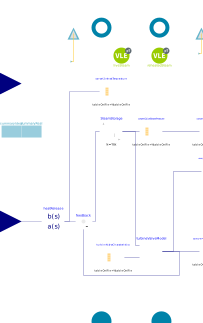
Extends from ClaRa.SubSystems.Boiler.CoalSupplyBoiler_base (The coal mills and the boiler), ClaRa.Basics.Icons.ComplexityLevel (Displays the complexity level inside model icon ).
Information
This steam generator model is based on transfer functions and characteristic lines. The aim of this model is to provide reasonable boundary conditions for other parts of the water steam cycle depending on the currend load. Be careful when combining this model with controllers and other physically motivated models as the model may behave in a unrealistic manner when used in off-design statesd!
Usage advices:
- The default parameter set do not refer to any real plant
- The inlet pressures (feedwater and cold reheat) are calculated due to the given relative heating power given. Any effects of disturbances in the equlibrium of heating and cooling are neglected. The model provides an ideal feedwater pressure condition (independent from the expansion or the preheating path)
- The inlet pressures (feedwater and cold reheat) take pressure losses using a caracteristic line into account. Any effects of local changing phsical states are neglected
- The live steam temperature is ideally controlled at a variable temperature. This temperature is used to calculate the live steam specific enthalpy
- The hot reheat temperature is ideally following the design profile. This temperature is used to calculate the hot reheat specific enthalpy
- At the lifesteam outlet adn the hot reheat outlet either an ideal pressure boundary condition or an ideal mass flow boundary is provided, not both at the same time. This means for instance that a boiler defining an ideal live steam pressure (as defined in the corresponding characteristic line for part load definition) the mass flow depends on the flow model (e.g. a turbine mode) following the boiler. This mass flow rate may differ from the design mass flow rate. However, there is no feedback of the surrounding models to the ideal beahaviour of the boiler.
- Be careful with turbine valve throttling the steam storage and mass flow through the valve will not be modelled in a correct way! The turbine valve opeing is included for the sake of completeness (see VDI cuideline 3508).