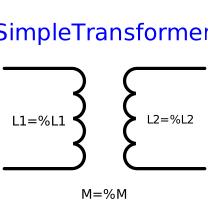
modelSimpleTransformer
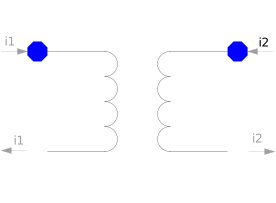
Extends from ComplexLib.SinglePhase.Interfaces.TwoPort (Component having four ComplexPins p1, p2, n1, n2 (two ports) and using current phasor balance).
Information
The SimpleTransformer is a two-port component consisting of two ideal inductors (having no resistance).
Between these inductors, there exists a non-ideal coupling.
The left port voltage phasor v1, the left port current phasor i1,
the right port voltage phasor
      v1 = jω*(L1*i1+ M*i2),
      v2 = jω*( M*i1+L2*i2),
where M²<L1*L2 is assumed.
The parameters L1 and L2 denote the primary and secondary self inductances, respectively,
while M is called mutual (or coupling) inductance.
All inductances have constant values.
Fraunhofer IIS/EAS, Dresden
email: olaf.enge@eas.iis.fraunhofer.de
Parameters
| Type | Name | Default | Description |
|---|---|---|---|
| SI.AngularFrequency | omega | Constants.omega | AngularFrequency of the complete AC circuit |
| SI.Inductance | L1 | 1 | Self inductance of first winding (main inductance plus stray inductance) |
| SI.Inductance | M | 0.99 | Mutual inductance |
| SI.Inductance | L2 | 1 | Self inductance of second winding (main inductance plus stray inductance) |
Connectors
| Type | Name | Default | Description |
|---|---|---|---|
| PosComplexPin | p1 (from TwoPort) | Positive complex pin no.1 | |
| PosComplexPin | p2 (from TwoPort) | Positive complex pin no.2 | |
| NegComplexPin | n1 (from TwoPort) | Negative complex pin no.1 | |
| NegComplexPin | n2 (from TwoPort) | Negative complex pin no.2 | |
| Modelica.Blocks.Interfaces.RealOutput | activePwr1 (from TwoPort) | Active power of port no.1 | |
| Modelica.Blocks.Interfaces.RealOutput | reactivePwr1 (from TwoPort) | Reactive power of port no.1 | |
| Modelica.Blocks.Interfaces.RealOutput | activePwr2 (from TwoPort) | Active power of port no.2 | |
| Modelica.Blocks.Interfaces.RealOutput | reactivePwr2 (from TwoPort) | Reactive power of port no.2 | |
| ComplexLib.Interfaces.ComplexOutput | complexPwr1 (from TwoPort) | Complex value of power of port no.1 | |
| ComplexLib.Interfaces.ComplexOutput | complexPwr2 (from TwoPort) | Complex value of power of port no.2 |
Components
| Type | Name | Default | Description |
|---|---|---|---|
| SI.Voltage | v1 (from TwoPort) | Voltage phasor of port no.1 | |
| SI.Voltage | v1Re (from TwoPort) | Active part of voltage phasor of port no.1 | |
| SI.Voltage | v1Im (from TwoPort) | Reactive part of voltage phasor of port no.1 | |
| SI.Voltage | v2 (from TwoPort) | Voltage phasor of port no.2 | |
| SI.Voltage | v2Re (from TwoPort) | Active part of voltage phasor of port no.2 | |
| SI.Voltage | v2Im (from TwoPort) | Reactive part of voltage phasor of port no.2 | |
| SI.Current | i1 (from TwoPort) | Current phasor of port no.1 | |
| SI.Current | i1Re (from TwoPort) | Active part of current phasor of port no.1 | |
| SI.Current | i1Im (from TwoPort) | Reactive part of current phasor of port no.1 | |
| SI.Current | i2 (from TwoPort) | Current phasor of port no.2 | |
| SI.Current | i2Re (from TwoPort) | Active part of current phasor of port no.2 | |
| SI.Current | i2Im (from TwoPort) | Reactive part of current phasor of port no.2 | |
| SI.Angle | phi1 (from TwoPort) | Angle between voltage and current phasors of port no.1 | |
| SI.Angle | phi_v1 (from TwoPort) | Angle of voltage phasor of port no.1 | |
| SI.Angle | phi_i1 (from TwoPort) | Angle of current phasor of port no.1 | |
| SI.Angle | phi2 (from TwoPort) | Angle between voltage and current phasors of port no.2 | |
| SI.Angle | phi_v2 (from TwoPort) | Angle of voltage phasor of port no.2 | |
| SI.Angle | phi_i2 (from TwoPort) | Angle of current phasor of port no.2 |