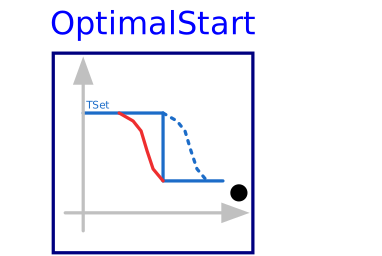
blockOptimalStart
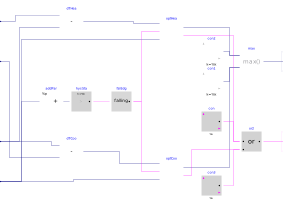
Information
This block predicts the shortest time for an HVAC system to meet the occupied setpoint
prior to the scheduled occupancy. The block requires inputs of zone temperature,
occupied zone setpoint(s) and next occupancy. The two outputs are the optimal start
duration tOpt and the optimal start on signal optOn for
the HVAC system.
The block estimates the thermal mass of a zone using its measured air temperature gradient with respect to time. Once the temperature slope of a zone is known, the optimal start time can be calculated by the difference between the zone temperature and the occupied setpoint divided by the temperature slope, assuming the zone responds as if all thermal mass were concentrated in the room air.
The temperature slope is self-tuned based on past data. The moving
average of the temperature slope of the past nDay days
is calculated and used for
the prediction of the optimal start time in the current day.
Parameters
The parameter nDay is used to compute the moving average of the temperature
slope; the first n days of simulation is therefore used to
initialize the block.
The parameter
tOptMax is the maximum allowed optimal start time.
The block includes two hysteresis parameters uLow and uHigh.
The parameter
uLow is used to determine if the zone temperature reaches
the setpoint. The algorithm assumes that the zone temperature has reached the setpoint if
TSetZonHea-TZon ≤ uLow for a heating system, or
TZon-TSetZonCoo ≤ uLow for a cooling system, where
TSetZonHea
denotes the zone heating setpoint during occupancy, TSetZonCoo
denotes the zone cooling setpoint during occupancy, and TZon denotes the
zone temperature.
The parameter
uHigh is used by the algorithm to determine if there is a need to
start the HVAC system prior to occupancy. If
TSetZonHea-TZon ≤ uHigh for heating case or
TZon-TSetZonCoo ≤ uHigh for cooling case,
then there is no need for the system to start before the occupancy.
The optimal start is only active (i.e., the optimal start on signal optOn
becomes true) if the optimal start time is larger than the parameter
thrOptOn.
Configuration for HVAC systems
The block can be used for heating system only or cooling system only or for both
heating and cooling system.
The two parameters computeHeating and computeCooling are
used to configure the block for these three scenarios.
The block calculates the optimal start time separately for heating and cooling systems. The base class IDEAS.Controls.OBC.Utilities.BaseClasses.OptimalStartCalculation is used for the calculation.
Algorithm
The algorithm is as follows:
Step 1: Calculate temperature slope TSlo
Once the HVAC system is started, a timer records the time duration
Δt for the zone temperature to reach the
setpoint. At the time when the timer starts, the zone temperature TSam1 is sampled.
The temperature slope is
approximated using the equation TSlo = |TSetZonOcc-TSam1|/Δt,
where TSetZonOcc is the occupied zone setpoint. Note that if
Δt is greater than the maximum optimal start time tOptMax,
then tOptMax is used instead of Δt.
This is to avoid corner cases where the setpoint is never reached, e.g., the HVAC
system is undersized, or there is a steady-state error associated with the HVAC control.
Step 2: Calculate temperature slope moving average TSloMa
After computing the temperature slope of each day, the moving average of the
temperature slope TSloMa during the previous nDay days
is calculated. Please refer to
IDEAS.Controls.OBC.CDL.Discrete.TriggeredMovingMean for details about
the moving average algorithm.
Step 3: Calculate optimal start time tOpt
Each day at a certain time before the occupancy, the algorithm takes another
sample of the zone temperature, denoted as TSam2. The sample
takes place tOptMax prior to occupancy start time.
The optimal start time is then calculated as tOpt = |TSetZonOcc-TSam2|/TSloMa.
Validation
Validation models can be found in the package IDEAS.Controls.OBC.Utilities.Validation.
Parameters
| Type | Name | Default | Description |
|---|---|---|---|
| Real | tOptMax | 10800 | Maximum optimal start time |
| Integer | nDay | 3 | Number of previous days used to compute the optimal start up time |
| Boolean | computeHeating | false | Set to true to compute optimal start for heating |
| Boolean | computeCooling | false | Set to true to compute optimal start for cooling |
| Real | uLow | 0 | Threshold to determine if the zone temperature reaches the occupied setpoint, must be a non-negative number |
| Real | uHigh | 0.5 | Threshold to determine the need to start the HVAC system before occupancy, must be greater than uLow |
| Real | thrOptOn | 60 | Threshold time, optimal start on signal becomes true when tOpt larger than thrOptOn |
Connectors
| Type | Name | Default | Description |
|---|---|---|---|
| IDEAS.Controls.OBC.CDL.Interfaces.RealInput | TSetZonHea | Zone heating setpoint temperature during occupancy | |
| IDEAS.Controls.OBC.CDL.Interfaces.RealInput | TZon | Zone temperature | |
| IDEAS.Controls.OBC.CDL.Interfaces.RealInput | TSetZonCoo | Zone cooling setpoint temperature during occupancy | |
| IDEAS.Controls.OBC.CDL.Interfaces.RealInput | tNexOcc | Time until next occupancy | |
| IDEAS.Controls.OBC.CDL.Interfaces.RealOutput | tOpt | Optimal start time duration of HVAC system | |
| IDEAS.Controls.OBC.CDL.Interfaces.BooleanOutput | optOn | Outputs true if the HVAC system remains in the optimal start period |
Components
| Type | Name | Default | Description |
|---|---|---|---|
| IDEAS.Controls.OBC.Utilities.BaseClasses.OptimalStartCalculation | optHea | Optimal start time for heating system | |
| IDEAS.Controls.OBC.Utilities.BaseClasses.OptimalStartCalculation | optCoo | Optimal start time for cooling system | |
| IDEAS.Controls.OBC.CDL.Reals.GreaterThreshold | hysSta | Hysteresis to activate the optimal start boolean output |
Revisions
-
January 30, 2021, by Michael Wetter:
Refactored sampling of history of temperature slope to only sample when control error requires optimal start up. Refactored guarding against division by zero.
This is for Buildings, issue 2345. -
August 6, 2020, by Michael Wetter:
Replaced hysteresis with new inequality block. -
December 15, 2019, by Kun Zhang:
First implementation. This is for Buildings, issue #1589.