modelPartialDynamicHeaterWithLosses
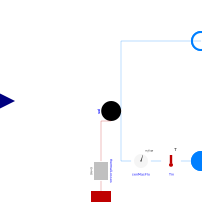
Extends from IDEAS.Fluid.Interfaces.TwoPortFlowResistanceParameters (Parameters for flow resistance for models with two ports), IDEAS.Fluid.Interfaces.LumpedVolumeDeclarations (Declarations for lumped volumes).
Information
Description
This is a partial model from which most heaters (boilers, heat pumps) will extend. This model is dynamic (there is a water content in the heater and a dry mass lumped to it) and it has thermal losses to the environment. To complete this model and turn it into a heater, a heatSource has to be added, specifying how much heat is injected in the heatedFluid pipe, at which efficiency, if there is a maximum power, etc. HeatSource models are grouped in IDEAS.Thermal.Components.Production.BaseClasses.
The set temperature of the model is passed as a realInput.The model has a realOutput PEl for the electricity consumption.
See the extensions of this model for more details.
Assumptions and limitations
- the temperature of the dry mass is identical as the outlet temperature of the heater
- no pressure drop
Model use
Depending on the extended model, different parameters will have to be set. Common to all these extensions are the following:
- the environmental heat losses are specified by a time constant. Based on the water content, dry capacity and this time constant, the UA value of the heat transfer to the environment will be set
- set the heaterType (useful in post-processing)
- connect the set temperature to the TSet realInput connector
- connect the flowPorts (flowPort_b is the outlet)
- if heat losses to environment are to be considered, connect heatPort to the environment. If this port is not connected, the dry capacity and water content will still make this a dynamic model, but without heat losses to environment,. IN that case, the time constant is not used.
Validation
This partial model is based on physical principles and is not validated. Extensions may be validated.
Examples
See the extensions, like the IdealHeater, the Boiler or air-water heat pump
Parameters
| Type | Name | Default | Description |
|---|---|---|---|
| Modelica.Units.SI.Power | QNom | Nominal power | |
| Modelica.Units.SI.Time | tauHeatLoss | 7200 | Time constant of environmental heat losses |
| Modelica.Units.SI.Mass | mWater | 5 | Mass of water in the condensor |
| Modelica.Units.SI.HeatCapacity | cDry | 4800 | Capacity of dry material lumped to condensor |
| Modelica.Units.SI.MassFlowRate | m_flow_nominal | Nominal mass flow rate | |
| Modelica.Units.SI.ThermalConductance | UALoss | mWater*vol.mSenFac/tauHeatLoss | Thermal conductance, computed based on time constant and thermal mass |
| Flow resistance | |||
| Boolean | computeFlowResistance (from TwoPortFlowResistanceParameters) | true | =true, compute flow resistance. Set to false to assume no friction |
| Boolean | from_dp (from TwoPortFlowResistanceParameters) | false | = true, use m_flow = f(dp) else dp = f(m_flow) |
| Boolean | linearizeFlowResistance (from TwoPortFlowResistanceParameters) | false | = true, use linear relation between m_flow and dp for any flow rate |
| Real | deltaM (from TwoPortFlowResistanceParameters) | 0.1 | Fraction of nominal flow rate where flow transitions to laminar |
| Boolean | dynamicBalance | true | Set to true to use a dynamic balance, which often leads to smaller systems of equations |
| Boolean | homotopyInitialization | true | = true, use homotopy method |
| Boolean | allowFlowReversal | true | = false to simplify equations, assuming, but not enforcing, no flow reversal. Used only if model has two ports. |
| Nominal condition | |||
| Modelica.Units.SI.PressureDifference | dp_nominal (from TwoPortFlowResistanceParameters) | Pressure difference | |
| Dynamics › Conservation equations | |||
| Modelica.Fluid.Types.Dynamics | energyDynamics (from LumpedVolumeDeclarations) | Modelica.Fluid.Types.Dynamics.DynamicFreeInitial | Type of energy balance: dynamic (3 initialization options) or steady state |
| Modelica.Fluid.Types.Dynamics | substanceDynamics (from LumpedVolumeDeclarations) | energyDynamics | Type of independent mass fraction balance: dynamic (3 initialization options) or steady state |
| Modelica.Fluid.Types.Dynamics | traceDynamics (from LumpedVolumeDeclarations) | energyDynamics | Type of trace substance balance: dynamic (3 initialization options) or steady state |
| Advanced › Dynamics | |||
| Modelica.Fluid.Types.Dynamics | massDynamics (from LumpedVolumeDeclarations) | energyDynamics | Type of mass balance: dynamic (3 initialization options) or steady state, must be steady state if energyDynamics is steady state |
| Initialization | |||
| Medium.AbsolutePressure | p_start (from LumpedVolumeDeclarations) | Medium.p_default | Start value of pressure |
| Medium.Temperature | T_start (from LumpedVolumeDeclarations) | Medium.T_default | Start value of temperature |
| Medium.MassFraction[Medium.nX] | X_start (from LumpedVolumeDeclarations) | Medium.X_default | Start value of mass fractions m_i/m |
| Medium.ExtraProperty[Medium.nC] | C_start (from LumpedVolumeDeclarations) | fill(0, Medium.nC) | Start value of trace substances |
| Medium.ExtraProperty[Medium.nC] | C_nominal (from LumpedVolumeDeclarations) | fill(1E-2, Medium.nC) | Nominal value of trace substances. (Set to typical order of magnitude.) |
| Dynamics | |||
| Real | mSenFac (from LumpedVolumeDeclarations) | 1 | Factor for scaling the sensible thermal mass of the volume |
Connectors
| Type | Name | Default | Description |
|---|---|---|---|
| Modelica.Blocks.Interfaces.RealInput | TSet | Temperature setpoint | |
| Modelica.Blocks.Interfaces.RealOutput | PEl | Electrical consumption | |
| Modelica.Thermal.HeatTransfer.Interfaces.HeatPort_a | heatPort | heatPort for thermal losses to environment | |
| Modelica.Fluid.Interfaces.FluidPort_a | port_a | Fluid inlet | |
| Modelica.Fluid.Interfaces.FluidPort_b | port_b | Fluid outlet |