
packageUsersGuide
Extends from Modelica.Icons.Information (Icon for general information packages).
Information
This package contains a model for photovoltaic–thermal (PVT) collectors based on the ISO 9806:2013 quasi-dynamic thermal procedure coupled with an internal electrical submodel.
Model description
Thermal part
The equations related to the heat losses and heat gains can be found in the following models:
- Quasi‑dynamic thermal losses: see IDEAS.Fluid.PVTCollectors.BaseClasses.ISO9806QuasiDynamicHeatLoss
- Solar (thermal) heat gain: see IDEAS.Fluid.SolarCollectors.BaseClasses.EN12975SolarGain
Thermal parameters used in the Quasi-dynamic thermal losses model follow the ISO 9806:2013 quasi-dynamic thermal procedure.
Parameters obtained from other ISO 9806 test procedures, such as the ISO 9806:2013 unglazed test or the ISO 9806:2017 quasi-dynamic method,
can be converted into the thermal parameter set required by this model (c1 to c6, η0, and Kd)
using the procedure detailed in
SKN-N0474R0: Thermal Performance Parameter Conversion to ISO 9806-2017.
Electrical part
The equations and assumptions related to electrical part can be found in the following model:
- Electrical generation: see IDEAS.Fluid.PVTCollectors.BaseClasses.ElectricalPVT
Electrical–thermal coupling
The internal heat transfer coefficient UAbsFluid (visualised in Figure 1) is approximately calculated from datasheet parameters:
| (τ·α)eff – η0,el · (c1 + c3·u + b1,el) |
| (τ·α)eff – η0,el – (1 – c6/η0,th·u) · η0,th |
- Here, (τ·α)eff = 0.901 for unglazed PVT collectors as reported in Lämmle (2018), and 0.84 for covered collectors.
- The electrical temperature‑dependence term is b1,el = |γ| · Gnom, where γ is the temperature coefficient of power (in % K−1) and Gnom = 1000 W m−2.
- u is the in-plane wind speed. In this approximation, u = 0 is used to derive UAbsFluid. The internal heat transfer coefficient is only weakly dependent on external wind speed when the datasheet thermal parameters are accurate (Stegmann 2011).
This approach removes the need for a hidden fit parameter: both thermal and electrical coupling coefficients derive solely from publicly available datasheet values.
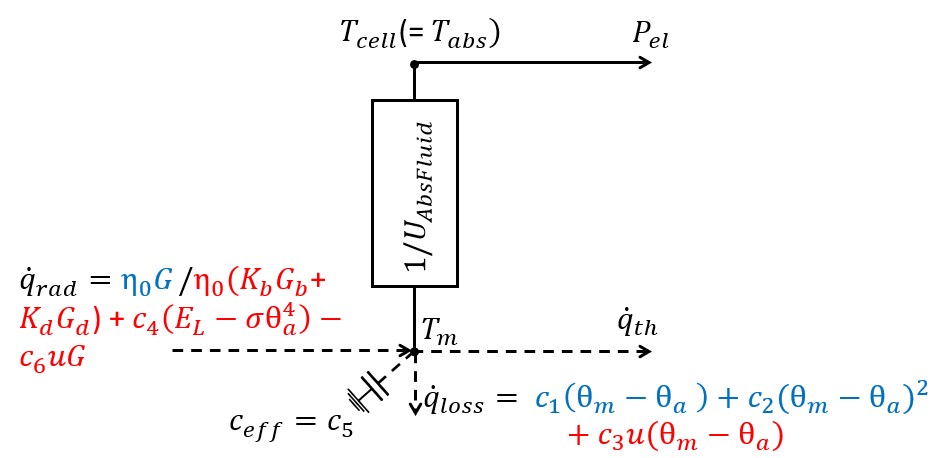
Figure 1: Two-node, one-capacitance thermal network for PVT collectors (ISO 9806: dashed lines; extension: solid lines) (Meertens et al., 2025).
References
- ISO 9806:2013. Solar thermal collectors — Test methods. ISO.
- SKN-N0474R0. Thermal Performance Parameter Conversion to ISO 9806-2017. Solar Heat Europe, 2019.
- Stegmann, M.; Bertram, E.; Rockendorf, G.; Janßen, S. (2011). Model of an Unglazed Photovoltaic Thermal Collector Based on Standard Test Procedures. ISES Solar World Congress proceedings. DOI: 10.18086/swc.2011.19.30
- Lämmle, M. (2018). Thermal management of PVT collectors: development and modelling of highly efficient glazed, flat plate PVT collectors with low emissivity coatings and overheating protection. PhD thesis, University of Freiburg. DOI: 10.6094/UNIFR/16446
- Dobos, A. P. (2014). PVWatts Version 5 Manual. NREL/TP-6A20-62641
- Meertens, L.; Jansen, J.; Helsen, L. (2025). Development and Experimental Validation of an Unglazed Photovoltaic-Thermal Collector Modelica Model that only needs Datasheet Parameters. Submitted to the 16th International Modelica & FMI Conference, Lucerne, Switzerland, Sep 8–10, 2025.