modelLoadCell

Information
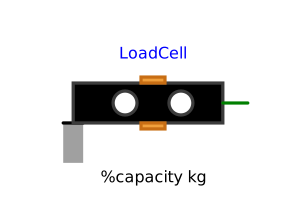
Load cell body of a force sensor (load cell): the metal part that deforms under the load, and to which the strain gauges of the bridge (WheatstoneBridge) are bonded. Quasi-static model: no mass nor damping, the strain follows the force instantly. This is legitimate as long as the load changes slowly compared with the natural frequency of the sensor (several tens of hertz for a kitchen scale).
The force comes in through the mechanical flange flange, typically from a standard source Modelica.Mechanics.Translational.Sources.Force (the weight: mass × g_n). The load cell body behaves like a spring of stiffness FNom/sNom resting on a fixed point, and outputs the strain eps = epsNom · F/FNom to the bridge.
Order of magnitude of the default parameters: 5 kg sensor, 500 µm/m at full load, i.e. a sensitivity of 1 mV/V once the full bridge is wired (gauge factor 2), which is typical of kitchen scale sensors. Beyond 150 % of the capacity, the icon turns red (overload): a real load cell body would be permanently deformed.
Parameters
| Type | Name | Default | Description |
|---|---|---|---|
| SI.Mass | capacity | 5 | Capacity: mass producing the nominal strain |
| SI.Force | FNom | capacity*Modelica.Constants.g_n | Nominal force (weight of the capacity) |
| Real | epsNom | 500e-6 | Strain seen by the gauges under the nominal force (500 µm/m, i.e. 1 mV/V at the bridge output with a gauge factor of 2) |
| SI.Length | sNom | 0.2e-3 | Deflection of the load cell body under the nominal force |
Connectors
| Type | Name | Default | Description |
|---|---|---|---|
| Modelica.Mechanics.Translational.Interfaces.Flange_a | flange | Point where the load is applied (pan): a positive force deforms the load cell body | |
| Modelica.Blocks.Interfaces.RealOutput | eps | Strain under the gauges, to the Wheatstone bridge |
Components
| Type | Name | Default | Description |
|---|---|---|---|
| SI.Force | F | Applied force | |
| SI.Length | s | Deflection | |
| Boolean | overload | F > 1.5*FNom | Overload: beyond 150 % of the capacity, a real load cell body would be permanently deformed |