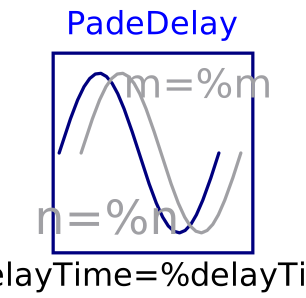
blockPadeDelay

Extends from Modelica.Blocks.Interfaces.SISO (Single Input Single Output continuous control block).
Information
The Input signal is delayed by a given time instant, or more precisely:
y = u(time - delayTime) for time > time.start + delayTime
  = u(time.start)       for time ≤ time.start + delayTime
The delay is approximated by a Pade approximation, i.e., by a transfer function
        b[1]*s^m + b[2]*s^[m-1] + ... + b[m+1]
y(s) = --------------------------------------------- * u(s)
        a[1]*s^n + a[2]*s^[n-1] + ... + a[n+1]
where the coefficients b[:] and a[:] are calculated such that the coefficients of the Taylor expansion of the delay exp(-T*s) around s=0 are identical up to order n+m.
The main advantage of this approach is that the delay is approximated by a linear differential equation system, which is continuous and continuously differentiable. For example, it is uncritical to linearize a system containing a Pade-approximated delay.
The standard text book version uses order "m=n", which is also the default setting of this block. The setting "m=n-1" may yield a better approximation in certain cases.
It is strongly recommended to always set parameter balance = true, in order to arrive at a much better reliable numerical computation. This is not the default, in order to be backwards compatible, so you have to explicitly set it. Besides better numerics, also all states are initialized with balance = true (in steady-state, so der(x)=0). Longer explanation:
By default the transfer function of the Pade approximation is implemented in controller canonical form. This results in coefficients of the A-matrix in the order of 1 up to the order of O(1/delayTime)^n. For already modest values of delayTime and n, this gives largely varying coefficients (for example delayTime=0.001 and n=4 results in coefficients between 1 and 1e12). In turn, this results in a large norm of the system matrix [A,B;C,D] and therefore in unreliable numerical computations. When setting parameter balance = true, a state transformation is performed that considerably reduces the norm of the system matrix. This is performed without introducing round-off errors. For details see function balanceABC. As a result, both the simulation of the PadeDelay block, and especially its linearization becomes more reliable.
Literature
Otto Foellinger: Regelungstechnik, 8. Auflage, chapter 11.9, page 412-414, Huethig Verlag Heidelberg, 1994
Parameters
| Type | Name | Default | Description |
|---|---|---|---|
| SI.Time | delayTime | Delay time of output with respect to input signal | |
| Integer | n | 1 | Order of Pade delay |
| Integer | m | n | Order of numerator (usually m=n, or m=n-1) |
| Boolean | balance | false | = true, if state space system is balanced (highly recommended), otherwise textbook version |
Connectors
| Type | Name | Default | Description |
|---|---|---|---|
| RealInput | u (from SISO) | Connector of Real input signal | |
| RealOutput | y (from SISO) | Connector of Real output signal |
Components
| Type | Name | Default | Description |
|---|---|---|---|
| Real[n] | x | State of transfer function from controller canonical form (balance=false), or balanced controller canonical form (balance=true) |
Contents
| Name | Description |
|---|---|
 padeCoefficients2protected padeCoefficients2protected |
Revisions
| Date | Author | Comment |
|---|---|---|
| 2015-01-05 | Martin Otter (DLR-SR) | Introduced parameter balance=true and a new implementation of the PadeDelay block with an optional, more reliable numerics |