modelVariableConductor
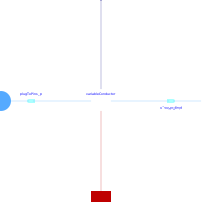
Extends from Interfaces.TwoPlug (Two plugs with pin-adapter, reference connection and declaration of voltage and current), Modelica.Electrical.Polyphase.Interfaces.ConditionalHeatPort (Partial model to include conditional HeatPorts in order to describe the power loss via a thermal network).
Information
The linear resistors connect the complex currents i with the complex
voltages v by v*G = i,
using m single-phase variable Conductors.
The conductances G are given as m input signals.
The conductor model also has m optional
conditional heat ports.
A linear temperature dependency of the conductances is also taken into account.
See also
VariableConductor, Resistor, Conductor, Capacitor, Inductor, Impedance, Admittance, Variable resistor, Variable capacitor, Variable inductor Variable impedance, Variable admittance
Parameters
| Type | Name | Default | Description |
|---|---|---|---|
| Integer | m (from TwoPlugElementary) | 3 | Number of phases |
| SI.Temperature[m] | T_ref | fill(293.15, m) | Reference temperatures |
| SI.LinearTemperatureCoefficient[m] | alpha_ref | zeros(m) | Temperature coefficient of resistance (G_actual = G_ref/(1 + alpha_ref*(heatPort.T - T_ref))) |
| Integer | mh (from ConditionalHeatPort) | 3 | Number of heatPorts=number of phases |
| Boolean | useHeatPort (from ConditionalHeatPort) | false | = true, if all heat ports are enabled |
| SI.Temperature[mh] | T (from ConditionalHeatPort) | fill(293.15, mh) | Fixed device temperatures if useHeatPort = false |
Connectors
| Type | Name | Default | Description |
|---|---|---|---|
| PositivePlug | plug_p (from TwoPlugElementary) | Positive quasi-static polyphase plug | |
| NegativePlug | plug_n (from TwoPlugElementary) | Negative quasi-static polyphase plug | |
| Modelica.Thermal.HeatTransfer.Interfaces.HeatPort_a[mh] | heatPort (from ConditionalHeatPort) | Conditional heat ports | |
| Modelica.Blocks.Interfaces.RealInput[m] | G_ref | Variable conductance |
Components
| Type | Name | Default | Description |
|---|---|---|---|
| SI.AngularVelocity | omega (from TwoPlugElementary) | Angular velocity of reference frame | |
| Basic.PlugToPins_p | plugToPins_p (from TwoPlugElementary) | ||
| Basic.PlugToPins_n | plugToPins_n (from TwoPlugElementary) | ||
| SI.ComplexVoltage[m] | v (from TwoPlug) | Complex voltage | |
| SI.Voltage[m] | abs_v (from TwoPlug) | Modelica.ComplexMath.abs(v) | Magnitude of complex voltage |
| SI.Angle[m] | arg_v (from TwoPlug) | Modelica.ComplexMath.arg(v) | Argument of complex voltage |
| SI.ComplexCurrent[m] | i (from TwoPlug) | Complex current | |
| SI.Current[m] | abs_i (from TwoPlug) | Modelica.ComplexMath.abs(i) | Magnitude of complex current |
| SI.Angle[m] | arg_i (from TwoPlug) | Modelica.ComplexMath.arg(i) | Argument of complex current |
| SI.ActivePower[m] | P (from TwoPlug) | {Modelica.ComplexMath.real(v[k]*Modelica.ComplexMath.conj(i[k])) for k in 1:m} | Active power |
| SI.ActivePower | P_total (from TwoPlug) | sum(P) | Total active power |
| SI.ReactivePower[m] | Q (from TwoPlug) | {Modelica.ComplexMath.imag(v[k]*Modelica.ComplexMath.conj(i[k])) for k in 1:m} | Reactive power |
| SI.ReactivePower | Q_total (from TwoPlug) | sum(Q) | Total reactive power |
| SI.ApparentPower[m] | S (from TwoPlug) | {Modelica.ComplexMath.abs(v[k]*Modelica.ComplexMath.conj(i[k])) for k in 1:m} | Magnitude of complex apparent power |
| SI.ApparentPower | S_total (from TwoPlug) | sqrt(P_total^2 + Q_total^2) | Magnitude of total complex apparent power |
| Real[m] | pf (from TwoPlug) | {cos(Modelica.ComplexMath.arg(Complex(P[k], Q[k]))) for k in 1:m} | Power factor |
| QuasiStatic.SinglePhase.Basic.VariableConductor[m] | variableConductor |