
classkc_laminar
Extends from Modelica.Icons.Information (Icon for general information packages).
Information
Calculation of the mean convective heat transfer coefficient kc for a laminar fluid flow over an even surface.
Functions kc_laminar and kc_laminar_KC
There are basically three differences:
- The function kc_laminar is using kc_laminar_KC but offers additional output variables like e.g. Reynolds number or Nusselt number and failure status (an output of 1 means that the function is not valid for the inputs).
- Generally the function kc_laminar_KC is numerically best used for the calculation of the mean convective heat transfer coefficient kc at known mass flow rate.
- You can perform an inverse calculation from kc_laminar_KC, where an unknown mass flow rate is calculated out of a given mean convective heat transfer coefficient kc
Restriction
- laminar regime (Reynolds number ≤ 1e5)
- Prandtl number 0.6 ≤ Pr ≤ 2000
Geometry
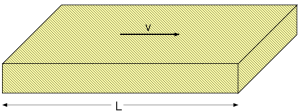
Calculation
The mean convective heat transfer coefficient kc for flat plate is calculated through the corresponding Nusselt number Nu_lam according to [VDI 2002, p. Gd 1, eq. 1] :
Nu_lam = 0.664 * Re^(0.5) * (Pr)^(1/3)
and the corresponding mean convective heat transfer coefficient kc:
kc = Nu_lam * lambda / L
with
| cp | as specific heat capacity at constant pressure [J/(kg.K)], |
| eta | as dynamic viscosity of fluid [Pa.s], |
| kc | as mean convective heat transfer coefficient [W/(m2.K)], |
| lambda | as heat conductivity of fluid [W/(m.K)], |
| L | as length of plate [m], |
| Nu_lam | as mean Nusselt number for laminar regime [-], |
| Pr = eta*cp/lambda | as Prandtl number [-], |
| rho | as fluid density [kg/m3], |
| Re = rho*v*L/eta | as Reynolds number [-]. |
Verification
The mean Nusselt number Nu in the laminar regime representing the mean convective heat transfer coefficient kc for Prandtl numbers of different fluids is shown in the figure below.
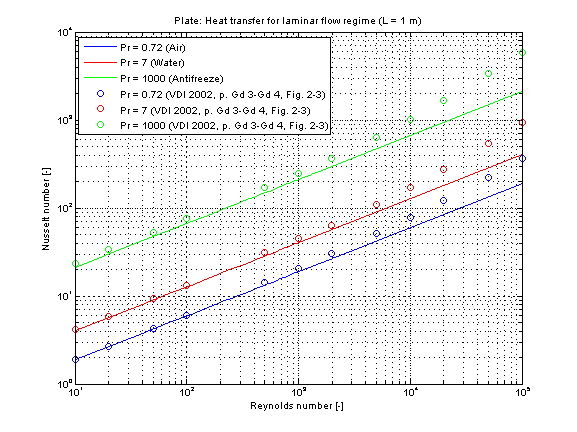
Note that this function is best used in the laminar regime up to a Reynolds number Re smaller than 2300. There is a deviation w.r.t. literature due to the neglect of the turbulence influence in the transition regime even though this function is used inside its cited restrictions for a higher Reynolds number. The function kc_overall is recommended for the simulation of a Reynolds number higher than 2300.
References
- VDI:
- VDI - Wärmeatlas: Berechnungsblätter für den Wärmeübergang. Springer Verlag, 9th edition, 2002.