modelRotorSaliencyAirGap

Information
This salient air gap model can be used for machines with uniform air gaps and for machines with rotor saliency. The air gap model is not symmetrical towards stator and rotor since it is assumed the saliency always refers to the rotor. The saliency of the air gap is represented by a main field inductance in the d- and q-axis.
For the mechanical interaction of the air gap model with the stator and the rotor is equipped with two
rotational connectors. The torques acting on both connectors have the same absolute values but different signs. The difference between the stator and the rotor angle,
 , is required for the transformation of the magnetic stator quantities to the rotor side.
The air gap model has two magnetic stator and two magnetic rotor ports. The magnetic potential difference and the magnetic flux of the stator (superscript s) are transformed to the rotor fixed reference frame (superscript r). The effective reluctances of the main field with respect to the d- and q-axis are considered then in the balance equations
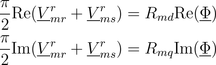
according to the following figure.
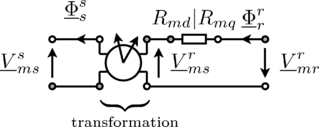
|
See also
SinglePhaseWinding, SymmetricPolyphaseWinding, SymmetricPolyphaseCageWinding SaliencyCageWinding
Parameters
| Type | Name | Default | Description |
|---|---|---|---|
| Integer | p | Number of pole pairs | |
| Magnetic.FundamentalWave.Types.SalientInductance | L0 | Salient inductance of a single unchorded coil w.r.t. the fundamental wave | |
| Magnetic.FundamentalWave.Types.SalientReluctance | R_m | Reluctance of the air gap model |
Connectors
| Type | Name | Default | Description |
|---|---|---|---|
| Interfaces.PositiveMagneticPort | port_sp | Positive complex magnetic stator port | |
| Interfaces.NegativeMagneticPort | port_sn | Negative complex magnetic stator port | |
| Interfaces.PositiveMagneticPort | port_rp | Positive complex magnetic rotor port | |
| Interfaces.NegativeMagneticPort | port_rn | Negative complex magnetic rotor port | |
| Modelica.Mechanics.Rotational.Interfaces.Flange_a | flange_a | Flange of the rotor | |
| Modelica.Mechanics.Rotational.Interfaces.Flange_a | support | Support at which the reaction torque is acting |
Components
| Type | Name | Default | Description |
|---|---|---|---|
| SI.ComplexMagneticPotentialDifference | V_mss | Complex magnetic potential difference of stator w.r.t. stator fixed frame | |
| SI.ComplexMagneticPotentialDifference | V_msr | Complex magnetic potential difference of stator w.r.t. rotor fixed frame | |
| SI.ComplexMagneticPotentialDifference | V_mrr | Complex magnetic potential difference of rotor w.r.t. rotor fixed frame | |
| SI.ComplexMagneticFlux | Phi_ss | Complex magnetic flux of stator w.r.t. stator fixed frame | |
| SI.ComplexMagneticFlux | Phi_sr | Complex magnetic flux of stator w.r.t. rotor fixed frame | |
| SI.ComplexMagneticFlux | Phi_rr | Complex magnetic flux of rotor w.r.t. rotor fixed frame | |
| SI.Torque | tauElectrical | Electrical torque | |
| SI.Angle | gamma | Electrical angle between rotor and stator | |
| Complex | rotator | Equivalent vector representation of orientation |