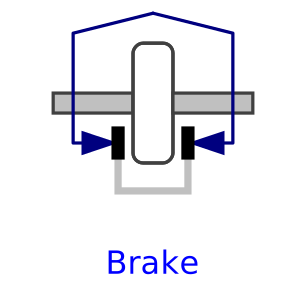
modelBrake

Extends from Modelica.Mechanics.Rotational.Interfaces.PartialElementaryTwoFlangesAndSupport2 (Partial model for a component with two rotational 1-dim. shaft flanges and a support used for textual modeling, i.e., for elementary models), Rotational.Interfaces.PartialFriction (Partial model of Coulomb friction elements), Modelica.Thermal.HeatTransfer.Interfaces.PartialElementaryConditionalHeatPortWithoutT (Partial model to include a conditional HeatPort in order to dissipate losses, used for textual modeling, i.e., for elementary models).
Information
This component models a brake, i.e., a component where a frictional torque is acting between the housing and a flange and a controlled normal force presses the flange to the housing in order to increase friction. The normal force fn has to be provided as input signal f_normalized in a normalized form (0 ≤ f_normalized ≤ 1), fn = fn_max*f_normalized, where fn_max has to be provided as parameter. Friction in the brake is modelled in the following way:
When the absolute angular velocity "w" is not zero, the friction torque is a function of the velocity dependent friction coefficient mu(w), of the normal force "fn", and of a geometry constant "cgeo" which takes into account the geometry of the device and the assumptions on the friction distributions:
frictional_torque = cgeo * mu(w) * fn
Typical values of coefficients of friction mu:
- 0.2 … 0.4 for dry operation,
- 0.05 … 0.1 when operating in oil.
When plates are pressed together, where ri is the inner radius, ro is the outer radius and N is the number of friction interfaces, the geometry constant is calculated in the following way under the assumption of a uniform rate of wear at the interfaces:
cgeo = N*(r0 + ri)/2
The positive part of the friction characteristic mu(w), w >= 0, is defined via table mu_pos (first column = w, second column = mu).
When the absolute angular velocity becomes zero, the elements connected by the friction element become stuck, i.e., the absolute angle remains constant. In this phase the friction torque is calculated from a torque balance due to the requirement, that the absolute acceleration shall be zero. The elements begin to slide when the friction torque exceeds a threshold value, called the maximum static friction torque, computed via:
frictional_torque = peak * cgeo * mu(w=0) * fn (peak >= 1)
This procedure is implemented in a "clean" way by state events and leads to continuous/discrete systems of equations if friction elements are dynamically coupled. The method is described in (see also a short sketch in UsersGuide.ModelingOfFriction):
- Otter M., Elmqvist H., and Mattsson S.E. (1999):
- Hybrid Modeling in Modelica based on the Synchronous Data Flow Principle. CACSD'99, Aug. 22.-26, Hawaii.
More precise friction models take into account the elasticity of the material when the two elements are "stuck", as well as other effects, like hysteresis. This has the advantage that the friction element can be completely described by a differential equation without events. The drawback is that the system becomes stiff (about 10-20 times slower simulation) and that more material constants have to be supplied which requires more sophisticated identification. For more details, see the following references, especially (Armstrong and Canudas de Wit 1996):
- Armstrong B. (1991):
- Control of Machines with Friction. Kluwer Academic
Press, Boston MA.
- Armstrong B., and Canudas de Wit C. (1996):
- Friction Modeling and Compensation.
The Control Handbook, edited by W.S.Levine, CRC Press,
pp. 1369-1382.
- Canudas de Wit C., Olsson H., Åström K.J., and Lischinsky P. (1995):
- A new model for control of systems with friction. IEEE Transactions on Automatic Control, Vol. 40, No. 3, pp. 419-425.
See also the discussion State Selection in the User's Guide of the Rotational library.
Parameters
| Type | Name | Default | Description |
|---|---|---|---|
| Boolean | useSupport (from PartialElementaryTwoFlangesAndSupport2) | false | = true, if support flange enabled, otherwise implicitly grounded |
| Real[:,2] | mu_pos | [0, 0.5] | Positive sliding friction coefficient [-] as function of w [rad/s] (w>=0) |
| Smoothness | smoothness | Smoothness.LinearSegments | Smoothness of table interpolation in mu_pos |
| Real | peak | 1 | Peak for maximum value of mu at w==0 (mu0_max = peak*mu_pos[1,2]) |
| Real | cgeo | 1 | Geometry constant containing friction distribution assumption |
| SI.Force | fn_max | Maximum normal force | |
| Integer | Unknown (from PartialFriction) | 3 | Value of mode is not known |
| Integer | Free (from PartialFriction) | 2 | Element is not active |
| Integer | Forward (from PartialFriction) | 1 | w_relfric > 0 (forward sliding) |
| Integer | Stuck (from PartialFriction) | 0 | w_relfric = 0 (forward sliding, locked or backward sliding) |
| Integer | Backward (from PartialFriction) | -1 | w_relfric < 0 (backward sliding) |
| Boolean | useHeatPort (from PartialElementaryConditionalHeatPortWithoutT) | false | = true, if heatPort is enabled |
| Advanced | |||
| SI.AngularVelocity | w_small (from PartialFriction) | 1.0e10 | Relative angular velocity near to zero if jumps due to a reinit(..) of the velocity can occur (set to low value only if such impulses can occur) |
Connectors
| Type | Name | Default | Description |
|---|---|---|---|
| Flange_a | flange_a (from PartialElementaryTwoFlangesAndSupport2) | Flange of left shaft | |
| Flange_b | flange_b (from PartialElementaryTwoFlangesAndSupport2) | Flange of right shaft | |
| Support | support (from PartialElementaryTwoFlangesAndSupport2) | Support/housing of component | |
| HeatTransfer.Interfaces.HeatPort_a | heatPort (from PartialElementaryConditionalHeatPortWithoutT) | Optional port to which dissipated losses are transported in form of heat | |
| Modelica.Blocks.Interfaces.RealInput | f_normalized | Normalized force signal 0..1 (normal force = fn_max*f_normalized; brake is active if > 0) |
Components
| Type | Name | Default | Description |
|---|---|---|---|
| SI.AngularVelocity | w_relfric (from PartialFriction) | Relative angular velocity between frictional surfaces | |
| SI.AngularAcceleration | a_relfric (from PartialFriction) | Relative angular acceleration between frictional surfaces | |
| SI.Torque | tau0 (from PartialFriction) | Friction torque for w_relfric=0 and forward sliding | |
| SI.Torque | tau0_max (from PartialFriction) | Maximum friction torque for w_relfric=0 and locked | |
| Boolean | free (from PartialFriction) | = true, if frictional element is not active | |
| Real | sa (from PartialFriction) | Path parameter of friction characteristic tau = f(a_relfric) | |
| Boolean | startForward (from PartialFriction) | = true, if w_relfric=0 and start of forward sliding | |
| Boolean | startBackward (from PartialFriction) | = true, if w_relfric=0 and start of backward sliding | |
| Boolean | locked (from PartialFriction) | = true, if w_rel=0 and not sliding | |
| Integer | mode (from PartialFriction) | Mode of friction (-1: backward sliding, 0: stuck, 1: forward sliding, 2: inactive, 3: unknown) | |
| SI.Power | lossPower (from PartialElementaryConditionalHeatPortWithoutT) | Loss power leaving component via heatPort (> 0, if heat is flowing out of component) | |
| SI.Angle | phi | Angle between shaft flanges (flange_a, flange_b) and support | |
| SI.Torque | tau | Brake friction torque | |
| SI.AngularVelocity | w | Absolute angular velocity of flange_a and flange_b | |
| SI.AngularAcceleration | a | Absolute angular acceleration of flange_a and flange_b | |
| Real | mu | Friction coefficient | |
| SI.Force | fn | Normal force (=fn_max*f_normalized) |