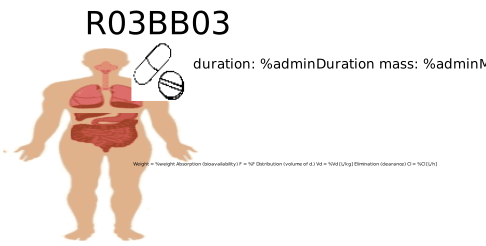
modelR03BB03
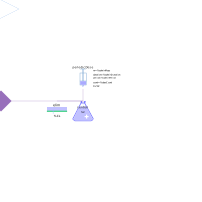
Extends from Pharmacokinetic.Models.PK_1C.
Information
| name: | StramoniPreparations | |
| ATC code: | R03BB03 | route: | inhalation |
| compartments: | 1 | |
| dosage: | 2 | mg |
| volume of distribution: | 2.6 | L |
| clearance: | 1.0 | L/h/kg |
| other parameters in model implementation | ||
Stramoni preparations are derived from the plant Datura stramonium, containing tropane alkaloids such as atropine, hyoscyamine, and scopolamine. Historically, they were used as bronchodilators in the treatment of asthma and other respiratory disorders, primarily in the form of inhaled powders or cigarettes. Due to significant toxicity and safer alternatives, such preparations are no longer in common or approved therapeutic use.
Pharmacokinetics
No clinical pharmacokinetic studies or precise population data for stramoni preparations as a mixture exist; parameter estimates are extrapolated from known pharmacokinetics of the major tropane alkaloid component (atropine) in healthy adult subjects following inhaled administration.
References
Zandvliet, AS, et al., & Beijnen, JH (2005). Population pharmacokinetics of caffeine and its metabolites theobromine, paraxanthine and theophylline after inhalation in combination with diacetylmorphine. Basic & clinical pharmacology & toxicology 96(1) 71–79. DOI:10.1111/j.1742-7843.2005.pto960111.x PUBMED:https://pubmed.ncbi.nlm.nih.gov/15667599
Corcoran, TE (2009). Aerosol drug delivery in lung transplant recipients. Expert opinion on drug delivery 6(2) 139–148. DOI:10.1517/17425250802685332 PUBMED:https://pubmed.ncbi.nlm.nih.gov/19239386
Walenga, RL, et al., & Roy, P (2024). Use of the Same Model or Modeling Strategy Across Multiple Submissions: Focus on Complex Drug Products. The AAPS journal 26(1) 12–None. DOI:10.1208/s12248-023-00879-2 PUBMED:https://pubmed.ncbi.nlm.nih.gov/38177638
Parameters
| Type | Name | Default | Description |
|---|---|---|---|
| Modelica.Units.SI.Mass | weight (from PK_1C) | 75 | patient weight (kg) |
| Modelica.Units.SI.SpecificVolume | VdPerKg (from PK_1C) | 0.9 | Volume of distribution (L/kg) |
| Modelica.Units.SI.MassFraction | F (from PK_1C) | 0.8 | bioavailiability (0-1) |
| Pharmacolibrary.Types.Clearance | Cl (from PK_1C) | 20 | clearance |
| Modelica.Units.SI.Time | adminTime (from PK_1C) | 60 | first administration time (s) |
| Modelica.Units.SI.Time | adminDuration (from PK_1C) | 600 | administration duration (s) |
| Modelica.Units.SI.Time | adminPeriod (from PK_1C) | 8*60*60 | period of administration (default 8 hours)(s) |
| Pharmacolibrary.Types.Mass | adminMass (from PK_1C) | 1000 | administration mass (mg) |
| Integer | adminCount (from PK_1C) | 8 | number of dose administered (1) |
| Pharmacolibrary.Types.Volume | Vd (from PK_1C) | VdPerKg*weight | Volume of distribution (m3) |
| Pharmacolibrary.Types.MassConcentration | Cmin (from PK_1C) | 0.004 | minimal therapeutic range |
| Pharmacolibrary.Types.MassConcentration | Cmax (from PK_1C) | 0.008 | minimal therapeutic range |
| Pharmacolibrary.Types.MassConcentration | Ctox_peak (from PK_1C) | 0.012 | toxicity peak level |
| Pharmacolibrary.Types.MassConcentration | Ctox_trough (from PK_1C) | 0.006 | toxicity trough level |
Connectors
| Type | Name | Default | Description |
|---|---|---|---|
| Types.ConcentrationOutput | C_central (from PK_1C) | ||
| Interfaces.ConcentrationPort_b | centralCPort (from PK_1C) |
Components
| Type | Name | Default | Description |
|---|---|---|---|
| Pharmacokinetic.NoPerfusedTissueCompartment | central (from PK_1C) | ||
| Pharmacokinetic.ClearanceDrivenElimination | elim (from PK_1C) | ||
| Sources.PeriodicDose | periodicDose (from PK_1C) | ||
| Modelica.Units.SI.Time | t1_2 (from PK_1C) | elimination half-life |
Revisions
- 06/2025 Tomas Kulhanek, generated model from data extracted from PUBMED, DrugBank and LLM(GPT4.1)