modelTrifluridineCombinations
Extends from Pharmacolibrary.Drugs.ATC.L.L01BC59.
Information
| name: | TrifluridineCombinations | |
| ATC code: | L01BC59 | route: | oral |
| compartments: | 1 | |
| dosage: | 35 | mg |
| volume of distribution: | 21.9 | L |
| clearance: | 10.5 | L/h |
| other parameters in model implementation | ||
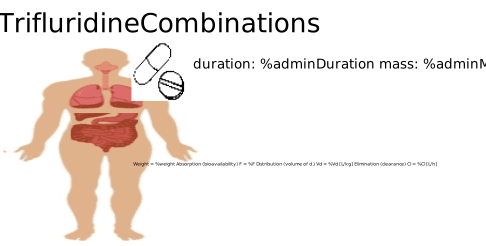
Trifluridine in combination (notably with tipiracil as L01BC59) is an antineoplastic agent used in the treatment of metastatic colorectal cancer. Trifluridine is a nucleoside analog which inhibits thymidylate synthase and gets incorporated into DNA, resulting in cytotoxicity. The combination with tipiracil inhibits trifluridine degradation, increasing its bioavailability. This combination has received regulatory approval for use in patients who have been previously treated with standard chemotherapeutic regimens.
Pharmacokinetics
Pharmacokinetic parameters reported for adult cancer patients (including both sexes, median age approximately 63, not kidney/liver impaired), under multiple-dose conditions at therapeutic doses.
References
Becerra, CR, et al., & Von Hoff, D (2017). A Phase 1, Open-Label, Randomized, Crossover Study Evaluating the Bioavailability of TAS-102 (Trifluridine/Tipiracil) Tablets Relative to an Oral Solution Containing Equivalent Amounts of Trifluridine and Tipiracil. Journal of clinical pharmacology 57(6) 751–759. DOI:10.1002/jcph.856 PUBMED:https://pubmed.ncbi.nlm.nih.gov/28070894
Yoshino, T, et al., & Ohtsu, A (2016). Effect of food on the pharmacokinetics of TAS-102 and its efficacy and safety in patients with advanced solid tumors. Cancer science 107(5) 659–665. DOI:10.1111/cas.12912 PUBMED:https://pubmed.ncbi.nlm.nih.gov/26918279
Overman, MJ, et al., & Abbruzzese, JL (2008). Phase 1 study of TAS-102 administered once daily on a 5-day-per-week schedule in patients with solid tumors. Investigational new drugs 26(5) 445–454. DOI:10.1007/s10637-008-9142-3 PUBMED:https://pubmed.ncbi.nlm.nih.gov/18528634
Parameters
| Type | Name | Default | Description |
|---|---|---|---|
| Modelica.Units.SI.Mass | weight (from PK_1C) | 75 | patient weight (kg) |
| Modelica.Units.SI.SpecificVolume | VdPerKg (from PK_1C) | 0.9 | Volume of distribution (L/kg) |
| Modelica.Units.SI.MassFraction | F (from PK_1C) | 0.8 | bioavailiability (0-1) |
| Pharmacolibrary.Types.Clearance | Cl (from PK_1C) | 20 | clearance |
| Modelica.Units.SI.Time | adminTime (from PK_1C) | 60 | first administration time (s) |
| Modelica.Units.SI.Time | adminDuration (from PK_1C) | 600 | administration duration (s) |
| Modelica.Units.SI.Time | adminPeriod (from PK_1C) | 8*60*60 | period of administration (default 8 hours)(s) |
| Pharmacolibrary.Types.Mass | adminMass (from PK_1C) | 1000 | administration mass (mg) |
| Integer | adminCount (from PK_1C) | 8 | number of dose administered (1) |
| Pharmacolibrary.Types.Volume | Vd (from PK_1C) | VdPerKg*weight | Volume of distribution (m3) |
| Pharmacolibrary.Types.MassConcentration | Cmin (from PK_1C) | 0.004 | minimal therapeutic range |
| Pharmacolibrary.Types.MassConcentration | Cmax (from PK_1C) | 0.008 | minimal therapeutic range |
| Pharmacolibrary.Types.MassConcentration | Ctox_peak (from PK_1C) | 0.012 | toxicity peak level |
| Pharmacolibrary.Types.MassConcentration | Ctox_trough (from PK_1C) | 0.006 | toxicity trough level |
| Pharmacolibrary.Types.TransferRate | ka (from PK_1C_enteral) | 0.016666666666666666 | first order absorption rate |
| Modelica.Units.SI.Time | Tlag (from PK_1C_enteral) | 600 | delay between oral administration and absorption (default 10min) |
Connectors
| Type | Name | Default | Description |
|---|---|---|---|
| Types.ConcentrationOutput | C_central (from PK_1C) | ||
| Interfaces.ConcentrationPort_b | centralCPort (from PK_1C) |
Components
| Type | Name | Default | Description |
|---|---|---|---|
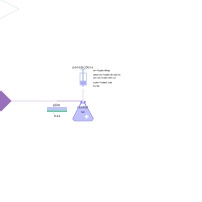
| Pharmacokinetic.NoPerfusedTissueCompartment | central (from PK_1C) | ||
| Pharmacokinetic.ClearanceDrivenElimination | elim (from PK_1C) | ||
| Sources.PeriodicDose | periodicDose (from PK_1C) | ||
| Modelica.Units.SI.Time | t1_2 (from PK_1C) | elimination half-life |
Revisions
- 06/2025 Tomas Kulhanek, generated model from data extracted from PUBMED, DrugBank and LLM(GPT4.1)