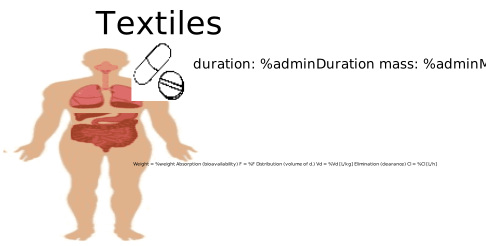
modelTextiles
Extends from Pharmacolibrary.Drugs.ATC.V.V01AA09.
Information
| name: | Textiles | |
| ATC code: | V01AA09 | route: |
| compartments: | 0 | |
| dosage: | 1 | mg |
| volume of distribution: | 1 | L |
| clearance: | 0 | |
| other parameters in model implementation | ||
Textiles (ATC code V01AA09) refers to specialized fabrics used in medical applications, particularly in diagnostic skin tests such as tuberculin skin testing or allergy testing. These are non-pharmacological agents used to deliver or hold diagnostic preparations on the skin, rather than conventional drugs acting via pharmacodynamics or pharmacokinetics. Textiles are not considered therapeutic drugs and do not undergo systemic absorption as APIs do. They are not approved, marketed, or used today for any direct pharmacological effect but are rather auxiliary materials in certain diagnostic procedures.
Pharmacokinetics
No pharmacokinetic model or parameters apply, as 'textiles' under ATC V01AA09 are not pharmacologically active drugs but auxiliary materials for diagnostic skin testing in general healthy and patient adult populations.
References
Oral, D, et al., & Erkekoglu, P (2021). Toxic Effects of Tetrabromobisphenol A: Focus on Endocrine Disruption. Journal of environmental pathology, toxicology and oncology : official organ of the International Society for Environmental Toxicology and Cancer 40(3) 1–23. DOI:10.1615/JEnvironPatholToxicolOncol.2021035595 PUBMED:https://pubmed.ncbi.nlm.nih.gov/34587401
Birnbaum, LS, & Cohen Hubal, EA (2006). Polybrominated diphenyl ethers: a case study for using biomonitoring data to address risk assessment questions. Environmental health perspectives 114(11) 1770–1775. DOI:10.1289/ehp.9061 PUBMED:https://pubmed.ncbi.nlm.nih.gov/17107866
Bahrami, F, et al., & Defraeye, T (2023). An individualized digital twin of a patient for transdermal fentanyl therapy for chronic pain management. Drug delivery and translational research 13(9) 2272–2285. DOI:10.1007/s13346-023-01305-y PUBMED:https://pubmed.ncbi.nlm.nih.gov/36897525
Parameters
| Type | Name | Default | Description |
|---|---|---|---|
| Modelica.Units.SI.Mass | weight (from PK_1C) | 75 | patient weight (kg) |
| Modelica.Units.SI.SpecificVolume | VdPerKg (from PK_1C) | 0.9 | Volume of distribution (L/kg) |
| Modelica.Units.SI.MassFraction | F (from PK_1C) | 0.8 | bioavailiability (0-1) |
| Pharmacolibrary.Types.Clearance | Cl (from PK_1C) | 20 | clearance |
| Modelica.Units.SI.Time | adminTime (from PK_1C) | 60 | first administration time (s) |
| Modelica.Units.SI.Time | adminDuration (from PK_1C) | 600 | administration duration (s) |
| Modelica.Units.SI.Time | adminPeriod (from PK_1C) | 8*60*60 | period of administration (default 8 hours)(s) |
| Pharmacolibrary.Types.Mass | adminMass (from PK_1C) | 1000 | administration mass (mg) |
| Integer | adminCount (from PK_1C) | 8 | number of dose administered (1) |
| Pharmacolibrary.Types.Volume | Vd (from PK_1C) | VdPerKg*weight | Volume of distribution (m3) |
| Pharmacolibrary.Types.MassConcentration | Cmin (from PK_1C) | 0.004 | minimal therapeutic range |
| Pharmacolibrary.Types.MassConcentration | Cmax (from PK_1C) | 0.008 | minimal therapeutic range |
| Pharmacolibrary.Types.MassConcentration | Ctox_peak (from PK_1C) | 0.012 | toxicity peak level |
| Pharmacolibrary.Types.MassConcentration | Ctox_trough (from PK_1C) | 0.006 | toxicity trough level |
Connectors
| Type | Name | Default | Description |
|---|---|---|---|
| Types.ConcentrationOutput | C_central (from PK_1C) | ||
| Interfaces.ConcentrationPort_b | centralCPort (from PK_1C) |
Components
| Type | Name | Default | Description |
|---|---|---|---|
| Pharmacokinetic.NoPerfusedTissueCompartment | central (from PK_1C) | ||
| Pharmacokinetic.ClearanceDrivenElimination | elim (from PK_1C) | ||
| Sources.PeriodicDose | periodicDose (from PK_1C) | ||
| Modelica.Units.SI.Time | t1_2 (from PK_1C) | elimination half-life |
Revisions
- 06/2025 Tomas Kulhanek, generated model from data extracted from PUBMED, DrugBank and LLM(GPT4.1)