modelTK_Retention

Information
TK_Retention
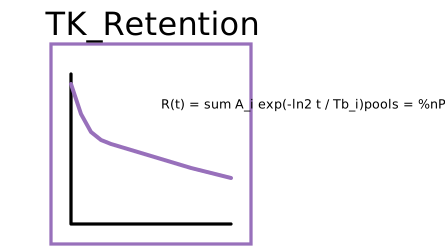
Whole-body retention of a substance as a sum of exponentials, the form in which ICRP biokinetic models and whole-body counting studies report the toxicokinetics of radionuclides and other long-lived contaminants (caesium, strontium, iodine, tritium, heavy metals):
R(t) = Σi Ai exp(-ln(2) t / Tb,i)
Each pool i receives the fraction A[i] of the absorbed intake and loses it at
lambda[i] = ln(2)/Tb[i]:
der(pool[i]) = A[i]·F·intake(t) - lambda[i]·pool[i]
After a single short intake retainedFraction reproduces R(t); under
repeated or chronic intake (adminCount > 1 or -1) it is the convolution of the intake
with R, and burden approaches the steady state
F·(adminMass/adminPeriod)·ΣAiTb,i/ln(2).
When sum(A) is below 1 the remainder is treated as excreted at once (a warning is
issued); it cannot exceed 1.
Why burden, not concentration
The state is the mass held in each pool. A retention study measures what the body holds,
not a plasma concentration, and its pools have no measured volume; the library's compartments
derive C = M/V and would need one. Two optional parameters give the derived quantities
when the paper supplies the scale:
bodyMass> 0 givesspecificBurden= burden / body mass (mg/kg, Bq/kg once multiplied by the specific activity);distributionVolume> 0 givesC_central= burden / volume, the output a PD model reads.
Both default to 0 = not supplied, as molarWeight does in the compartments.
Intake
The intake schedule uses the parameter names of PK_1C (adminTime,
adminDuration, adminPeriod, adminMass, adminCount,
F) and the same rectangular pulse as Sources.PeriodicDose, so the
co-simulation note there applies: keep the FMU communication step at most
adminDuration/50.
Default example
The defaults are the two-pool caesium retention measured in adults by whole-body counting (Tb,1 = 0.30 d, Tb,2 = 6.27 d, equal fractions), a single 1 mg intake over 10 minutes, simulated for 30 days.
Parameters
| Type | Name | Default | Description |
|---|---|---|---|
| Integer | nPool | 2 | number of retention pools |
| Real[nPool] | A | {0.5, 0.5} | fraction of the absorbed intake that enters each pool; sum(A) <= 1, the remainder is excreted at once |
| Modelica.Units.SI.Time[nPool] | Tb | {0.30*86400, 6.27*86400} | biological half-time of each pool |
| Pharmacolibrary.Types.EliminationRate[nPool] | lambda | {Modelica.Math.log(2)/max(Tb[i], Modelica.Constants.small) for i in 1:nPool} | elimination rate constant of each pool, ln(2)/Tb |
| Modelica.Units.SI.MassFraction | F | 1 | absorbed fraction of the intake (0-1); f1 / fA in ICRP terms |
| Modelica.Units.SI.Time | adminTime | 60 | first intake time (s) |
| Modelica.Units.SI.Time | adminDuration | 600 | duration of one intake (s) |
| Modelica.Units.SI.Time | adminPeriod | 24*60*60 | period between intakes (default 1 day)(s) |
| Pharmacolibrary.Types.Mass | adminMass | 1e-6 | mass of one intake |
| Integer | adminCount | 1 | number of intakes, -1 = unlimited (chronic intake) |
| Modelica.Units.SI.Mass | bodyMass | 0 | body mass for the specific burden; 0 = not supplied (specificBurden is then 0) |
| Pharmacolibrary.Types.Volume | distributionVolume | 0 | volume that turns the burden into a concentration; 0 = not supplied (C_central is then 0) |
| Info › Substance metadata | |||
| Modelica.Units.SI.MolarMass | MM | 0 | molar mass [kg/mol]; 0 = not supplied |
| Info › Substance metadata (not used in equations) | |||
| Pharmacolibrary.Types.Dose | LD50 | 0 | median lethal dose [mg/kg]; 0 = unknown |
Connectors
| Type | Name | Default | Description |
|---|---|---|---|
| Types.ConcentrationOutput | C_central | burden / distributionVolume |
Components
| Type | Name | Default | Description |
|---|---|---|---|
| Real[nPool] | q | burden of each pool in units of one absorbed intake | |
| Real | qAbsorbed | cumulative absorbed intake in units of one absorbed intake | |
| Pharmacolibrary.Types.Mass[nPool] | pool | burden held in each pool | |
| Pharmacolibrary.Types.Mass | burden | whole-body burden, sum of the pools | |
| Pharmacolibrary.Types.Mass | absorbed | cumulative absorbed intake | |
| Pharmacolibrary.Types.MassFlowRate | intakeRate | absorbed intake rate | |
| Pharmacolibrary.Types.MassFlowRate | eliminationRate | rate at which the body loses the substance | |
| Real | retainedFraction | burden / cumulative absorbed intake; R(t) of the retention function after a single intake | |
| Real | specificBurden | burden per body mass |