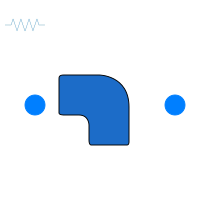
 .TRANSFORM.Fluid.FittingsAndResistances.Elbow .TRANSFORM.Fluid.FittingsAndResistances.Elbow
Minor-loss resistance for a smooth circular pipe bend (elbow). The pressure loss is computed as
dp = K*m_flow^2/(2*rho*A^2)where A is the pipe cross-sectional area and the
resistance coefficient K is given by the Rennels &
Hudson (2012) smooth-bend correlation (K_smoothBend),
combining an arc-friction term, the primary turning loss, and a
secondary-flow (Dean-vortex) term. The Darcy friction factor used
in the friction terms is evaluated from the existing single-phase
2-region correlation, so wall roughness and the
laminar/turbulent transition (Re_lam,
Re_turb) are honoured.
dimension – pipe inner diameter
D.radius – bend radius of curvature rc
measured to the pipe centerline; the relative bend radius is
rc/D.angle – deflection (turning) angle; defaults to
90°.The correlation is referenced to the (constant) pipe velocity head and applies to circular cross-sections. It is a turbulent-flow minor-loss correlation; at very low Reynolds number the friction contribution dominates and the model remains well-behaved (the friction factor uses an internal Reynolds-number floor). Flow reversal is supported: the loss always opposes the flow direction.
Rennels, D. C. & Hudson, H. M. Pipe Flow: A Practical and Comprehensive Guide. John Wiley & Sons (2012).
Cross-check implementation: Bell, C. fluids
(open-source),
fluids.fittings.bend_rounded(method="Rennels").