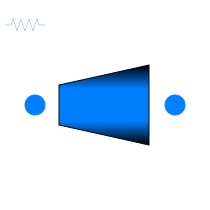
 .TRANSFORM.Fluid.FittingsAndResistances.SmoothAdaptor .TRANSFORM.Fluid.FittingsAndResistances.SmoothAdaptor
Minor-loss resistance for a smooth (gradual, conical) circular adaptor connecting two pipe diameters. Unlike SharpEdgedAdaptor (an abrupt area change), this component represents a tapered transition with a finite cone angle, so the losses are substantially lower.
The pressure loss is computed as
dp =
K*m_flow^2/(2*rho*min(A)^2)
referenced to the velocity head in the smaller of the two
cross-sections. The coefficient K is selected by flow
direction and geometry, mirroring SharpEdgedAdaptor:
The two directions are blended smoothly with
spliceTanh around the equal-area point, and the design
and reverse coefficients K_ab/K_ba are
selected by the sign of the mass flow rate, so flow reversal is
fully supported.
dimensions_ab – pipe inner diameters at
port_a and port_b.angle – cone half-angle of the taper; the
closure functions receive the total included angle
2*angle. The implied axial taper length is L =
|d_b - d_a|/(2*tan(angle)).Circular cross-sections; turbulent-flow minor-loss correlations
(Rennels & Hudson, 2012). As the half-angle approaches 90°
(total angle 180°) the expansion direction reduces to the
Borda-Carnot sudden-expansion limit K = (1 -
beta^2)^2. Wall roughness and the
laminar/turbulent transition (Re_lam,
Re_turb) are honoured through the friction term.
Rennels, D. C. & Hudson, H. M. Pipe Flow: A Practical and Comprehensive Guide. John Wiley & Sons (2012).
Cross-check implementation: Bell, C. fluids
(open-source), fluids.fittings.diffuser_conical /
contraction_conical (method="Rennels").