 .TRANSFORM.Fluid.FittingsAndResistances.TeeJunctionVolumeLoss .TRANSFORM.Fluid.FittingsAndResistances.TeeJunctionVolumeLoss
A tee/wye junction with a central ideal-mixing volume (like TeeJunctionVolume) plus angle-dependent junction losses on the run and branch legs, using the Crane TP-410 correlations. This captures the loss of a pipe taking off the run at an angle (e.g. a 90° branch) including its dependence on take-off angle, area ratio and flow split – which a simple area-change resistance on the leg cannot.
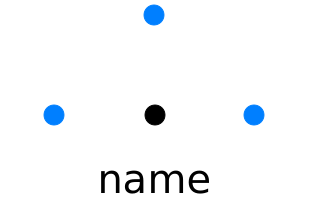
port_1 – combined leg (run inlet for dividing flow
/ run outlet for combining flow), diameter d_run;port_2 – run / straight-through leg, diameter
d_run;port_3 – branch leg at angle to the
run, diameter d_branch.The branch and run loss coefficients are referenced to the
combined-leg velocity head ½ρw_c² (with
w_c the velocity in port_1). Both the
dividing (port_1.m_flow > 0) and combining
(port_1.m_flow < 0) correlation sets are evaluated
and blended smoothly about zero combined flow with
spliceTanh, so flow reversal is supported. Note that
the run and combined diameters are assumed equal (Crane model); the
branch may be a different size. Loss coefficients can be slightly
negative (pressure recovery), consistent with the correlations.
Crane Co. Flow of Fluids Through Valves, Fittings, and Pipe (Technical Paper No. 410), 2009. Closures: ClosureRelations...Functions.Tees.