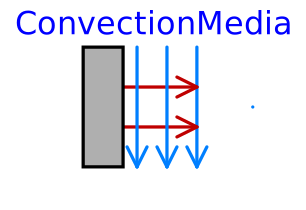
modelConvectionMedia

Information
This is a model of linear heat convection, e.g., the heat transfer between a plate and the surrounding air; see also: ConvectiveResistor. It may be used for complicated solid geometries and fluid flow over the solid by determining the convective thermal conductance Gc by measurements. The basic constitutive equation for convection is
   Q_flow = Gc*(solid.T - fluid.T);
   Q_flow: Heat flow rate from connector 'solid' (e.g., a plate)
      to connector 'fluid' (e.g., the surrounding air)
Gc = G.signal[1] is an input signal to the component, since Gc is nearly never constant in practice. For example, Gc may be a function of the speed of a cooling fan. For simple situations, Gc may be calculated according to
   Gc = A*h
   A: Convection area (e.g., perimeter*length of a box)
   h: Heat transfer coefficient
where the heat transfer coefficient h is calculated from properties of the fluid flowing over the solid. Examples:
Machines cooled by air (empirical, very rough approximation according to R. Fischer: Elektrische Maschinen, 10th edition, Hanser-Verlag 1999, p. 378):
    h = 7.8*v^0.78 [W/(m2.K)] (forced convection)
      = 12         [W/(m2.K)] (free convection)
    where
      v: Air velocity in [m/s]
Laminar flow with constant velocity of a fluid along a flat plate where the heat flow rate from the plate to the fluid (= solid.Q_flow) is kept constant (according to J.P.Holman: Heat Transfer, 8th edition, McGraw-Hill, 1997, p.270):
   h  = Nu*k/x;
   Nu = 0.453*Re^(1/2)*Pr^(1/3);
   where
      h  : Heat transfer coefficient
      Nu : = h*x/k       (Nusselt number)
      Re : = v*x*rho/mue (Reynolds number)
      Pr : = cp*mue/k    (Prandtl number)
      v  : Absolute velocity of fluid
      x  : distance from leading edge of flat plate
      rho: density of fluid (material constant
      mue: dynamic viscosity of fluid (material constant)
      cp : specific heat capacity of fluid (material constant)
      k  : thermal conductivity of fluid (material constant)
   and the equation for h holds, provided
      Re < 5e5 and 0.6 < Pr < 50
Parameters
| Type | Name | Default | Description |
|---|---|---|---|
| Integer | n | 1 | Number of mass transfer segments |
| Integer | nC | 1 | Number of substances |
Connectors
| Type | Name | Default | Description |
|---|---|---|---|
| Interfaces.MolePort_Flow[n] | port_a | ||
| Interfaces.MolePort_Flow[n] | port_b |
Components
| Type | Name | Default | Description |
|---|---|---|---|
| Medium.ThermodynamicState | states | Medium.setState_pTX(fill(1e5, n), fill(Medium.T_default, n)) | Thermodynamic state of fluid at port_b |
| SI.Temperature[n] | Ts_wall | Wall temperature | |
| SI.MassFlowRate[n] | m_flows | zeros(n) | Mass flow rate |
| SI.Diameter[n] | dimensions | fill(1, n) | Characteristic dimension (e.g. hydraulic diameter) |
| SI.Area[n] | crossAreas | fill(1, n) | Cross sectional flow area |
| SI.Length[n] | dlengths | fill(1, n) | Characteristic length of mass transfer segment |
| SI.Area[n] | surfaceAreas | dimensions./dlengths | Surface area for mass transfer |
| SI.Height[n] | roughnesses | fill(2.5e-5, n) | Average height of surface asperities |
| MassTransferCoeff | massTransferCoeff | ||
| SI.MolarFlowRate[n,nC] | n_flows | Mole flow rate from port_a -> port_b | |
| SI.Concentration[n,nC] | dCs | = port_a.C - port_b.C | |
| Units.DiffusionResistance[n,nC] | R | Thermal resistance |
Contents
| Name | Description |
|---|---|
 Medium Medium | |
 MassTransferCoeff MassTransferCoeff |