Information
## Copyright © EDF 2002 - 2026
## ThermoSysPro Version 4.2
This component model is documented in Sect. 9.6.1 of the ThermoSysPro book.
# Dynamic water water exchanger
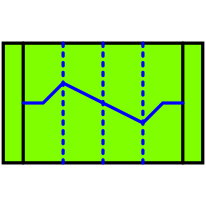
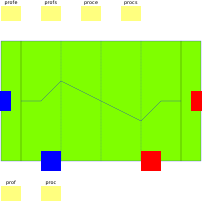
The plate heat exchanger is composed of thousand sheets separated from each other by a small space where fluids flow. The plates exhibit a wavy surface to create a turbulent flow that generates better heat transfers. This type of exchanger is widely used in the food industry as it can easily be taken apart for cleanup.
This model represents a single-phase counter-flow thermal exchange between the hot fluid and the cold fluid. The two fluids are separated by a wall through which heat transfer takes place by conduction. Convection transfers the heat between each fluid and the wall.
Following assumptions are made:
- the flow in each mesh cell is single-phase.
- the energy accumulation in the wall is neglected.
- the phenomenon of longitudinal heat conduction in the wall and in the fluid is neglected.
- the pressure and specific enthalpy are assumed constant in each mesh cell.
For a steady-state plate heat exchanger, see [static water water exchanger](modelica://ThermoSysPro.WaterSteam.HeatExchangers.StaticWaterWaterExchanger).
## Modelica component model
The equations mentioned below are implemented in the component *DynamicWaterWaterExchanger*, located in the *WaterSteam.HeatExchangers* sub-library.

## Nomenclature
| Symbol| Description| Unit| Definition| Modelica name |
| :-------------------------------- | :------------------------------------------------------------------------------------------ | :------------------------------------------- | :----------------------------------------------------------------------------------------------------------------------- | :----------- |
| \\(c\_{p, c, i}\\)| Cold fluid specific heat in thermal cell \\(i\\)| \\(\mathrm{J} / \mathrm{kg} / \mathrm{K}\\)|| prof[i].cp |
| \\(c\_{p, \mathrm{h}, i}\\)| Hot fluid specific heat in thermal cell \\(i\\)| \\(\mathrm{J} / \mathrm{kg} / \mathrm{K}\\)|| proc[i].cp |
| \\(D\_{\mathrm{h}}\\)| Hydraulic diameter| \\(\mathrm{m}\\)|| - |
| \\(e\_{\mathrm{m}}\\)| Wall thickness| \\(\mathrm{m}\\)|| emetal |
| \\(h\_{\mathrm{c}, i}\\)| Cold fluid specific enthalpy in thermal cell \\(i\\)| \\(\mathrm{J} / \mathrm{kg}\\)|| Hmf[i] |
| \\(h\_{\mathrm{c}, i: i+1}\\)| Cold fluid specific enthalpy in hydraulic cell \\(i: i+1\\)| \\(\mathrm{J} / \mathrm{kg}\\)|| Hcf[i] |
| \\(h\_{\mathrm{h}, i}\\)| Hot fluid specific enthalpy in thermal cell \\(i\\)| \\(\mathrm{J} / \mathrm{kg}\\)|| Hmc[i] |
| \\(h\_{\mathrm{h}, i: i+1}\\)| Hot fluid specific enthalpy in hydraulic cell \\(i: i+1\\)| \\(\mathrm{J} / \mathrm{kg}\\)|| Hcc[i] |
| \\(K\_{\mathrm{c}, i}\\)| Convective heat exchange coefficient for the cold fluid in thermal cell \\(i\\)| \\(\mathrm{W} / \mathrm{m}^{2} / \mathrm{K}\\) || hf[i] |
| \\(K\_{\mathrm{h}, i}\\)| Convective heat exchange coefficient for the hot fluid in thermal cell \\(i\\)| \\(\mathrm{W} / \mathrm{m}^{2} / \mathrm{K}\\) || hc[i] |
| \\(m\_{\mathrm{c}, i: i+1}\\)| Cold fluid mass flow rate in hydraulic cell \\(i:\\) \\(i+1\\)| \\(\mathrm{kg} / \mathrm{s}\\)|| Qcf[i] |
| \\(m\_{\mathrm{h}, i: i+1}\\)| Hot fluid mass flow rate in hydraulic cell \\(i:\\) \\(i+1\\)| \\(\mathrm{kg} / \mathrm{s}\\)|| Qcc[i] |
| \\(N\\)| Number of hydraulic cells| \\(-\\)|| N + 1 |
| \\(N\_{\mathrm{c}}\\)| Number of channels of each fluid| \\(-\\)| \\(\left\(N\_{\mathrm{p}}-1\right\) / 2\\)| - |
| \\(N\_{\mathrm{p}}\\)| Number of plates| \\(-\\)|| nbp |
| \\(P\_{\mathrm{c}, i}\\)| Cold fluid pressure at the outlet of thermal cell \\(i\\)| \\(\mathrm{Pa}\\)|| Pcf[i + 1] |
| \\(P\_{\mathrm{h}, i}\\)| Hot fluid pressure at the outlet of thermal cell \\(i\\)| \\(\mathrm{Pa}\\)|| Pcc[i + 1] |
| \\(P r\_{\mathrm{c}, i}\\)| Prandtl number of the cold fluid in thermal cell \\(i\\)| \\(-\\)| \\(\frac{\mu\_{\mathrm{c}, i} \cdot c\_{p, \mathrm{c}, i}}{\lambda\_{\mathrm{c}, i}}\\)| - |
| \\(P r\_{h, i}\\)| Prandtl number of the hot fluid in thermal cell \\(i\\)| \\(-\\)| \\(\frac{\mu\_{\mathrm{h}, i} \cdot c\_{p, \mathrm{h}, i}}{\lambda\_{\mathrm{h}, i}}\\)| - |
| \\(R e\_{c, i:i+1}\\)| Reynolds number of the cold fluid in hydraulic cell \\(i: i+1\\)| \\(-\\)| \\(\frac{4 \cdot m\_{\mathrm{c}, i: i+1}}{\pi \cdot D\_{\mathrm{h}} \cdot \mu\_{\mathrm{c}, i} \cdot N\_{\mathrm{c}}}\\)| - |
| \\(R e\_{\mathrm{h}, i: i+1}\\)| Reynolds number of the hot fluid in hydraulic cell \\(i: i+1\\)| \\(-\\)| \\(\frac{4 \cdot \dot{m}\_{\mathrm{h}, i: i+1}}{\pi \cdot D\_{\mathrm{h}} \cdot \mu\_{\mathrm{h}, i} \cdot N\_{\mathrm{c}}}\\) | - |
| \\(S\_{\mathrm{p}}\\)| Plate area| \\(\mathrm{m}^{2}\\)|| Sp |
| \\(T\_{\mathrm{c}, i}\\)| Temperature of the cold fluid in thermal cell \\(i\\)| \\(\mathrm{K}\\)|| Tmf[i] |
| \\(T\_{\mathrm{h}, i}\\)| Temperature of the hot fluid in thermal cell \\(i\\)| \\(\mathrm{K}\\)|| Tmc[i] |
| \\(T\_{\mathrm{w}, \mathrm{c}, i}\\) | Wall temperature of for cold fluid in thermal cell \\(i\\)| \\(\mathrm{K}\\)|| Tmf[i] |
| \\(T\_{\mathrm{w}, \mathrm{h}, i}\\) | Wall temperature for the hot fluid in thermal cell \\(i\\)| \\(\mathrm{K}\\)|| Tmc[i] |
| \\(U\_{i}\\)| Global heat transfer coefficient for thermal cell \\(i\\)| \\(\mathrm{W} / \mathrm{m}^{2} / \mathrm{K}\\) || K[i] |
| \\(V\_{\mathrm{c}}\\)| Cold fluid volume| \\(\mathrm{m}^{3}\\)|| Vf |
| \\(V\_{\mathrm{h}}\\)| Hot fluid volume| \\(\mathrm{m}^{3}\\)|| Vc |
| \\(\Delta A\_{i}\\)| Heat exchange surface for thermal cell \\(i\\)| \\(\mathrm{m}^{2}\\)| \\(\frac{s\_{\mathrm{p}} \cdot\left\(N\_{\mathrm{p}}-2\right\)}{N-1}\\)| dS |
| \\(\Delta W\_{i}\\)| Thermal power released by the hot fluid to the cold fluid for thermal cell \\(i\\)| \\(\mathrm{W}\\)|| dW[i] |
| \\(\lambda\_{\mathrm{c}, i}\\)| Cold fluid thermal conductivity in thermal cell \\(i\\)| \\(\mathrm{W} / \mathrm{m} / \mathrm{K}\\)|| lambdaf[i] |
| \\(\lambda\_{\mathrm{h}, i}\\)| Hot fluid thermal conductivity in thermal cell \\(i\\)| \\(\mathrm{W} / \mathrm{m} / \mathrm{K}\\)|| lambdac[i] |
| \\(\lambda\_{\mathrm{m}}\\)| Metal thermal conductivity| \\(\mathrm{W} / \mathrm{m} / \mathrm{K}\\)|| lambdam |
| \\(\Lambda\_{\mathrm{c}}\\)| Friction pressure loss coefficient of the entire length of the exchanger for the cold fluid | \\(\mathrm{m}^{-4}\\)|| p_Kf |
| \\(\Lambda\_{\mathrm{h}}\\)| Friction pressure loss coefficient of the entire length of the exchanger for the hot fluid| \\(\mathrm{m}^{-4}\\)|| p_Kc |
| \\(\mu\_{\mathrm{c}, i}\\)| Cold fluid dynamic viscosity in thermal cell \\(i\\)| \\(\mathrm{Pa} \mathrm{s}\\)|| muf[i] |
| \\(\mu\_{\mathrm{c}, i: i+1}\\)| Cold fluid dynamic viscosity in hydraulic cell \\(i: i+1\\)| \\(\mathrm{Pa} \mathrm{s}\\)|| muf[i] |
| \\(\mu\_{\mathrm{h}, i}\\)| Hot fluid dynamic viscosity in thermal cell \\(i\\)| \\(\mathrm{Pa} \mathrm{s}\\)|| muc[i] |
| \\(\mu\_{\mathrm{h}, i: i+1}\\)| Hot fluid dynamic viscosity in hydraulic cell \\(i: i+1\\)| \\(\mathrm{Pa} \mathrm{s}\\)|| muc[i] |
| \\(\rho\_{\mathrm{c}, i}\\)| Cold fluid density in thermal cell \\(i\\)| \\(\mathrm{kg} / \mathrm{m}^{3}\\)|| rhof[i] |
| \\(\rho\_{\mathrm{h}, i}\\)| Hot fluid density in thermal cell \\(i\\)| \\(\mathrm{kg} / \mathrm{m}^{3}\\)|| rhoc[i] |
## Governing equations
The following set of equations must be completed by the state equations for the following water and steam properties \\(c\_{p, c}, c\_{p, h}, \rho\_{c}, \rho\_{h}, \mu\_{c}, \mu\_{h}, \lambda\_{c}\\) and \\(\lambda\_{h}\\).
### Steady-state mass balance equation (hot fluid)
- Validity domain:
\\(\forall \dot{m}\_{\mathrm{h}, i:i+1}\\)
- Mathematical formulation:
$$\dot{m}\_{\mathrm{h}, i-1:i}-\dot{m}\_{\mathrm{h}, i:i+1}=0$$
- Comments:
### Steady-state mass balance equation (cold fluid)
- Validity domain:
\\(\forall \dot{m}\_{\mathrm{c}, i:i+1}\\)
- Mathematical formulation:
$$\dot{m}\_{\mathrm{c}, i-1:i}-\dot{m}\_{\mathrm{c}, i:i+1}=0$$
- Comments:
### Dynamic energy balance equation (hot fluid)
- Validity domain:
\\(\forall \dot{m}\_{\mathrm{h}, i:i+1}\\)
- Mathematical formulation:
$$\frac{V\_{\mathrm{h}}}{N-1} \cdot \rho\_{\mathrm{h}, i} \cdot \frac{\mathrm{d} h\_{\mathrm{h}, i}}{\mathrm{d} t}=\dot{m}\_{\mathrm{h}, i-1:i} \cdot h\_{\mathrm{h}, i-1:i}-\dot{m}\_{\mathrm{h}, i:i+1} \cdot h\_{\mathrm{h}, i:i+1}-\Delta W\_{i}$$
- Comments:
The fluid is assumed to be incompressible.
### Dynamic energy balance equation (cold fluid)
- Validity domain:
\\(\forall \dot{m}\_{c, i:i+1}\\)
- Mathematical formulation:
$$\frac{V\_{\mathrm{c}}}{N-1} \cdot \rho\_{\mathrm{c}, i} \cdot \frac{\mathrm{d} h\_{\mathrm{c}, i}}{\mathrm{d} t}=\dot{m}\_{\mathrm{c}, i-1:i} \cdot h\_{\mathrm{c}, i-1:i}-\dot{m}\_{\mathrm{c}, i:i+1} \cdot h\_{\mathrm{c}, i:i+1}+\Delta W\_{i}$$
- Comments:
The fluid is assumed to be incompressible.
### Heat exchanged between the hot and cold fluids
- Validity domain:
\\(\forall T\_{\mathrm{h}, i}\\) and \\(\forall T\_{\mathrm{c}, i}\\)
- Mathematical formulation:
$$\Delta W\_{i}=U\_{i} \cdot \Delta A\_{i} \cdot\left\(T\_{\mathrm{h}, i}-T\_{\mathrm{c}, i}\right\)$$
- Comments:
The global heat transfer coefficient \\(U\_{i}\\) between the two fluids is given by \\(\frac{1}{U\_{i}}=\frac{1}{K\_{\mathrm{h}, i}}+\frac{1}{\lambda\_{\mathrm{m}}}+\frac{1}{K\_{\mathrm{c}, i}}\\).
### Momentum balance equation (hot fluid)
- Validity domain:
\\(\forall \dot{m}\_{\mathrm{h}, i:i+1}\\)
- Mathematical formulation:
$$P\_{\mathrm{h}, i+1} = P\_{\mathrm{h}, i}-\frac{\Lambda\_{\mathrm{h}}}{N} \cdot \frac{\dot{m}\_{\mathrm{h}, i:i+1} \cdot \lvert \dot{m}\_{\mathrm{h}, i:i+1} \rvert}{N\_{\mathrm{c}}^{2} \cdot \rho\_{\mathrm{h}, i}}$$
- Comments:
Only pressure losses due to friction are taken into account. The friction coefficient \\(\Lambda\_{\mathrm{h}}\\) can be directly provided by the user or computed using a correlation.
### Momentum balance equation (cold fluid)
- Validity domain:
\\(\forall \dot{m}\_{\mathrm{c}, i:i+1}\\)
- Mathematical formulation:
$$P\_{\mathrm{c}, i+1}=P\_{\mathrm{c}, i}-\frac{\Lambda\_{\mathrm{c}}}{N} \cdot \frac{\dot{m}\_{\mathrm{c}, i:i+1} \cdot \lvert \dot{m}\_{\mathrm{c}, i:i+1} \rvert}{N\_{\mathrm{c}}^{2} \cdot \rho\_{\mathrm{c}, i}}$$
- Comments:
Only pressure losses due to friction are taken into account. The friction coefficient \\(\Lambda\_{\mathrm{c}}\\) can be directly provided by the user or computed using a correlation.
## References
El Hefni, Baligh and Bouskela, Daniel (2019). [Modeling and Simulation of Thermal Power Plants with ThermoSysPro](https://link.springer.com/book/10.1007/978-3-030-05105-1), sect. 9.6.1. Springer Nature Switzerland AG.