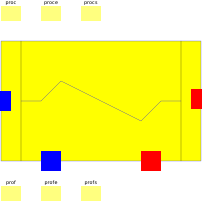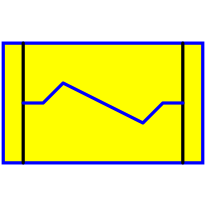
modelStaticWaterWaterExchanger
Static plate heat exchanger
Information
## Copyright © EDF 2002 - 2026
## ThermoSysPro Version 4.2
This component model is documented in Sect. 9.6.2 of the ThermoSysPro book.
# Static water water exchanger
This static plate heat exchanger is the steady-state version of the [dynamic water water exchanger](modelica://ThermoSysPro.WaterSteam.HeatExchangers.DynamicWaterWaterExchanger).
In addition to the [dynamic model](modelica://ThermoSysPro.WaterSteam.HeatExchangers.DynamicWaterWaterExchanger) assumptions, the specific heats and mass flow rates of both fluids are supposed constant.
## Modelica component model
The equations mentioned below are implemented in the component *StaticWaterWaterExchanger*, located in the *WaterSteam.HeatExchangers* sub-library.

## Nomenclature
| Symbol| Description| Unit| Definition| Modelica name |
| :----------------------------------- | :------------------------------------------------------------------------------------------- | :------------------------------------------- | :---------------------------------------------------------------------- | :----------- |
| \\(A\\)| Heat exchange surface| \\(\mathrm{m}^{2}\\)| \\(\left\(N\_{\mathrm{p}}-2\right\) \cdot S\_{\mathrm{p}}\\)| S |
| \\(m\_{\mathrm{h}}\\)| Hot fluid mass flow rate| \\(\mathrm{kg} / \mathrm{s}\\)|| Qc |
| \\(m\_{\mathrm{c}}\\)| Cold fluid mass flow rate| \\(\mathrm{kg} / \mathrm{s}\\)|| Qf |
| \\(N\_{\mathrm{c}}\\)| Number of channels of each fluid| \\(-\\)| \\(\left\(N\_{\mathrm{p}}-1\right\) / 2\\)| N |
| \\(N\_{\mathrm{p}}\\)| Number of plates| \\(-\\)|| nbp |
| \\(P\_{\mathrm{c}, \mathrm{i}}\\) | Cold fluid pressure at the inlet| \\(\mathrm{Pa}\\)|| Ef.P |
| \\(P\_{\mathrm{c}, \mathrm{o}}\\) | Cold fluid pressure at the outlet| \\(\mathrm{Pa}\\)|| Sf.P |
| \\(P\_{\mathrm{h}, \mathrm{i}}\\) | Hot fluid pressure at the inlet| \\(\mathrm{Pa}\\)|| Ec.P |
| \\(P\_{\mathrm{h}, \mathrm{o}}\\) | Hot fluid pressure at the outlet| \\(\mathrm{Pa}\\)|| Sc.P |
| \\(T\_{\mathrm{c}, \mathrm{i}}\\) | Cold fluid temperature at the inlet| \\(\mathrm{K}\\)|| Tef |
| \\(T\_{\mathrm{c}, \mathrm{o}}\\) | Cold fluid temperature at the outlet| \\(\mathrm{K}\\)|| Tsf |
| \\(T\_{\mathrm{h}, \mathrm{i}}\\) | Hot fluid temperature at the inlet| \\(\mathrm{K}\\)|| Tec |
| \\(T\_{\mathrm{h}, \mathrm{o}}\\) | Hot fluid temperature at the outlet| \\(\mathrm{K}\\)|| Tsc |
| \\(U\\)| Global heat transfer coefficient \(internal overall heat exchange coefficient\)| \\(\mathrm{W} / \mathrm{m}^{2} / \mathrm{K}\\) || K |
| \\(W\\)| Thermal power exchanged between the two fluids| \\(\mathrm{W}\\)|| W |
| \\(\Delta T\_{1}\\)| Temperature difference 1| \\(\mathrm{K}\\)| For counter flow \\(T\_{\mathrm{h}, \mathrm{i}}-T\_{\mathrm{c}, \mathrm{o}}\\) For parallel flow \\(T\_{\mathrm{h}, \mathrm{i}}-T\_{\mathrm{c}, \mathrm{i}}\\) | DT1 |
| \\(\Delta T\_{2}\\)| Temperature difference 2| \\(\mathrm{K}\\)| For counter flow \\(T\_{\mathrm{h}, \mathrm{o}}-T\_{\mathrm{c}, \mathrm{i}}\\) For parallel flow \\(T\_{\mathrm{h}, \mathrm{o}}-T\_{\mathrm{c}, \mathrm{o}}\\) | DT2 |
| \\(\Lambda\_{\mathrm{c}}\\)| Friction pressure loss coefficient of the entire length of the exchanger for the cold fluid | \\(\mathrm{m}^{-4}\\)|| p_Kf |
| \\(\Lambda\_{\mathrm{h}}\\)| Friction pressure loss coefficient of the entire length of the exchanger for the hot fluid| \\(\mathrm{m}^{-4}\\)|| p_Kc |
| \\(\rho\_{\mathrm{c}}\\)| Cold fluid density| \\(\mathrm{kg} / \mathrm{m}^{3}\\)|| rhof |
| \\(\rho\_{\mathrm{h}}\\)| Hot fluid density| \\(\mathrm{kg} / \mathrm{m}^{3}\\)|| rhoc |
## Governing equations
### Energy balance equation \(hot fluid\)
- Validity domain:
\\(\forall \dot{m}\_{\mathrm{h}}\\)
- Mathematical formulation:
$$W=\dot{m}\_{\mathrm{h}} \cdot c\_{p, \mathrm{h}} \cdot\left\(T\_{\mathrm{h}, \mathrm{i}}-T\_{\mathrm{h}, \mathrm{o}}\right\)$$
### Energy balance equation \(cold fluid\)
- Validity domain:
\\(\forall \dot{m}\_{\mathrm{c}}\\)
- Mathematical formulation:
$$W=\dot{m}\_{\mathrm{c}} \cdot c\_{p, \mathrm{c}} \cdot\left\(T\_{\mathrm{c}, \mathrm{o}}-T\_{\mathrm{c}, \mathrm{i}}\right\)$$
### Heat exchanged between the fluid and the wall
- Validity domain:
\\(\dot{m}\_{\mathrm{h}} \neq 0, \dot{m}\_{\mathrm{c}} \neq 0, \Delta T\_{1} \neq 0\\) and \\(\Delta T\_{2} \neq 0\\)
- Mathematical formulation:
$$W=U \cdot A \cdot \frac{\Delta T\_{2}-\Delta T\_{1}}{\ln \left\(\frac{\Delta T\_{2}}{\Delta T\_{1}}\right\)}$$
- Comments:
### Momentum balance equation \(hot fluid\)
- Validity domain:
\\(\forall \dot{m}\_{\mathrm{h}}\\)
- Mathematical formulation:
$$P\_{\mathrm{h}, \mathrm{o}}=P\_{\mathrm{h}, \mathrm{i}}-\Lambda\_{\mathrm{h}} \cdot \frac{\dot{m}\_{\mathrm{h}} \cdot \lvert \dot{m}\_{\mathrm{h}}\rvert}{N\_{\mathrm{c}}^{2} \cdot \rho\_{\mathrm{h}}}$$
- Comments:
### Momentum balance equation \(cold fluid\)
- Validity domain:
\\(\forall \dot{m}\_{\mathrm{c}}\\)
- Mathematical formulation:
$$P\_{\mathrm{c}, \mathrm{o}}=P\_{\mathrm{c}, \mathrm{i}}-\Lambda\_{\mathrm{c}} \cdot \frac{\dot{m}\_{\mathrm{c}} \cdot \lvert \dot{m}\_{\mathrm{c}}\rvert }{N\_{\mathrm{c}}^{2} \cdot \rho\_{\mathrm{c}}}$$
- Comments:
## References
El Hefni, Baligh and Bouskela, Daniel (2019). [Modeling and Simulation of Thermal Power Plants with ThermoSysPro](https://link.springer.com/book/10.1007/978-3-030-05105-1), sect. 9.6.2. Springer Nature Switzerland AG.
Parameters
| Type | Name | Default | Description |
|---|
| Units.SI.ThermalConductivity | lambdam | 15.0 | Metal thermal conductivity |
| Units.SI.CoefficientOfHeatTransfer | p_hc | 6000 | Heat transfer coefficient for the hot side if not computed by the correlations |
| Units.SI.CoefficientOfHeatTransfer | p_hf | 3000 | Heat transfer coefficient for the cold side if not computed by the correlations |
| Real | p_Kc | 100 | Pressure loss coefficient for the hot side if not computed by the correlations |
| Real | p_Kf | 100 | Pressure loss coefficient for the cold side if not computed by the correlations |
| Units.SI.Thickness | emetal | 0.0006 | Wall thickness |
| Units.SI.Area | Sp | 2 | Plate area |
| Real | nbp | 499 | Number of plates |
| Real | c1 | 1.12647 | Correction coefficient |
| Units.SI.Density | p_rhoc | 0 | If > 0, fixed fluid density for the hot fluid |
| Units.SI.Density | p_rhof | 0 | If > 0, fixed fluid density for the cold fluid |
| Integer | modec | 0 | IF97 region for the hot fluid. 1:liquid - 2:steam - 4:saturation line - 0:automatic |
| Integer | modef | 0 | IF97 region for the cold fluid. 1:liquid - 2:steam - 4:saturation line - 0:automatic |
| Integer | exchanger_type | 1 | Exchanger type - 1: countercurrent. 2: cocurrent |
| Integer | heat_exchange_correlation | 1 | Correlation for the computation of the heat exchange coefficient - 0: no correlation. 1: SRI correlations |
| Integer | pressure_loss_correlation | 1 | Correlation for the computation of the pressure loss coefficient - 0: no correlation. 1: SRI correlations |
Revisions
Author

Daniel Bouskela