Information
## Copyright © EDF 2002 - 2026
## ThermoSysPro Version 4.2
This component model is documented in Sect. 14.2 of the ThermoSysPro book.
# Dynamic drum
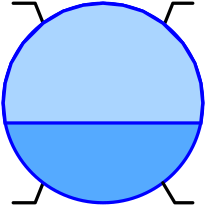
A drum is a reservoir of steam and water at the top end of the boiler.
It separates water from steam in the mixture generated in the boiler and stores them.
The drum is represented as a dynamic non-adiabatic two-phase volume, with cylindrical geometry.
The model takes into account the condensation and vaporization flow.
The [two-phase cavity](modelica://ThermoSysPro.WaterSteam.Volumes.TwoPhaseCavity) has similar equations, but a different role in the plant: the two-phase volume is a condenser, whereas the dynamic drum separates the steam for the evaporator.
Following assumptions are made:
- the two phases are always present.
- pressure losses are not taken into account in the drum.
- the liquid and vapor phases are not necessarily in thermal equilibrium, but always in pressure equilibrium.
- the steam may enter the superheated cavity.
- the liquid can be subcooled by the incoming drain and the wetted tube bundle.
## Modelica component model
The equations mentioned below are implemented in the component *DynamicDrum*, located in the *WaterSteam.Volumes* sub-library.
This component has 10 connectors:
- Ce1: feedwater input 1,
- Ce2: feedwater input 2,
- Ce3: feedwater input 3,
- Cth: thermal input to the liquid,
- Cex: thermal input to the wall,
- Cd: evaporator inlet coming from the tank,
- Cm: evaporator outlet toward the tank,
- Cv: steam outlet,
- Cs: water outlet,
- yLevel: water level output,

## Nomenclature
| Symbol| Description| Unit| Definition| Modelica name |
| :-------------------------------- | :------------------------------------------------------------------------------------------ | :-------------------------------------------------- | :------------------------------------------------------------------------------------------------------------------------ | :----------- |
| \\(A\_{l})\\)| Cross-sectional area of the \\(\mathrm{m}^{2}\\) liquid phase in the cavity|| For a vertical cavity: \\(\pi \cdot \mathrm{R}^{2}\\)| Al |
| \\(A\_{\mathrm{aw}}\\)| Contact surface between the ambient and the cavity wall| \\(\mathrm{m}^{2}\\)| \\(A\_{\mathrm{lw}}+A\_{\mathrm{vw}}\\)| Ape |
| \\(A\_{l \mathrm{w}}\\)| Contact surface between the liquid phase and the cavity wall| \\(\mathrm{m}^{2}\\)| For a vertical cavity: \\(2 \cdot \pi \cdot R \cdot z\_{l}+A\_{l}\\). </br> For a horizontal cavity: \\(\(\pi-2 \cdot \theta\) \cdot R \cdot L+2 \cdot A\_{l}\\)| Alp |
| \\(A\_{\mathrm{vl}}\\)| Contact surface between the vapor phase and the liquid phase| \\(\mathrm{m}^{2}\\)| For a vertical cavity: \\(A\_{l}\\). </br> For a horizontal cavity: \\(2 . R \cdot L . \cos \(\theta\)\\)| Avl |
| \\(A\_{\mathrm{vw}}\\)| Contact surface between the vapor phase and the cavity wall| \\(\mathrm{m}^{2}\\)| For a vertical cavity: \\(2 \cdot \pi \cdot R \cdot\left\(L-z\_{l}\right\)+A\_{l}\\). </br> For a horizontal cavity: \\(\(\pi+2 \cdot \theta\) \cdot R \cdot L \\) \\(+ 2\left\(\pi \cdot R^{2}-A\_{l}\right\)\\) | Avp |
| \\(c\_{\mathrm{p}, \mathrm{w}}\\)| Specific heat capacity of the drum wall| \\(\mathrm{J} / \mathrm{kg} / \mathrm{K}\\)|| Cpp |
| \\(C\_{\text {cond }}\\)| Condensation rate| \\(\mathrm{s}^{-1}\\)|| Ccond |
| \\(C\_{\text {evap }}\\)| Evaporation rate| \\(\mathrm{s}^{-1}\\)|| Cevap |
| \\(g\\)| Acceleration due to gravity| \\(\mathrm{m} / \mathrm{s}^{2}\\)|| g |
| \\(h\_{\mathrm{ev}}\\)| Specific enthalpy of the water/steam mixture coming from the evaporator| \\(\mathrm{J} / \mathrm{kg}\\)|| Cm.h |
| \\(h\_{\mathrm{i}\_{1}}\\)| Specific enthalpy of the liquid phase at inlet \\(1\\) | \\(\mathrm{J} / \mathrm{kg}\\)|| Ce1.h |
| \\(h\_{\mathrm{i}\_{2}}\\)| Specific enthalpy of the liquid phase at inlet \\(2\\) | \\(\mathrm{J} / \mathrm{kg}\\)|| Ce2.h |
| \\(h\_{\mathrm{i}\_{3}}\\)| Specific enthalpy of the liquid phase at inlet \\(3\\) | \\(\mathrm{J} / \mathrm{kg}\\)|| Ce3.h |
| \\(h\_{l}\\)| Specific enthalpy of the liquid phase in the cavity | \\(\mathrm{J} / \mathrm{kg}\\)|| hl |
| \\(h\_{l, \mathrm{ev}}\\)| Specific enthalpy of the liquid coming from the evaporator| \\(\mathrm{J} / \mathrm{kg}\\)|| Cm.h |
| \\(h\_{l, \mathrm{o}\_{l}}\\)| Specific enthalpy of the liquid phase at outlet 1, going to the evaporator | \\(\mathrm{J} / \mathrm{kg}\\)|| Cd.h |
| \\(h\_{l, \mathrm{o} 2}\\)| Specific enthalpy of the liquid phase at outlet 2 | \\(\mathrm{J} / \mathrm{kg}\\)|| Cs.h |
| \\(h\_{l}^{\mathrm{sat}}\\)| Saturation enthalpy of the liquid in the cavity| \\(\mathrm{J} / \mathrm{kg}\\)|| lsat.h |
| \\(h\_{\mathrm{v}}\\)| Specific enthalpy of the vapor phase in the cavity| \\(\mathrm{J} / \mathrm{kg}\\)|| hv |
| \\(h\_{\mathrm{v}, \mathrm{ev}}\\)| Specific enthalpy of the vapor coming from the evaporator| \\(\mathrm{J} / \mathrm{kg}\\)|| vsat.h |
| \\(h\_{\mathrm{v}, \mathrm{o}}\\)| Specific enthalpy of the vapor phase at the outlet of the drum, going to the super-heater| \\(\mathrm{J} / \mathrm{kg}\\)|| Cv.h |
| \\(h\_{\mathrm{v}}^{\mathrm{sat}}\\) | Saturation enthalpy of the vapor in the cavity| \\(\mathrm{J} / \mathrm{kg}\\)|| vsat.h |
| \\(K\_{\mathrm{lw}}\\)| Convective heat exchange coefficient between the liquid and the wall| \\(\mathrm{W} / \mathrm{m}^{2} / \mathrm{K}\\)|| Klp |
| \\(K\_{\mathrm{vl}}\\)| Convective heat exchange coefficient between the liquid and the vapor in the cavity| \\(\mathrm{W} / \mathrm{m}^{2} / \mathrm{K}\\)|| Kvl |
| \\(K\_{\mathrm{vw}}\\)| Convective heat exchange coefficient between the vapor and the wall| \\(\mathrm{W} / \mathrm{m}^{2} / \mathrm{K}\\)|| Kvp |
| \\(K\_{\mathrm{wa}}\\)| Convective heat exchange coefficient between the wall and the ambient| \\(\mathrm{W} / \mathrm{m}^{2} / \mathrm{K}\\)|| Kpa |
| \\(L\\)| Cavity length||| L |
| \\(\dot{m}\_{\text {cond }}\\)| Condensation mass flow rate inside the cavity| \\(\mathrm{m} / \mathrm{s}\\)|| Qcond |
| \\(\dot{m}\_{\mathrm{ev}}\\)| Fluid mass flow rate entering the cavity coming from the evaporator| \\(\mathrm{kg} / \mathrm{s}\\)|| Cm.Q |
| \\(\dot{m}\_{\mathrm{evap}}\\)| Evaporation mass flow rate inside the cavity| \\(\mathrm{kg} / \mathrm{s}\\)|| Qevap |
| \\(\dot{m}\_{l, \mathrm{o}_1}\\)| Mass flow rate of outgoing condensate 1 \(going to the evaporator\)| \\(\mathrm{kg} / \mathrm{s}\\)|| Cd.Q |
| \\(\dot{m}\_{l, \mathrm{o}\_{2}}\\)| Mass flow rate of outgoing condensate 2| \\(\mathrm{kg} / \mathrm{s}\\)|| Cs.Q |
| \\(\dot{m}\_{\mathrm{i}\_{1}}\\)| Mass flow rate of the liquid at inlet \\(1\\)| \\(\mathrm{kg} / \mathrm{s}\\)|| Ce1.Q |
| \\(\dot{m}\_{\mathrm{i}\_{2}}\\)| Mass flow rate of the liquid at inlet \\(2\\)| \\(\mathrm{kg} / \mathrm{s}\\)|| Ce2.Q |
| \\(\dot{m}\_{\mathrm{i}\_{3}}\\)| Mass flow rate of the liquid at inlet \\(3\\)| \\(\mathrm{kg} / \mathrm{s}\\)|| Ce3.Q |
| \\(m\_{\mathrm{v}}\\)| Mass flow rate of the vapor going to the super-heater| \\(\mathrm{kg} / \mathrm{s}\\)|| Cv.Q |
| \\(M\_{\mathrm{w}}\\)| Mass of the wall cavity| \\(\mathrm{kg}\\)|| Mp |
| \\(P\\)| Pressure of the liquid and vapor phases inside the cavity| \\(\mathrm{Pa}\\)|| P |
| \\(P\_{\mathrm{b}}\\)| Pressure of the liquid phase at the bottom of the cavity| \\(\mathrm{Pa}\\)| \\(\mathrm{P}+\rho\_{l} \cdot g \cdot z\_{l}\\)| Pfond |
| \\(R\\)| Cavity radius| \\(\mathrm{K}\\)|| R |
| \\(T\_{\mathrm{a}}\\)| Ambient temperature| \\(\mathrm{K}\\)|| Ta |
| \\(T\_{l}\\)| Liquid temperature| \\(\mathrm{K}\\)|| Tl |
| \\(T\_{\text {sat }}\\)| Saturation temperature| \\(\mathrm{K}\\)|| lsat.T, vsat.T |
| \\(T\_{\mathrm{v}}\\)| Vapor temperature| \\(\mathrm{K}\\)|| Tv |
| \\(T\_{\mathrm{w}}\\)| Cavity wall temperature| \\(\mathrm{K}\\)|| Tp |
| \\(u\\)| Fluid specific internal energy| \\(\mathrm{J} / \mathrm{kg}\\)|| - |
| \\(V\\)| Volume of the cavity| \\(\mathrm{m}^{3}\\)| \\(V\_{l}+V\_{\mathrm{v}}\\)| V |
| \\(V\_{l}\\)| Volume of the liquid in the cavity| \\(\mathrm{m}^{3}\\)| \\(A\_{l} \cdot z\_{l}\\)| Vl |
| \\(V\_{\mathrm{v}}\\)| Volume of the vapor in the cavity| \\(\mathrm{m}^{3}\\)|| Vv |
| \\(W\\)| Power directly provided to the liquid phase| \\(\mathrm{W}\\)|| Cth.W |
| \\(\mathrm{W}\_{\mathrm{aw}}\\)| Power exchanged from the ambient to the drum wall| \\(\mathrm{W}\\)|| Wpa |
| \\(\mathrm{W}\_{\mathrm{lw}}\\)| Power exchanged from the liquid to the drum wall| \\(\mathrm{W}\\)|| Wpl |
| \\(W\_{\mathrm{vl}}\\)| Power exchanged from the vapor to the liquid| \\(\mathrm{W}\\)|| Wlv |
| \\(\mathrm{W}\_{\mathrm{vw}}\\)| Power exchanged from the vapor to the drum wall| \\(\mathrm{W}\\)|| Wpv |
| \\(x\_{\mathrm{ev}}\\)| Vapor mass fraction of the fluid coming from the evaporator| \\(-\\)|| xmv |
| \\(x\_{l}\\)| Vapor mass fraction in the liquid phase| \\(-\\)|| xl |
| \\(X\_{\mathrm{lo}}\\)| Vapor mass fraction in the liquid phase from which the liquid starts to evaporate| \\(-\\)|| Xlo |
| \\(x\_{\mathrm{v}}\\)| Vapor mass fraction in the vapor phase| \\(-\\)|| xv |
| \\(X\_{\mathrm{vo}}\\)| Vapor mass fraction in the vapor phase from which the liquid starts to condensate| \\(-\\)|| Xvo |
| \\(z\_{l}\\)| Liquid level in the cavity| \\(\mathrm{m}\\)| \\(V\_{l} / A\_{l}\\)| zl |
| \\(\theta\\)| | \\(\mathrm{rad}\\)| \\(\arcsin \left\(\frac{R-z\_{l}}{R}\right\)\\)| theta |
| \\(\lambda\_{l}\\)| Liquid thermal conductivity in the cavity| \\(\mathrm{W} / \mathrm{m} / \mathrm{K}\\)|| - |
| \\(\rho\_{l}\\)| Liquid density in the cavity| \\(\mathrm{kg} / \mathrm{m}^{3}\\)|| rhol |
| \\(\rho\_{\mathrm{v}}\\)| Vapor density in the cavity| \\(\mathrm{kg} / \mathrm{m}^{3}\\)|| rhov |
## Governing equations
### Dynamic mass balance equation for the liquid phase
- Validity domain:
\\(\forall \dot{m}\\) and \\(0<V\_{l}<V\\)
- Mathematical formulation:
$$\rho\_{l} \frac{\mathrm{d} V\_{l}}{\mathrm{d} t}+V\_{l}\left[\left\(\frac{\partial \rho\_{l}}{\partial P}\right\)\_{h} \cdot \frac{\mathrm{d} P}{\mathrm{d} t}+\left\(\frac{\partial \rho\_{l}}{\partial h\_{l}}\right\)\_{P} \cdot \frac{\mathrm{d} h\_{l}}{\mathrm{d} t}\right]=\dot{m}\_{\mathrm{i}\_{l}}+\dot{m}\_{\mathrm{i}\_{2}}+\dot{m}\_{\mathrm{i}\_{3}}-\dot{m}\_{l,0\_{l}}-\dot{m}\_{l,0\_{2}}$$ $$+\left\(1-x\_{\mathrm{ev}}\right\) \cdot \dot{m}\_{\mathrm{ev}}+\dot{m}\_{\text {cond }}-\dot{m}\_{\text {evap }}$$
- Comments:
The liquid fraction of the evaporator outlet condensates directly.
### Dynamic mass balance equation for the vapor phase
- Validity domain:
\\(\forall \dot{m}\\) and \\(0<V\_{\mathrm{v}}<V\\)
- Mathematical formulation:
$$\rho\_{\mathrm{v}} \cdot \frac{\mathrm{d} V\_{\mathrm{v}}}{\mathrm{d} t}+V\_{\mathrm{v}} \cdot\left[\left\(\frac{\partial \rho\_{\mathrm{v}}}{\partial P}\right\)\_{h} \cdot \frac{\mathrm{d} P}{\mathrm{d} t}+\left\(\frac{\partial \rho\_{\mathrm{v}}}{\partial h\_{\mathrm{v}}}\right\)\_{P} \cdot \frac{\mathrm{d} h\_{v}}{\mathrm{d} t}\right]=-\dot{m}\_{\mathrm{v}}+x\_{\mathrm{ev}} \cdot \dot{m}\_{\mathrm{ev}}+\dot{m}\_{\mathrm{evap}}-\dot{m}\_{\mathrm{cond}}$$
### Dynamic energy balance equation for the liquid phase
- Validity domain:
\\(\forall \dot{m}\\) and \\(0<V\_{l}<V\\)
- Mathematical formulation:
$$V\_{l} \cdot\left[\left\(\frac{P}{\rho\_{l}} \cdot\left\(\frac{\partial \rho\_{l}}{\partial P}\right\)\_{h}-1\right\) \cdot \frac{\mathrm{d} P}{\mathrm{d} t}+\left\(\frac{P}{\rho\_{l}} \cdot\left\(\frac{\partial \rho\_{l}}{\partial h\_{l}}\right\)\_{P}+\rho\_{l}\right\) \cdot \frac{\mathrm{d} h\_{l}}{\mathrm{d} t}\right] $$ $$=\dot{m}\_{\mathrm{i}\_{l}} \cdot\left\(h\_{\mathrm{i}\_{l}}-\left\(h\_{l}-\frac{P}{\rho\_{l}}\right\)\right\)+\dot{m}\_{\mathrm{i}\_{2}} \cdot\left\(h\_{\mathrm{i}\_{2}}-\left\(h\_{l}-\frac{P}{\rho\_{l}}\right\)\right\) + \dot{m}\_{\mathrm{i}\_{3}} \cdot\left\(h\_{\mathrm{i}\_{3}}-\left\(h\_{l}-\frac{P}{\rho\_{l}}\right\)\right\) $$ $$-\dot{m}\_{l, \mathrm{o}\_{l}} \cdot\left\(h\_{l, \mathrm{o}\_{2}}-\left\(h\_{l}-\frac{P}{\rho\_{l}}\right\)\right\) -\dot{m}\_{l, \mathrm{o}\_{2}} \cdot\left\(h\_{l, \mathrm{o}\_{2}}-\left\(h\_{l}-\frac{P}{\rho\_{l}}\right\)\right\)+\dot{m}\_{\mathrm{cond}} \cdot\left\(h\_{l}^{\mathrm{sat}}-\left\(h\_{l}-\frac{P}{\rho\_{l}}\right\)\right\) $$ $$-\dot{m}\_{\mathrm{evap}} \cdot\left\(h\_{\mathrm{v}}^{\mathrm{sat}}-\left\(h\_{l}-\frac{P}{\rho\_{l}}\right\)\right\) +\left\(1-x\_{\mathrm{ev}}\right\) \cdot \dot{m}\_{\mathrm{ev}} \cdot\left\(h\_{l, \mathrm{ev}}-\left\(h\_{l}-\frac{P}{\rho\_{l}}\right\)\right\)
+W\_{\mathrm{vl}}-W\_{\mathrm{lw}}+W$$
- Comments:
The value of \\(h\_{l, \mathrm{ev}}\\) is given by:
$$ h_{l, \mathrm{ev}}=\left\{\begin{array}{ll} h_{\mathrm{ev}} \text{ for } x_{\mathrm{ev}}=0 \\ h_{l}^{\mathrm{sat}} \text{ for } x_{\mathrm{ev}}>0 \end{array}\right.$$
### Dynamic energy balance equation for the vapor phase
- Validity domain:
\\(\forall \dot{m}\\) and \\(0<V\_{\mathrm{v}}<V\\)
- Mathematical formulation:
$$V\_{\mathrm{v}} \cdot\left[\left\(\frac{P}{\rho\_{\mathrm{v}}} \cdot\left\(\frac{\partial \rho\_{\mathrm{v}}}{\partial P}\right\)\_{h}-1\right\) \cdot \frac{\mathrm{d} P}{\mathrm{d} t}+\left\(\frac{P}{\rho\_{\mathrm{v}}} \cdot\left\(\frac{\partial \rho\_{\mathrm{v}}}{\partial h\_{\mathrm{v}}}\right\)\_{P}+\rho\_{\mathrm{v}}\right\) \cdot \frac{\mathrm{d} h\_{v}}{\mathrm{d} t}\right]$$ $$=-\dot{m}\_{\mathrm{v}} \cdot\left\(h\_{\mathrm{v}, \mathrm{o}}-\left\(h\_{\mathrm{v}}-\frac{P}{\rho\_{\mathrm{v}}}\right\)\right\)-\dot{m}\_{\mathrm{cond}} \cdot\left\(h\_{\mathrm{v}}^{\mathrm{sat}}-\left\(h\_{\mathrm{v}}-\frac{P}{\rho\_{\mathrm{v}}}\right\)\right\) $$ $$ +\dot{m}\_{\mathrm{evap}} \cdot\left\(h\_{\mathrm{v}}^{\mathrm{sat}}-\left\(h\_{\mathrm{v}}-\frac{P}{\rho\_{\mathrm{v}}}\right\)\right\) +x\_{\mathrm{ev}} \cdot \dot{m}\_{\mathrm{ev}} \cdot\left\(h\_{\mathrm{v}, \mathrm{ev}}-\left\(h\_{\mathrm{v}}-\frac{P}{\rho\_{\mathrm{v}}}\right\)\right\)-W\_{\mathrm{vl}}-W\_{\mathrm{vw}}$$
- Comments:
The value of \\(h\_{v, \mathrm{ev}}\\) is given by:
$$ h_{v, \mathrm{ev}}=\left\{\begin{array}{ll} h_{\mathrm{ev}} \text{ for } x_{\mathrm{ev}}=1 \\ h_{v}^{\mathrm{sat}} \text{ for } x_{\mathrm{ev}}<1\end{array}\right.$$
### Energy accumulation in the wall
- Validity domain:
\\(\forall T\_{\mathrm{w}}\\)
- Mathematical formulation:
$$M\_{\mathrm{w}} \cdot c\_{\mathrm{p}, \mathrm{w}} \cdot \frac{\mathrm{d} T\_{\mathrm{w}}}{\mathrm{d} t}=W\_{\mathrm{lw}}+W\_{\mathrm{vw}}+W\_{\mathrm{aw}}$$
### Power exchanged between the vapor and liquid phases
- Validity domain:
\\(\forall T\_{\mathrm{v}}\\) and \\(\forall T\_{l}\\)
- Mathematical formulation:
$$W\_{\mathrm{vl}}=K\_{\mathrm{vl}} \cdot A\_{\mathrm{vl}} \cdot\left\(T\_{\mathrm{v}}-T\_{l}\right\)$$
### Power exchanged between the liquid and the drum wall
- Validity domain:
\\(\forall T\_{l}\\) and \\(\forall T\_{\mathrm{w}}\\)
- Mathematical formulation:
$$W\_{\mathrm{lw}}=K\_{\mathrm{lw}} \cdot A\_{\mathrm{lw}} \cdot\left\(T\_{l}-T\_{\mathrm{w}}\right\)$$
### Power exchanged between the vapor and the drum wall
- Validity domain:
\\(\forall T\_{\mathrm{v}}\\) and \\(\forall T\_{\mathrm{w}}\\)
- Mathematical formulation:
$$W\_{\mathrm{vw}}=K\_{\mathrm{vw}} \cdot A\_{\mathrm{vw}} \cdot\left\(T\_{\mathrm{v}}-T\_{\mathrm{w}}\right\)$$
### Power exchanged between the ambient and the drum wall
- Validity domain:
\\(\forall T\_{\mathrm{a}}\\) and \\(\forall T\_{\mathrm{w}}\\)
- Mathematical formulation:
$$W\_{\mathrm{aw}}=K\_{\mathrm{aw}} \cdot A\_{\mathrm{aw}} \cdot\left\(T\_{\mathrm{a}}-T\_{\mathrm{w}}\right\)$$
### Condensation mass flow rate
- Validity domain:
\\(\forall x\_{\mathrm{v}}\\) close to \\(X\_{\mathrm{vo}}\\)
- Mathematical formulation:
$$\dot{m}\_{\text {cond }}=\max \left\(C\_{\text {cond }} \cdot \rho\_{\mathrm{v}} \cdot V\_{\mathrm{v}} \cdot\left\(X\_{\mathrm{vo}}-x\_{\mathrm{v}}\right\), 0\right\)$$
### Condensation mass flow rate
- Validity domain:
\\(\forall x\_{\mathrm{v}}\\) close to \\(X\_{\mathrm{vo}}\\)
- Mathematical formulation:
$$\dot{m}\_{\text {cond }}=\max \left\(C\_{\text {cond }} \cdot \rho\_{\mathrm{v}} \cdot V\_{\mathrm{v}} \cdot\left\(X\_{\mathrm{vo}}-x\_{\mathrm{v}}\right\), 0\right\)$$
### Evaporation mass flow rate
- Validity domain:
\\(\forall x\_{l}\\) close to \\(X\_{\mathrm{lo}}\\)
- Mathematical formulation:
$$\dot{m}\_{\mathrm{evap}}=\max \left\(C\_{\text {evap }} \cdot \rho\_{l} \cdot V\_{l} \cdot\left\(x\_{l}-X\_{\mathrm{lo}}\right\), 0\right\)$$
## References
El Hefni, Baligh and Bouskela, Daniel (2019). [Modeling and Simulation of Thermal Power Plants with ThermoSysPro](https://link.springer.com/book/10.1007/978-3-030-05105-1), sect. 14.2. Springer Nature Switzerland AG.