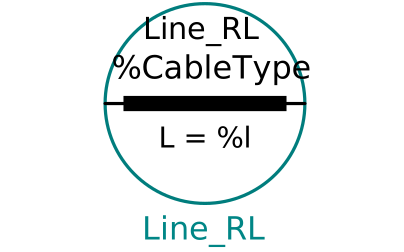
modelLine_RL
Extends from TransiEnt.Basics.Icons.Model (Icon for models).
Information
1. Purpose of model
Simple model of a cable with consideration of resistance and inductive reactance per unit length. Computes losses and voltage drop depend on typical cable types and specified length.
2. Level of detail, physical effects considered, and physical insight
L3E (defined in the CodingConventions) - Quasi-Stationary model of transmission line as a concentrated element. Active- and (inductive) reactive power (losses) are regarded. Cable capacitance is neglected. When checkbox simpleModel is activated: calculation based on nominal grid voltage instead of actual voltage at power ports.
3. Limits of validity
Limited by length due to neglecting of cable capacitance, esp. at medium and high voltage. When checkbox simpleModel is activated: limited by voltage drops of about 20 % of nominal grid voltage.
4. Interfaces
Two ApparentPowerPort for each terminal.
5. Nomenclature
(no elements)
6. Governing Equations
(no equations)
7. Remarks for Usage
(no remarks)
8. Validation
(no remarks)
9. References
(no remarks)
10. Version History
Model created by Saba Al-Sader during the project IntegraNet in 2017.
Model modified by Julian Urbansky, Fraunhofer UMSICHT, in 2021.
Parameters
| Type | Name | Default | Description |
|---|---|---|---|
| TransiEnt.Components.Electrical.Grid.Characteristics.LVCabletypes | CableType | TransiEnt.Components.Electrical.Grid.Characteristics.LVCabletypes.K4 | type of cable |
| SI.Length | l | 100 | Length of the cable |
| Real | v_n | 400 | Nominal grid voltage |
| Boolean | simpleModel | false | Ignore phase shift angle of connected loads |
Connectors
| Type | Name | Default | Description |
|---|---|---|---|
| TransiEnt.Basics.Interfaces.Electrical.ApparentPowerPort | epp_p | ||
| TransiEnt.Basics.Interfaces.Electrical.ApparentPowerPort | epp_n |
Components
| Type | Name | Default | Description |
|---|---|---|---|
| TransiEnt.SimCenter | simCenter | ||
| SI.ApparentPower | S1 | sqrt(epp_p.P^2 + epp_p.Q^2) | |
| SI.ApparentPower | S2 | sqrt(epp_n.P^2 + epp_n.Q^2) | |
| SI.ActivePower | P_loss | epp_n.P + epp_p.P | |
| SI.ReactivePower | Q_loss | epp_n.Q + epp_p.Q | |
| SI.Angle | phi_v |